
Open-Science
Organize projects, run analyses, and inspect outputs.
Orchestrate end-to-end scientific workflows with agents, tools, and data connectors in one place.
System roleWorkbench · Orchestrator
Open-Science is AIPOCH's open-source, local-first AI research workbench. It combines agent workflows, Python and R execution, scientific data connectors, and traceable research artifacts in one inspectable workspace.
 GPT
GPT Claude
 Grok
Grok DeepSeek
 Qwen
Qwen GLM
GLM Kimi
Kimi MiniMax
 StepFun
Product tour / Video
Find installation steps, project setup, workspace guides, and troubleshooting. Check the documented version when following instructions.
Ecosystem / signal flow
Open Science runs and documents the work. Medical Research Skills provide vetted domain methods, and MedSkillAudit checks each skill before release.
Organize projects, run analyses, and inspect outputs.
Orchestrate end-to-end scientific workflows with agents, tools, and data connectors in one place.
System roleWorkbench · Orchestrator

Domain knowledge and execution logic.
Access 550+ vetted medical research skills covering analysis, reporting, data ops, and study operations.
Skill library597 skills
1.9K
Audited release-ready before deployment.
Validate skills for safety, correctness, and reliability with automated and human-in-the-loop review.
Release gatePass / Reject
Find installation steps, project setup, workspace guides, and troubleshooting. Check the documented version when following instructions.
Open the Wiki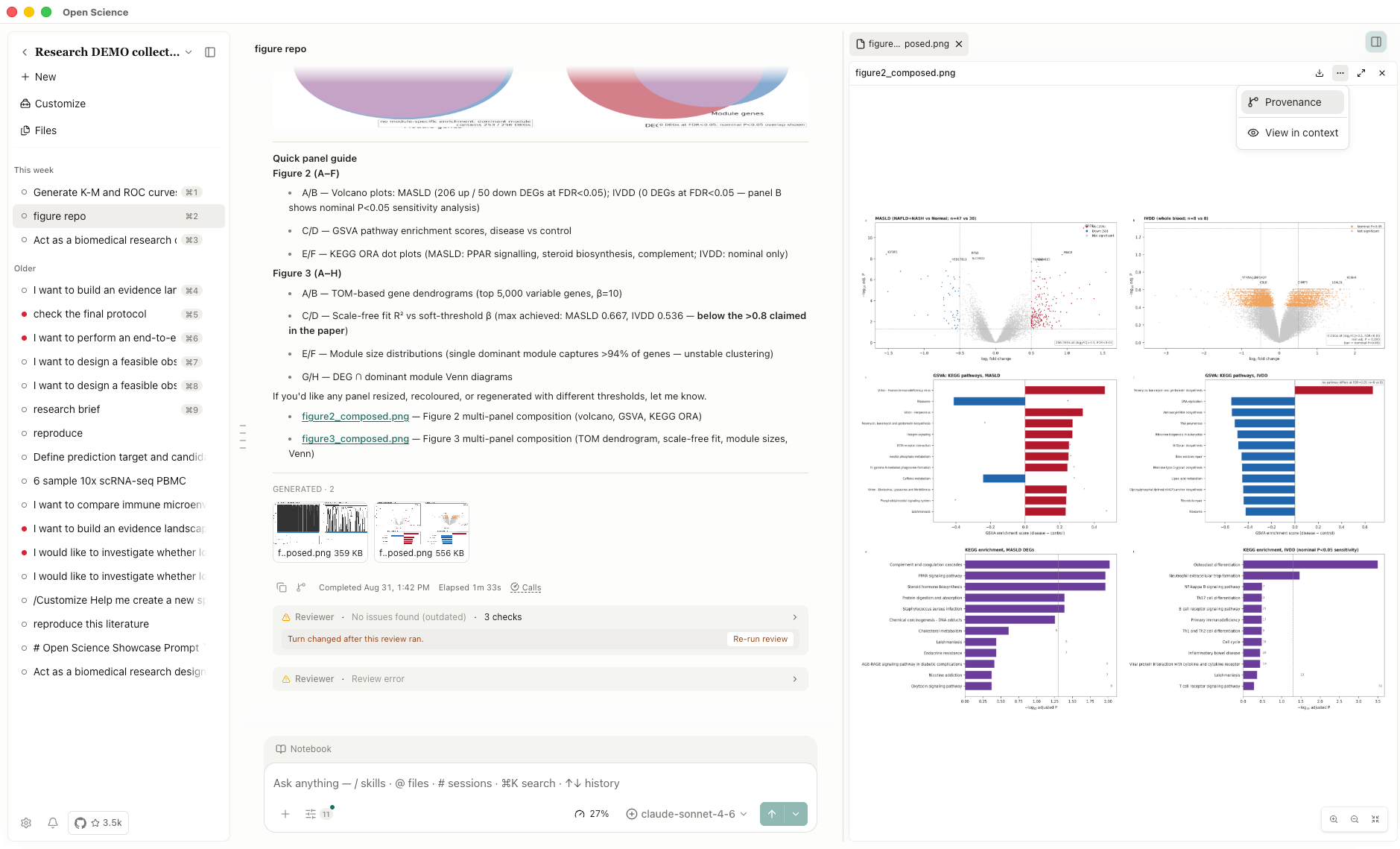
:PDF structure extraction keeps complete figures and ruled tables, Windows handles non-ASCII install paths and quiet Notebook subprocesses, and installers shrink after the runtime split.
Run open-science start without Electron and connect the desktop application as a native backend client
Use ten tools for miRNA targets, RNA–RNA interactions, regulatory evidence, reference tables and bulk datasets
Retrieve assay details and paginate bioactivity results beyond the first 1,000 records
Compare individual submitters' classifications using submission-level evidence
See project guidance and create a project directly from an empty Home screen
Articles & guides
Product overview
The Workbench / Workflow
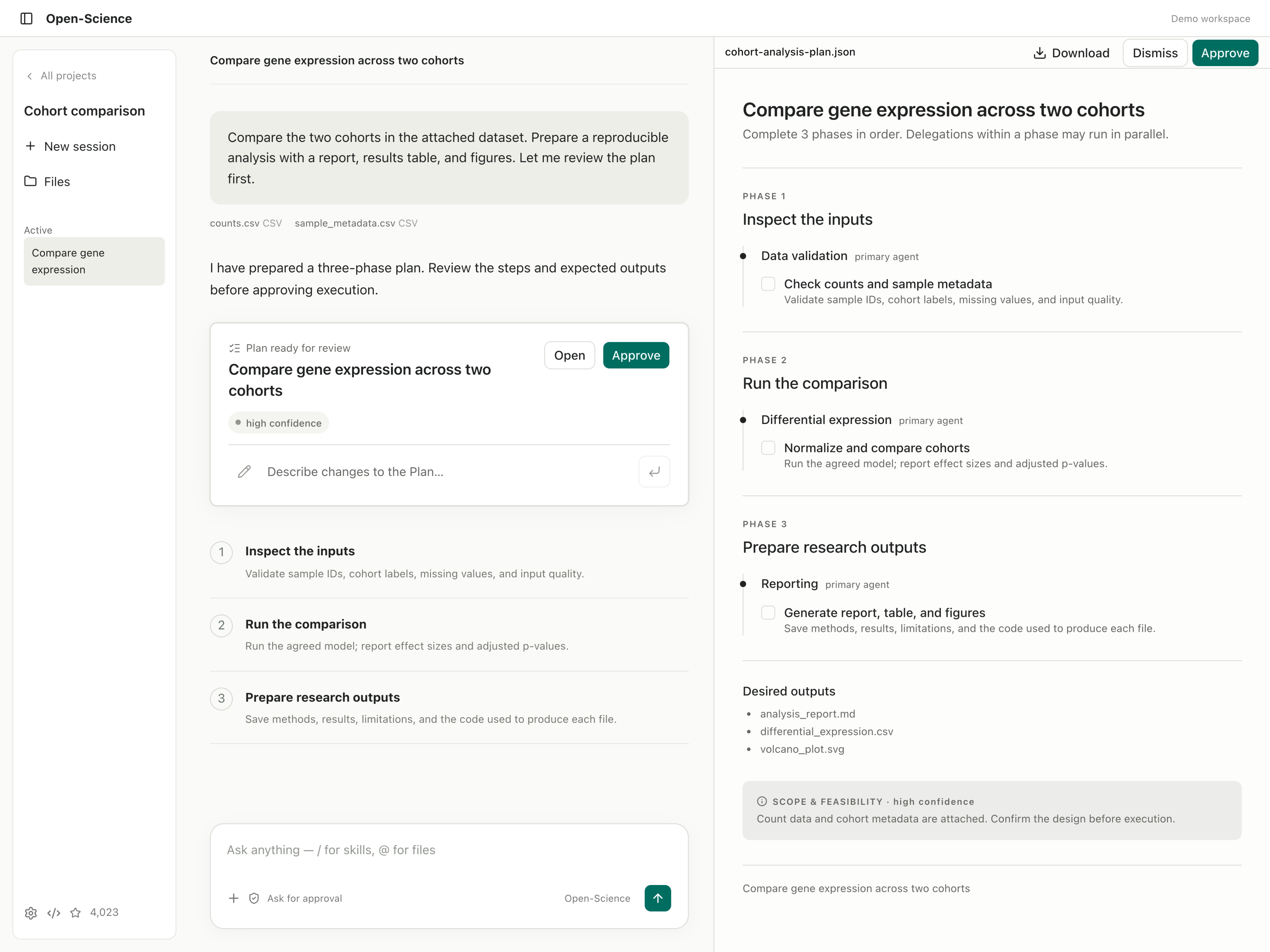
Create a project, add your research files, and describe the task. Use AI agents to run analysis and create reports, tables, and figures, then inspect the outputs alongside available execution records and provenance.
Describe the task in plain language. The agent drafts a step-by-step execution plan for your review — nothing runs until you approve it.
Learn moreRun commands, Python, R, search, and connectors in one persistent workspace. Every action stays visible, approval-gated, and open to review.
Learn moreTurn the work into reports, tables, figures, and structured outputs while preserving the evidence and steps behind every result.
Learn moreOpen every result in place. Inspect data, documents, images, source, structures, and notebook output before you approve or share it.
Learn more
Agent Skills / The library
597 skills
Browse AIPOCH skills for literature review, study planning, data analysis, and academic writing. Each skill packages instructions and supporting resources for a specific task. Check its requirements and any available evaluation results before use.
01

Search, assess, and synthesize research evidence.
02

Plan study methods, endpoints, and analyses.
03

Prepare data, run analyses, and inspect results.
04

Draft manuscripts, methods, and figure descriptions for researcher review.
Benchmark / Release gate
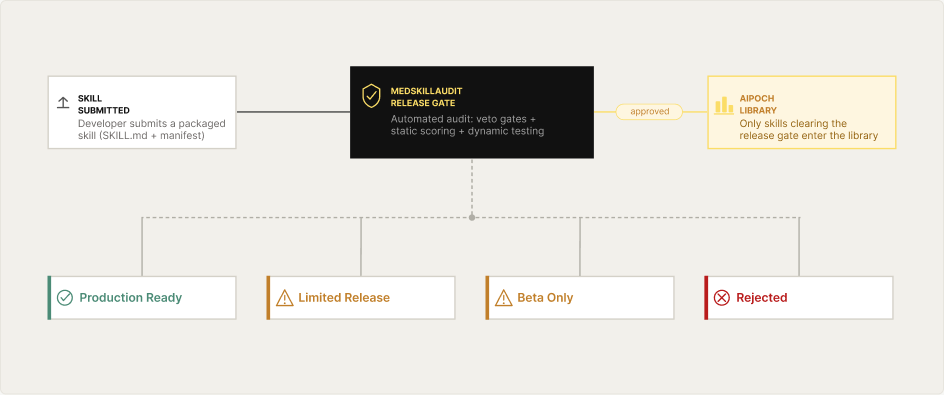
MedSkillAudit is a domain-specific audit framework to evaluate whether a medical research agent skill is ready for release before deployment. It combines two hard veto gates with a two-layer scoring system: static design evaluation and dynamic task-based testing.

No fabricated citations, DOIs, sample sizes, or p-values. Enforced as a hard veto gate — one FAIL means rejection, regardless of the numeric score. Applies to research skills in categories 1–4.

Core results must stay reproducible: no unseeded random-number calls, no unbounded loops, and generated code that runs with its declared dependencies. Each audit runs 3, 5 or 7 test inputs, scaled to assessed complexity.

No logical fallacies such as conflating correlation with causation; statistical methods and study-design choices must be valid and defensible for the stated task. Also a hard veto gate — one FAIL means rejection, regardless of score.
 Claude Code
 Codex
Codex OpenCode