Discover AIPOCH, a growing library of medical research ai agent skills that helps AI agents support structured workflows across evidence analysis, study design, data analysis, and academic writing.
Introducing AIPOCH: Turning an AI Agent Into a Medical Research Assistant
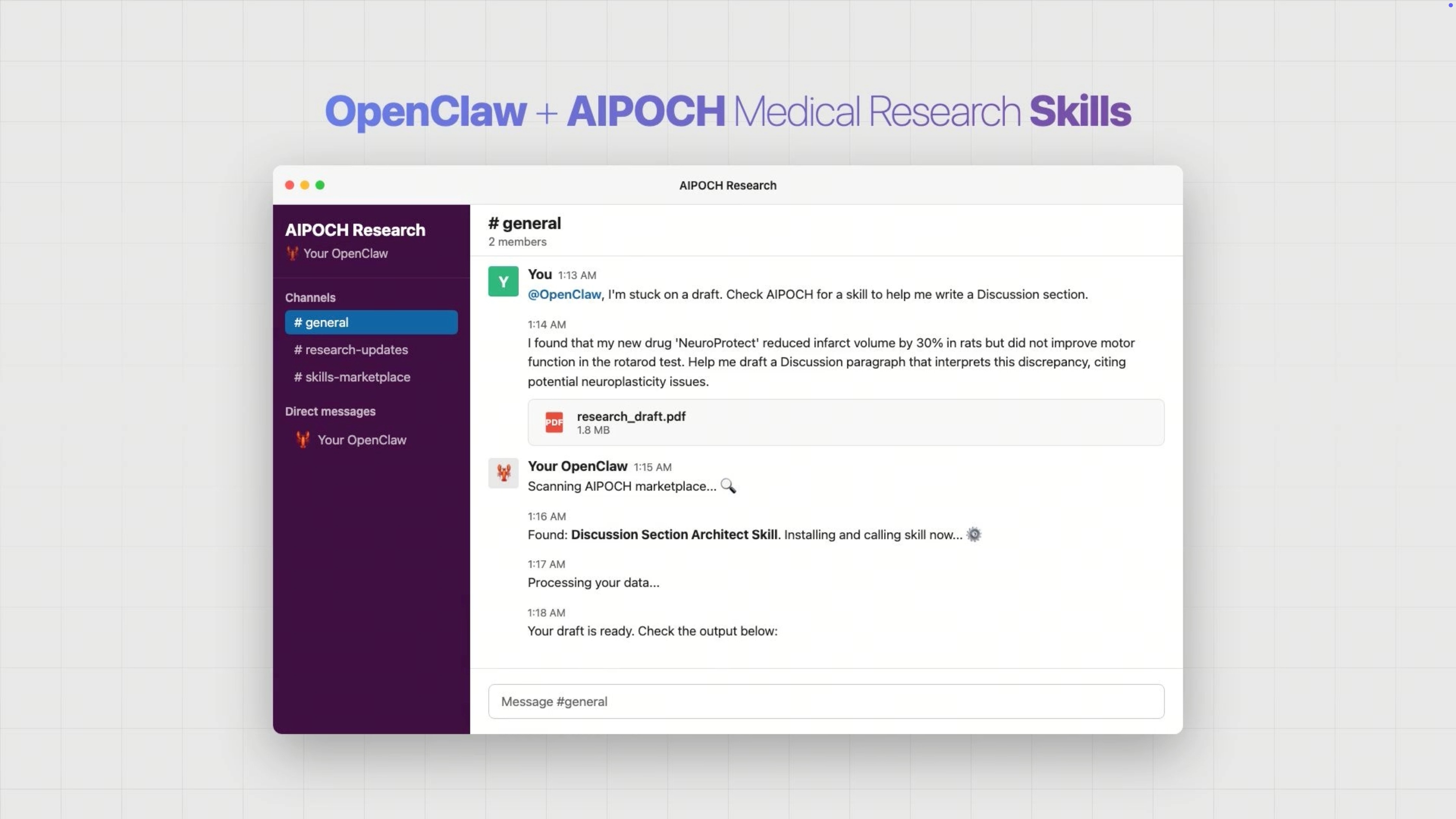 Today, we’re introducing AIPOCH, a curated library of Medical Research Agent Skills designed to support your medical research workflows.
What is AIPOCH?
AIPOCH is a curated library of 200+ Medical Research Agent Skills, built to work with OpenClaw and other AI agent platforms like OpenCode and Claude.
Skills Overview
AIPOCH organizes its agent skills into five primary categories: Evidence Insights, Protocol Design, Data Analysis, Academic Writing, and Others.
| Category | Highlights |
|---|---|
| Evidence Insight | e.g., search strategy design, database selection, evidence-level prioritization, critical appraisal, literature synthesis and gap identification. |
| Protocol Design | e.g., experimental design generation, study type selection, causal inference planning, statistical power calculation, validation strategy. |
| Data Analysis | e.g., R/Python bioinformatics code generation, statistical modeling, data cleaning pipelines, machine learning workflows, result visualization. |
| Academic Writing | e.g., SCI manuscript drafting, methods/results/discussion writing, meta-analysis narrative, cover letters, abstract generation. |
| Other (General / Non-Research) | all general skills that do not fall into categories 1–4. |
Total Skills in Library: 200+ and growing. Explore AIPOCH Github.
Human Expertise Remains Central
Although AI technologies are playing an increasingly prominent role in research, human expertise remains indispensable in medical research.
Platforms like AIPOCH are designed to support the research process, not to replace researchers. AI can help organize information, provide structured starting points, or assist with certain procedural tasks, but these capabilities do not substitute for the critical roles researchers play in formulating scientific questions, designing studies, interpreting results, and taking responsibility for their work.
Medical research relies not only on technological tools, but also on the judgment, experience, and deep understanding of scientific problems that researchers bring. Any output generated by AI systems should be treated as a supportive reference rather than a final conclusion.
Thus, the most appropriate approach is human–AI collaboration: AI supports the research workflow, while researchers retain ultimate responsibility for the direction, quality, and conclusions of their work.
Explore AIPOCH Agent Skills
Researchers and AI agents can explore the growing library of medical research agent skills through multiple resources:
- Open-Source Repository on GitHub
- AIPOCH Medical Research Agent Skills List – Browse all skills organized by category, from Evidence Insights to Academic Writing.
- Full Agent Skills Overview – Learn about the purpose, workflow integration, and capabilities of each skill in detail.
These resources make it easy to explore, validate, and experiment with AIPOCH’s growing library.
Final Thoughts
Medical research is becoming increasingly complex, while AI systems are becoming increasingly capable.
The challenge is not simply adding more tools, but designing workflows where AI can meaningfully assist researchers.
Agent skills offer one possible direction — modular capabilities that allow AI agents to support structured scientific tasks.
As these systems evolve, the relationship between researchers and AI may shift from simple assistance to deeper collaboration within the research process.