Agent Skills are modular, reusable units of procedural knowledge that allow AI agents to perform specific tasks.
 People hear “AI agent” and assume it’s already a complete system. Then they hear “agent skills” and things get fuzzy—are these tools? prompts? plugins?
The short answer: agent skills are structured capabilities that help AI agents do specific tasks.
People hear “AI agent” and assume it’s already a complete system. Then they hear “agent skills” and things get fuzzy—are these tools? prompts? plugins?
The short answer: agent skills are structured capabilities that help AI agents do specific tasks.
- According to a DataCamp article, agent skills are “portable, self-contained units of domain knowledge and procedural logic” that define how to perform workflows, not just what to know.
- Similarly, Spring AI describes them as “modular folders of instructions, scripts, and resources that AI agents can discover and load on demand.”
Instead of giving an AI a long messy instruction every time, you package the instructions into a reusable “mini-workflow” it can run anytime.
So if we strip away the buzzwords, a consistent pattern appears:
👉 Agent Skills = structured workflows + reusable logic + optional code/tools
Why Agent Skills Exist?
Prompts are great… until they aren’t. If you’ve ever written a long prompt and noticed the AI ignored half of it, you’ve already seen the limitation.
As prompts grow larger and more complex, important instructions can get diluted inside the model’s context window, leading to inconsistent behavior.
Agent skills address this by:
- Keeping logic modular
- Loading only when needed
- Separating concerns (instead of one giant prompt blob)
According to Microsoft documentation, skills are:
- Advertised to the agent
- Loaded only when relevant
- Expanded with additional resources as needed
This architectural idea is often called “progressive disclosure.”
How Agent Skills Actually Work?
Let’s walk through a simplified version of how they function:
- The agent receives a task
- It evaluates what kind of work is needed
- It selects a matching skill
- It loads that skill
- It executes the workflow
- It returns a structured result
The important idea here is selective loading. The AI is not guessing everything from scratch each time—it’s using prebuilt procedures. That’s why agent systems feel more stable than raw prompting.
Where to Find Agent Skills?
If you look around, you’ll notice there isn’t just one place. The ecosystem is still forming, and it’s a bit fragmented—somewhat like the early days of app stores. A lot of skills live on platforms like GitHub, where developers publish reusable workflows for others to try. However, many of agent skills collections are broad, not specialized. They cover many use cases—but not always with deep domain precision. So What if You Need Domain-Specific Agent Skills?
AIPOCH for Medical Research Agent Skills
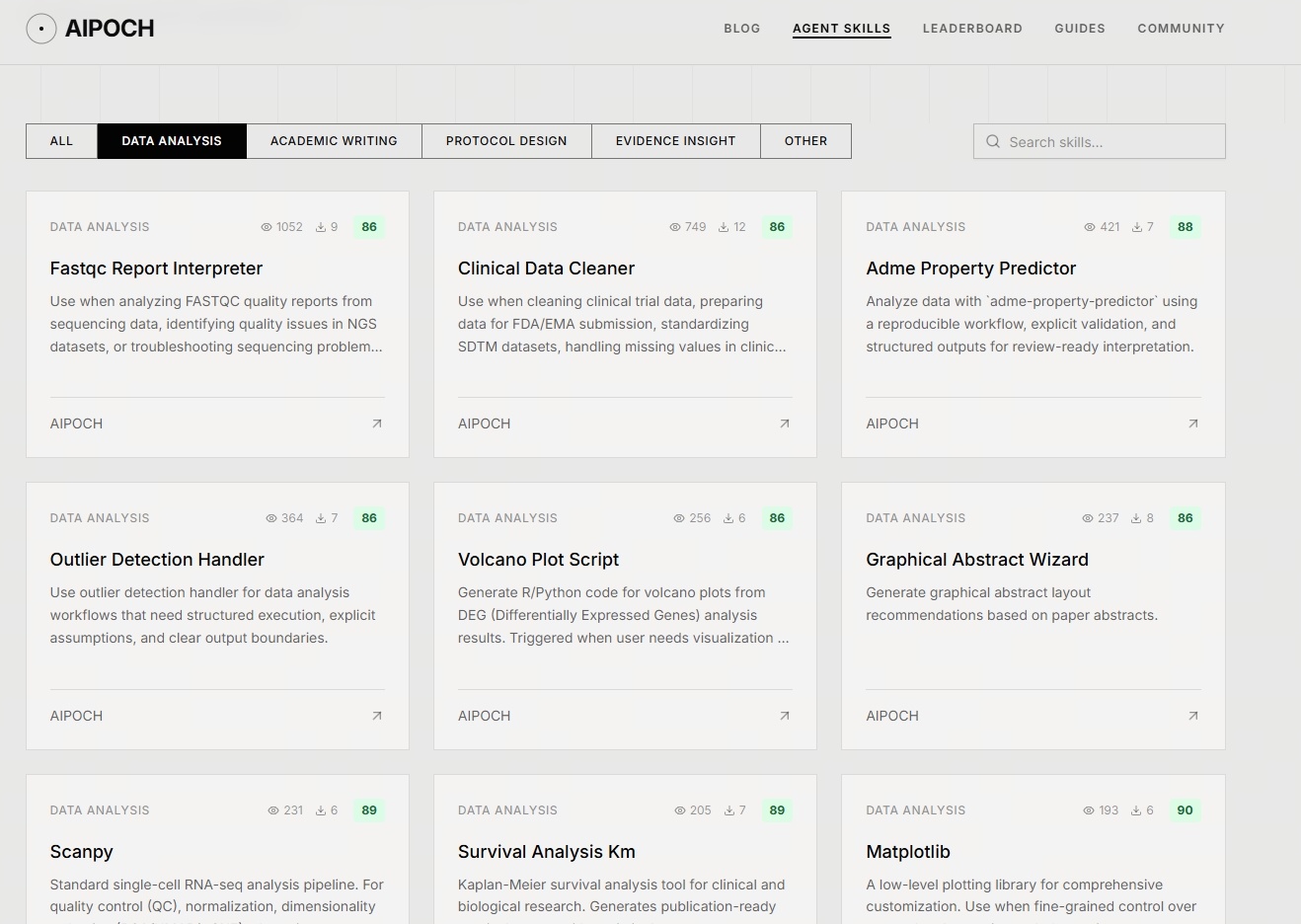
If you’re specifically looking for medical research agent skills, that’s exactly where AIPOCH comes in. As explained in the introduction to AIPOCH, AIPOCH offers a curated library of Medical Research Agent Skills built around medical research workflows—things like:
- evidence Insights
- protocol design
- data analysis
- academic writing
You can explore the complete agent skills library here: 👉 Medical Research Skills Github Repo
⭐ If you find this repository useful, consider giving it a star! It helps more researchers discover Medical Research Agent Skills and supports the continued development of this library.
Instead of asking an AI to figure everything out from scratch, you’re using predefined research processes that are already structured and consistent. That makes a difference.
FAQs
Are there agent skills for medical research?
Yes, there are specialized agent skills designed for medical research workflows. AIPOCH provides curated medical research agent skills for tasks such as evidence extraction, protocol design, data analysis, and academic writing. These skills are designed to support more structured and consistent research workflows, which can be helpful when working with complex scientific tasks.
What are AI agent skills?
Agent skills are modular, reusable workflows that allow AI agents to perform specific tasks in a structured and consistent way.
How do agent skills work in practice?
Agent skills work by being selected and loaded by an AI agent when needed. The agent evaluates a task, chooses the relevant skill, executes its predefined workflow, and returns structured results. This makes outputs more reliable compared to raw prompting.
Where can I find agent skills or an agent skills hub?
You can find agent skills in open-source repositories (such as GitHub), developer platforms, and curated libraries, often referred to as agent skills hubs. These hubs provide reusable workflows for different domains, from general automation to specialized fields like medical research.
Disclaimer This content is for informational purposes only. It does not constitute medical, clinical, or professional advice. AIPOCH Medical Research Agent Skills are designed to support research workflows. They are not intended to replace professional judgment, clinical decision-making, or peer-reviewed validation. AI-generated outputs may be incomplete or inaccurate and should be independently verified before use. References to third-party tools, platforms, or publications are provided for context only and do not imply endorsement or affiliation.