A detailed comparison of literature review AI agent skills. Analyze differences in evidence reasoning, reproducibility, and workflow design across leading agent skills.
Literature Review AI Agent Skills Comparison (2026): Accuracy, Granularity & Usability
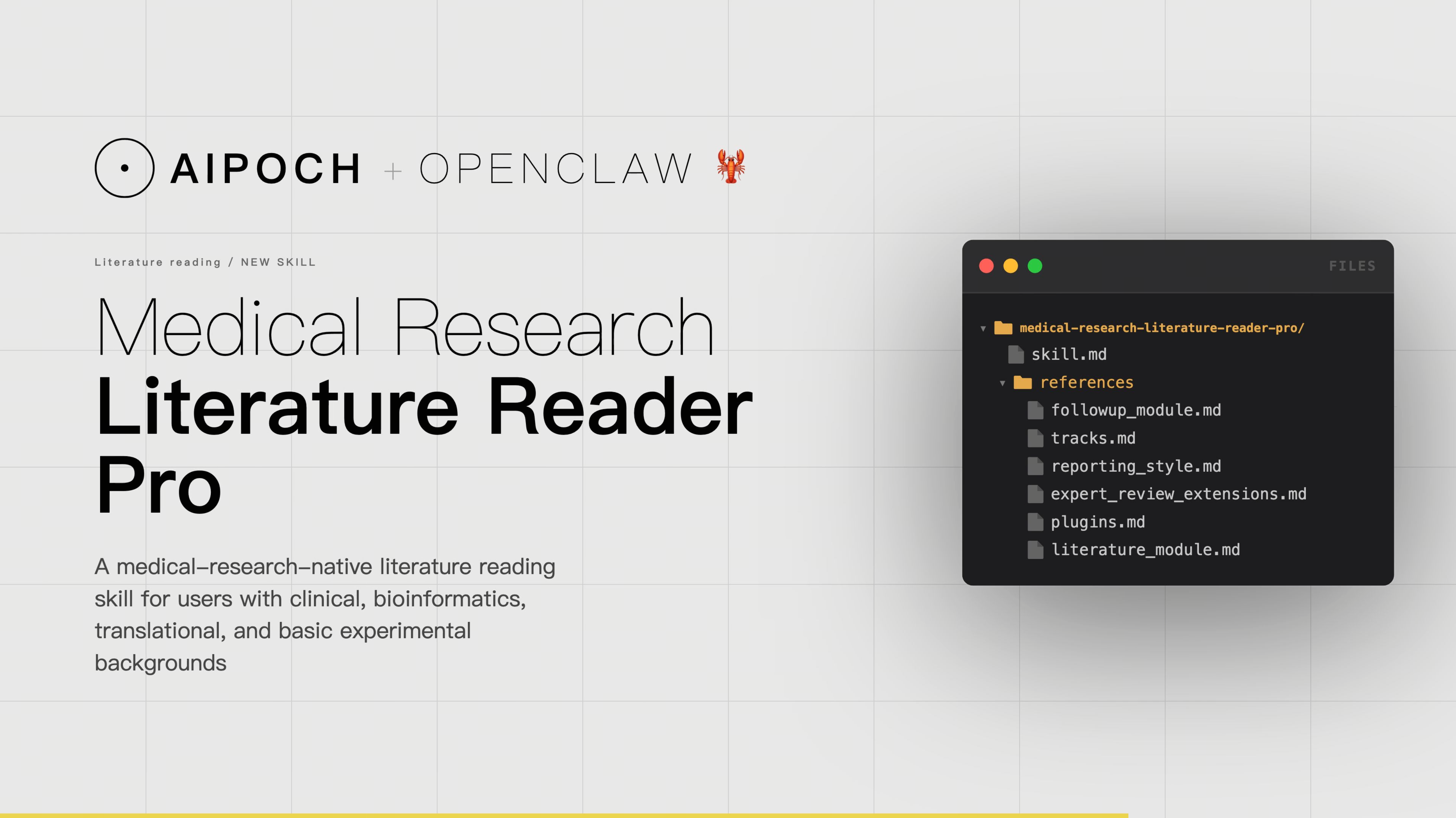 What happens when the same research paper is processed by different ai agent skills?
In this article, we use a single input and compare the outputs from three agent skills to see how they differ in interpretation and analysis.
Literature Review AI Agent Skills Compared
- AIPOCH — medical-research-literature-reader-pro
- ClawBio — lit-synthesizer
- K-Dense — literature-review
How We Compare These Agent Skills
To keep things simple, we focus on three practical dimensions:
- Accuracy
- Granularity
- Practicality
Comparison Results
AIPOCH — medical-research-literature-reader-pro
Strengths
- Strongest evidence boundary control
- Clearly separates what the paper can and cannot claim
- Highly structured output
- Stable and reliable for medical paper critique
Limitations
- Single-expert perspective
- Not designed for multi-reviewer simulation
Conclusion
The strongest option for deep analysis of a single research paper
ClawBio — lit-synthesizer
Strengths
- Retrieval results are verifiable (e.g., PubMed, bioRxiv)
- Provides reproducibility artifacts (JSON, graph, checksum)
- Strong transparency in how outputs are generated
Limitations
- Sensitive to query quality
- Shallower depth for single-paper critique
- May introduce noisy or less relevant literature
Conclusion
Best for retrieval + reproducible literature aggregation.
K-Dense — Literature Review
Strengths
- Complete systematic review structure
- PRISMA-style thinking
- Clear, template-driven outputs
Limitations
- Less adaptive to single-paper analysis
- Outputs can feel generic or template-heavy
Conclusion
Better suited for multi-paper literature review workflows.
Category Leaders (By Capability)
Instead of asking “which one is best,” it’s more useful to look at what each skill does best:
- Accuracy (strongest evidence control) → medical-research-literature-reader-pro
- Reproducibility (traceable outputs) → lit-synthesizer
- Workflow completeness (multi-paper reviews) → literature-review
Closing Thought
As AI becomes more widely used in research workflows, the focus is no longer just on which AI agent you use, but also on which agent skills it uses.
If you want a deeper breakdown of how agent skills work—you can read the full guide here:
Disclaimer
Different agent skills are designed for different use cases, and performance may vary depending on input quality, task requirements, and implementation details. The goal of this article is to highlight differences in behavior and design, rather than provide a definitive ranking.