Biomarker Landscape Mapping: How AI Agents Support Structured Evidence Scanning?
Learn how AI agents support biomarker landscape mapping through structured evidence scanning, validation auditing, biomarker classification, and literature organization workflows for medical research.
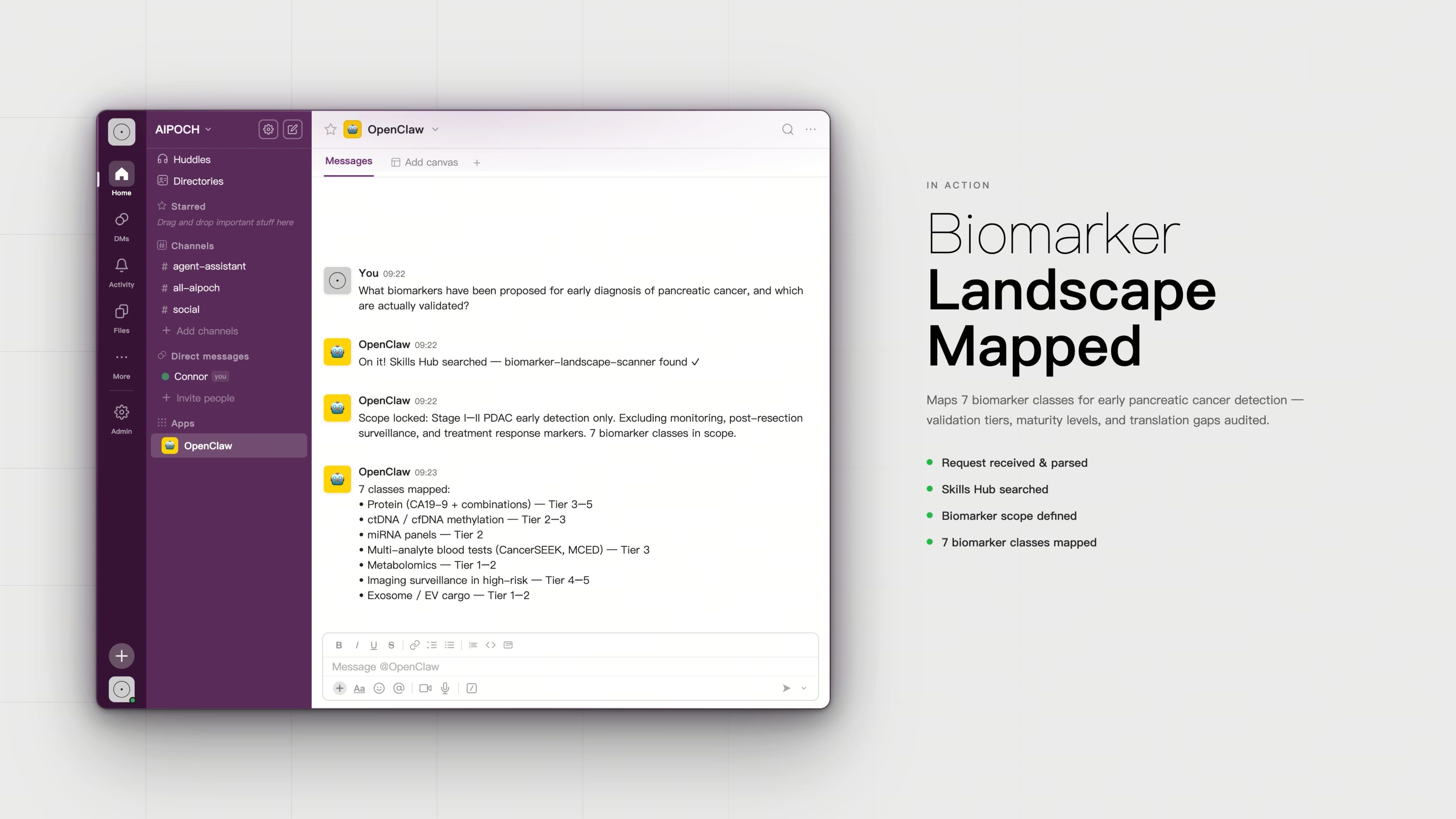 Biomarker research is growing rapidly across many areas of medical research. Researchers may encounter large numbers of papers discussing different biomarkers, testing methods, patient groups, and research outcomes.
As the amount of biomarker-related literature increases, one of the biggest challenges is often not simply finding papers — it is organizing the information in a structured way.
Researchers may need to answer questions such as:
- What biomarkers have already been proposed in a field?
- how those biomarkers are being used?
- which specimen / modality classes dominate the field?
- which biomarkers are still exploratory?
- which have reached external validation?
- which are repeatedly reported but still weak for translation?
- which biomarker spaces remain under-validated despite strong interest?
These tasks can become difficult when literature is scattered across hundreds of studies.
This is where AI-assisted research workflows are beginning to help researchers organize biomarker information more efficiently.
The Biomarker Landscape Scanner from AIPOCH is designed to support this workflow. Rather than acting as a scientific authority, the skill helps AI agents organize biomarker evidence into structured, auditable research maps that researchers can further evaluate and review.
This agent skill is also available on GitHub.
Traditional Biomarker Landscape Workflow
Traditionally, researchers build biomarker landscapes manually through iterative literature review and spreadsheet-based evidence tracking.
A typical workflow may include:
- Defining the disease or phenotype scope
- Searching biomedical literature databases
- Extracting biomarker candidates from papers
- Categorizing biomarkers by modality or specimen type
- Reviewing validation evidence
- Comparing reported performance metrics
- Assessing reproducibility and translation readiness
- Preparing internal evidence summaries
While effective, this process is time-intensive and difficult to standardize across teams.
How the AIPOCH Biomarker Landscape Scanner Works
Scans the biomarker landscape of a disease area by type, use case, and level of validation.
Biomarker Landscape Scanner design to Help review biomarkers proposed for diagnosis, stratification, prognosis, or treatment response and identify which ones still lack validation.
Biomarker Landscape Scanner Workflow Demo
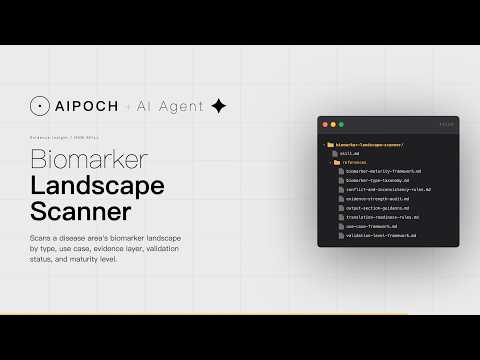
The Core Function of the Biomarker Landscape Scanner
The Biomarker Landscape Scanner is designed to support several structured research operations, including:
- define the exact disease and biomarker scope
- retrieve and organize biomarker-focused literature
- build a structured biomarker inventory
- classify biomarkers by type, specimen, and intended use case
- separate single markers, signatures, panels, and composite models
- assign both validation level and maturity level
- identify strong candidates, overclaimed areas, and under-validated spaces
- assess translation readiness and main barriers
- recommend one best-supported next-step direction
Agent Skill Execution
Step 1 — Define the Biomarker Question Precisely
Step 1.5 — Scope Check Before Full Analysis
Step 2 — Retrieve Biomarker-Focused Literature Before Mapping
Step 3 — Build a Structured Biomarker Inventory
Step 4 — Classify by Type, Specimen, and Use Case
Step 5 — Audit Validation Level and Evidence Strength
Step 6 — Assign Biomarker Maturity Tier Strictly
Step 7 — Detect Inconsistencies, Bottlenecks, and Translation Barriers
Step 8 — Prioritize the Landscape and Perform Self-Critical Review
Conclusion
Building a reliable biomarker landscape requires more than collecting papers or summarizing abstracts. Researchers must organize evidence across biomarker types, validation stages, assay systems, and operational use cases while carefully avoiding maturity overstatement.
The AIPOCH Biomarker Landscape Scanner addresses these workflow problems by providing a structured agent skill system for:
- biomarker evidence mapping
- validation-aware organization
- maturity classification
- operational landscape review
- translation readiness assessment
Rather than functioning as a scientific authority, the workflow positions AI agents as operational assistants that help researchers structure complex biomarker evidence landscapes more efficiently.
As biomarker ecosystems continue to expand, structured AI-assisted research workflows may become increasingly useful for managing large-scale biomedical evidence organization tasks.
Explore more AIPOCH Medical Research Skills
Researchers can browse the complete collection of structured Medical Research Agent Skills in the AIPOCH Agent Skills Library or explore the open-source workflows available in the AIPOCH Medical Research Skills GitHub Repository.
Disclaimer
This article is intended for informational purposes only. The content describes AI-assisted medical literature retrieval workflows and does not constitute medical advice, clinical guidance, diagnostic recommendations, or professional research consultation.
AIPOCH agent skills are intended to support researchers, not replace human scientific judgment, domain expertise, institutional review processes, or editorial decision-making. Researchers should independently verify all outputs, evidence interpretations, annotations, citations, manuscript revisions, and scientific conclusions before use in academic, clinical, regulatory, or publication settings.