How AI Agents Use a PubMed Search Skill for Medical Research
Learn how AI agents build advanced PubMed search strategies using MeSH mapping, Boolean logic, and systematic review workflows with the AIPOCH PubMed Search Specialist.
If you have ever searched PubMed for a medical research project, you already know the problem:
A simple keyword search often returns either:
- thousands of irrelevant papers
- or only a small fraction of the literature you actually need
Medical literature retrieval is not just about typing keywords into PubMed. High-quality evidence searching usually requires:
- MeSH term mapping
- Boolean query logic
- synonym expansion
- field tag optimization
- clinical query filters
- sensitivity vs specificity balancing
- systematic review search design
This is exactly where the AIPOCH skill Pubmed Search Specialist was designed to help.
The skill helps AI agents build complex Boolean query strings for precise PubMed/MEDLINE literature retrieval.
What Is the AIPOCH PubMed Search Specialist?
The PubMed Search Specialist is an AIPOCH Medical Research Agent Skill designed to help build complex Boolean query strings for precise PubMed/MEDLINE literature retrieval. Trigger when user needs MeSH term mapping, Boolean query construction, advanced PubMed filters, citation searching, systematic review search strategy, or clinical query optimization.
Core Capabilities of the Skill
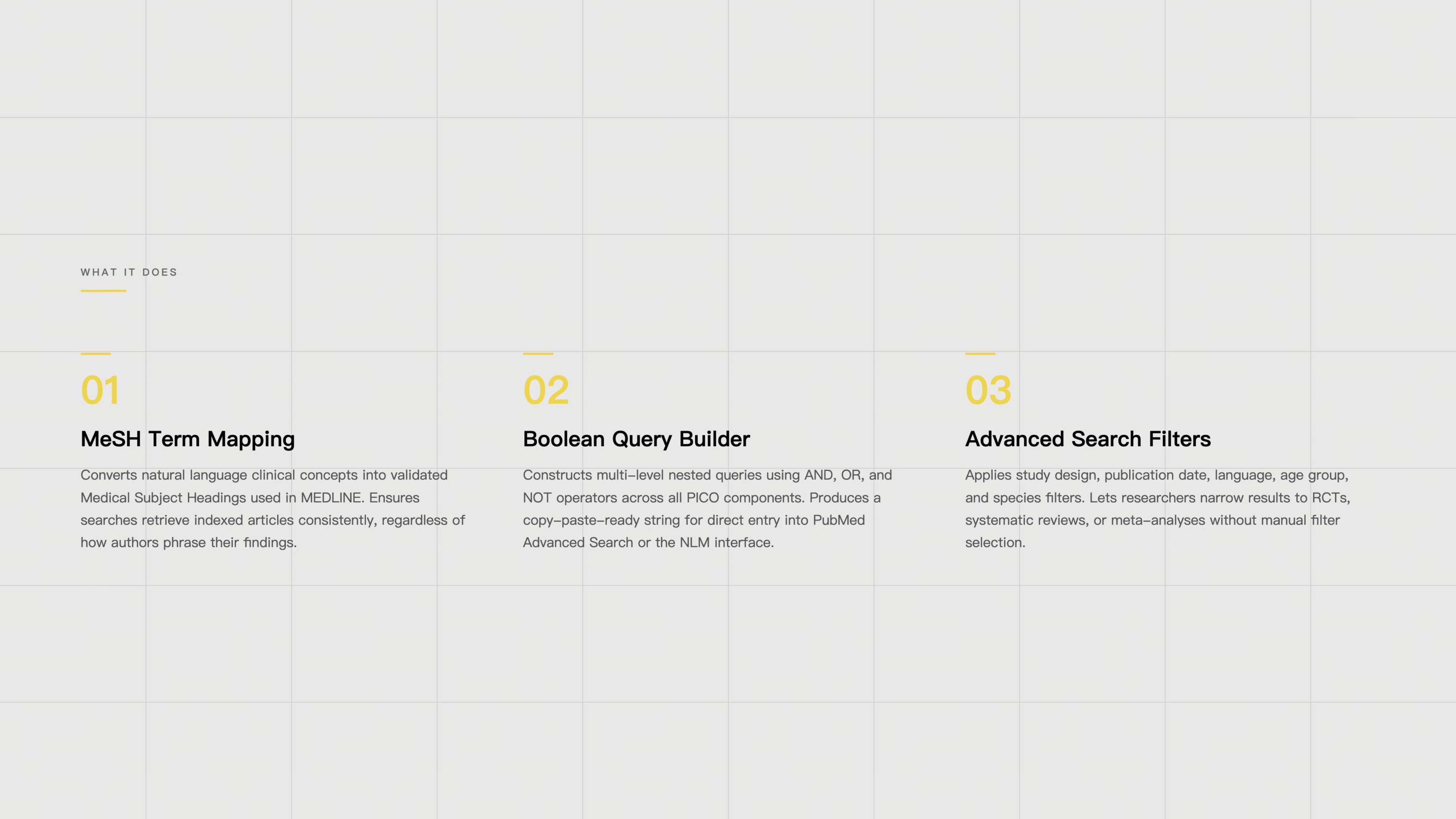
MeSH Term Mapping
Convert natural language concepts to standardized Medical Subject Headings
Boolean Query Builder
Construct complex nested queries with AND/OR/NOT operators
Advanced Filters
Apply study type, date, language, age, and species filters
Search Strategy Optimization
Refine sensitivity vs specificity trade-offs
Watch the PubMed Search Specialist Demo
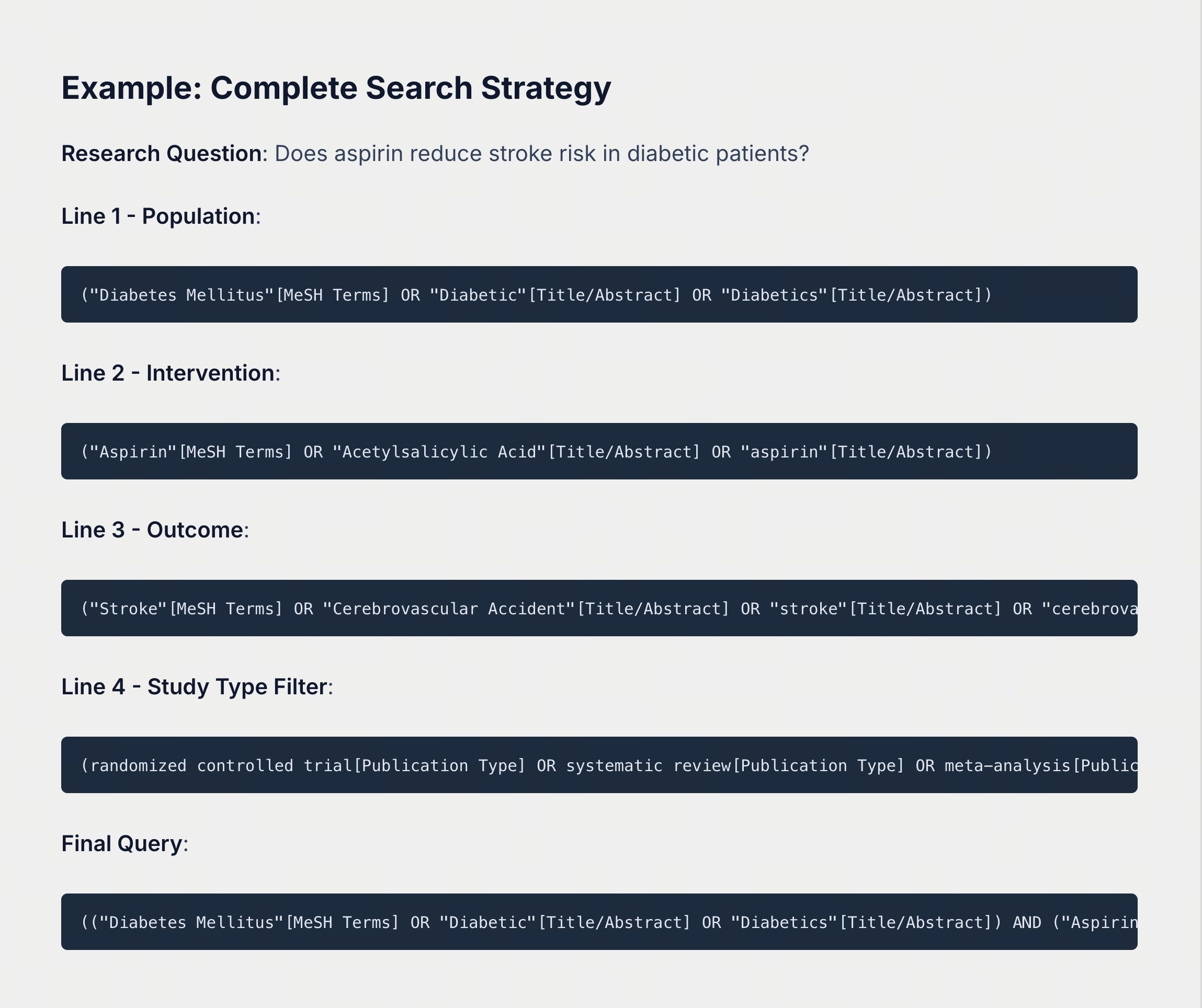
Example PubMed Search Query
Below is an example of a structured PubMed Boolean search strategy generated for biomedical literature retrieval workflows.
Related AIPOCH Agent Skills
Researchers working on literature retrieval workflows may also find these related AIPOCH skills useful:
- Biomedical Search Strategy Builder — Builds professional search strategies for PubMed, Embase, Web of Science, and similar databases.
- Multi Database Literature Collector — Collects candidate biomedical literature across multiple databases, adapts search logic by database, preserves source metadata, and organizes results into a structured, screening-ready candidate pool.
- Reference Finder — Automatically finds and ranks PubMed references for each sentence in scientific text; use when you need titles, DOIs, and brief recommendation reasons from the PubMed E-utilities API.
- Citation Management — Comprehensive citation management for academic research; use when you need to discover papers (Google Scholar/PubMed), extract/verify metadata (DOI/PMID/arXiv/URL), and produce validated, clean BibTeX for manuscripts.
AIPOCH Skill Library
Researchers and AI agent developers can explore the open AIPOCH Medical Research Skills ecosystem on GitHub:
Or browse the full AIPOCH Medical Research Skill collection here:
The library includes hundreds of structured agent skills across areas such as:
- Evidence Insights
- Literature Retrieval
- Protocol Design
- Academic Writing
- Bioinformatics
- Biomedical Data Analysis
Final Thoughts
PubMed searching is increasingly being integrated into structured AI-assisted research workflows rather than relying solely on simple keyword lookup processes.
The AIPOCH PubMed Search Specialist helps AI agents build reproducible, MeSH-aware, Boolean-optimized search strategies for medical literature retrieval, systematic reviews, and evidence synthesis workflows.
Researchers working with biomedical literature, systematic reviews, or evidence-based medicine workflows can use structured Medical Research Agent Skills to improve search consistency, retrieval precision, and literature organization efficiency.
Disclaimer
This article is intended for informational purposes only. The content describes AI-assisted medical literature retrieval workflows and does not constitute medical advice, clinical guidance, diagnostic recommendations, or professional research consultation.
AIPOCH agent skills are intended to support researchers, not replace human scientific judgment, domain expertise, institutional review processes, or editorial decision-making.
Researchers should independently verify all outputs, evidence interpretations, annotations, citations, manuscript revisions, and scientific conclusions before use in academic, clinical, regulatory, or publication settings.