How to Identify Study Design in Medical Research Papers with AI
Explore how AI can support study design classification in biomedical literature by identifying methodological structures across clinical studies, real-world evidence research, omics workflows, and hybrid evidence designs.
Medical research papers are built on different types of study designs, and identifying those designs is often one of the first steps in evidence-based research workflows.
Before researchers evaluate evidence quality, perform risk-of-bias assessment, or prepare a systematic review, they typically need to determine:
- Is this paper a randomized controlled trial (RCT)?
- Is it a cohort study?
- A case-control study?
- A cross-sectional study?
- A real-world evidence study?
- A mechanism-focused experiment?
- Or an omics-driven exploratory study?
The answer matters because study design influences how evidence is interpreted, categorized, and appraised in biomedical research workflows.
As biomedical literature continues to expand rapidly, manually identifying study design across large collections of papers can become time-consuming and inconsistent. This is where AI-assisted study design identification workflows are beginning to support researchers.
Screening at Scale Is Time-Consuming
Identifying study design for a single paper may take only a few minutes. But systematic reviews rarely involve just one paper — researchers routinely screen hundreds or even thousands of papers to build a literature collection. As the volume of biomedical publications continues to grow, the time cost of manually identifying study design at scale becomes a meaningful bottleneck in evidence synthesis workflows.
AI-Assisted Study Design Identification
What does the AIPOCH Study Design Identifier do?
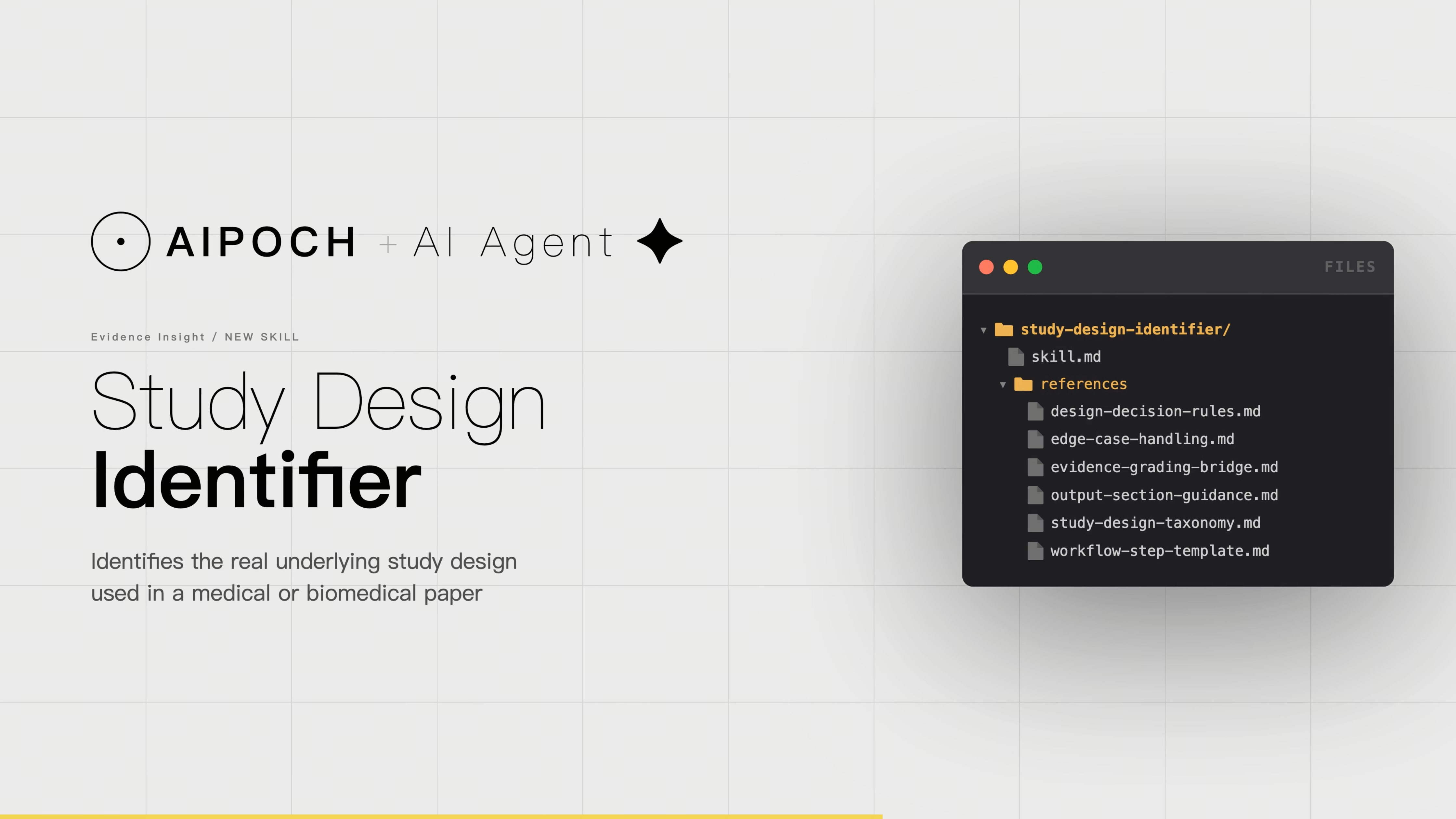
The AIPOCH Study Design Identifier is an AI agent skill designed to help identify the real underlying study design used in a medical or biomedical paper, distinguish primary and secondary design components when papers are hybrid, and convert the paper into an evidence-aware design label suitable for literature appraisal, evidence grading, and downstream review workflows.
Identify and Classify Medical Study Designs
This agent skill helps identify study design from what the study actually did.
The classification distinguishes among major families such as:
- randomized controlled trial
- non-randomized interventional study
- prospective cohort
- retrospective cohort
- case-control study
- cross-sectional study
- registry/database study
- real-world evidence study
- diagnostic accuracy study
- prognostic model / prediction study
- systematic review / meta-analysis
- omics screening study
- mechanism experiment
- hybrid multi-layer study
When a paper contains multiple evidence layers, this skill identifies:
- Primary design = the layer that carries the main claim
- Secondary design = supportive but non-dominant layer
- Hybrid status = whether the paper should be treated as multi-design rather than forced into one oversimplified label
You can explore the skill here:
How Study Design Identifier Works?
Video Walkthrough: AI-Assisted Study Design Identification
The following demonstration shows how the AIPOCH Study Design Identifier analyzes a biomedical paper and classifies its underlying methodological structure.
Conclusion
Study design is one of the most important dimensions in medical evidence interpretation. Study design classification may remain challenging in papers with incomplete methods reporting, ambiguous terminology, or highly layered hybrid evidence structures. As biomedical research continues to expand rapidly, AI-assisted study design identification may help researchers organize evidence more efficiently and support more structured evidence review workflows.
The AIPOCH Study Design Identifier Skill is designed to support this process within AI-assisted medical research workflows.
Explore More AIPOCH Medical Research Skills
The Study Design Identifier is part of the broader AIPOCH Medical Research Skills Library. The library is primarily organized into five categories: Evidence Insights, Protocol Design, Data Analysis, Academic Writing, and Others.
The full open-source skill collection is also available on GitHub:
If you find this repository useful, consider giving it a star! ⭐ It helps more researchers discover Medical Research Agent Skills and supports the continued development of this library.
Disclaimer
This AI-assisted content is intended for informational purposes only and does not constitute medical advice, clinical guidance, diagnostic recommendations, treatment decisions, publication acceptance recommendations, or formal scientific peer review outcomes.
AIPOCH agent skills are intended to support researchers, not replace human scientific judgment, domain expertise, institutional review processes, or editorial decision-making.
Researchers should independently verify all outputs, evidence interpretations, annotations, citations, manuscript revisions, and scientific conclusions before use in academic, clinical, regulatory, or publication settings.