How to design single-cell research plans with an AI agent skill?
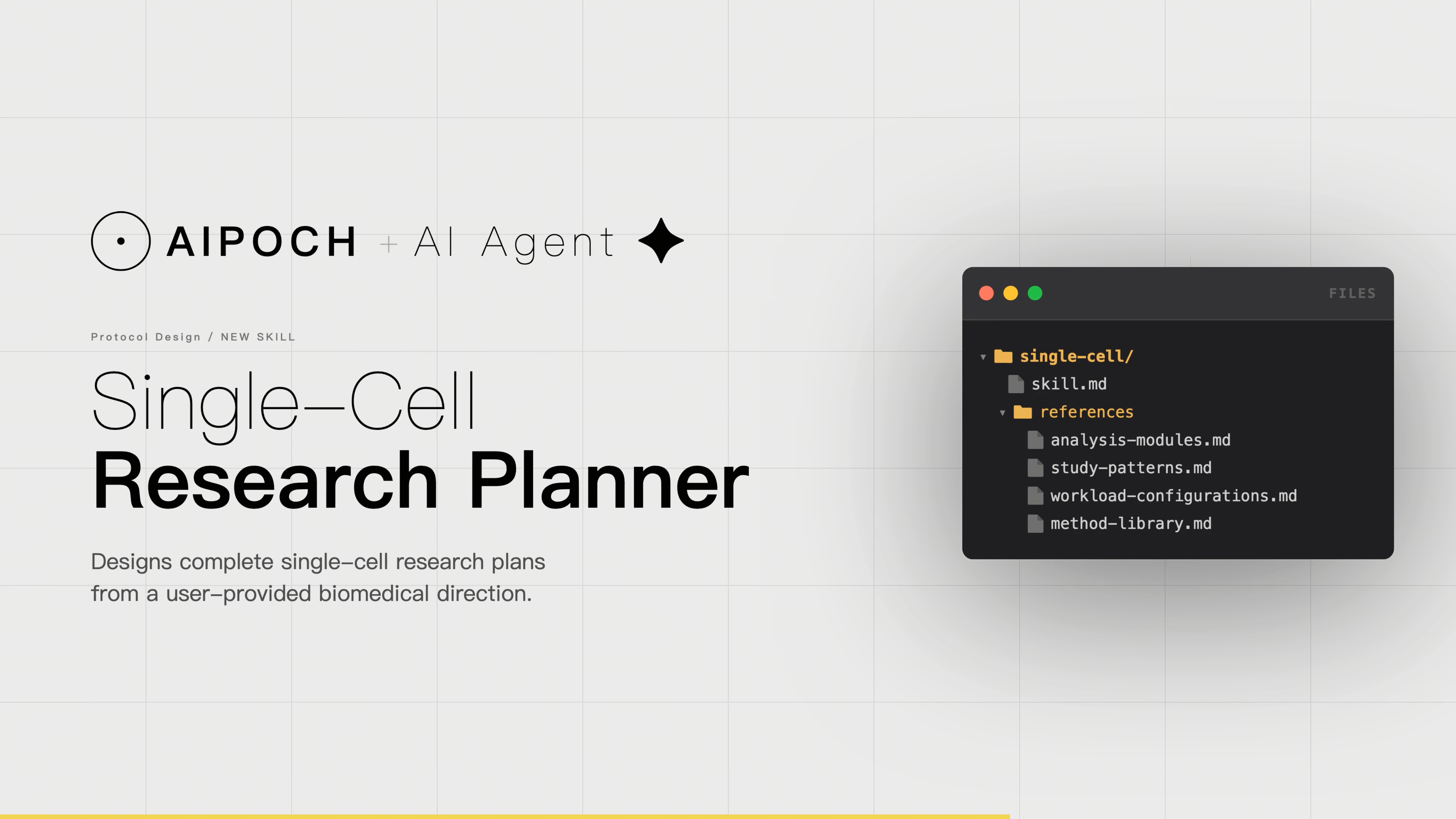
Explore the AIPOCH Single Cell Research Planner — Designs complete single-cell research plans from a user-provided biomedical direction.
Single-cell research projects often involve more than downstream RNA-seq analysis.
Researchers frequently need to determine:
- how to structure the study
- how to organize cohorts and comparison groups
- which analysis modules are appropriate
- and how validation should be planned
The AIPOCH Single Cell Research Planner is designed to help researchers design single-cell research plans from an initial biomedical research direction.
What the Skill Is Designed to Do?
The agent skill's task is to generate a complete, structured, execution-oriented single-cell study design from a user-provided research direction.
Skill Overview:
GitHub repository:
It is part of AIPOCH Awesome Med Research Skills, a curated collection of specialized medical research agent skills built for real-world research workflows.
When to use this skill?
This skill is intended for researchers who want to design, scope, or structure a single-cell study from an initial research direction.
It can support multiple research scenarios, including:
- disease-focused projects
- mechanism-focused projects
- biomarker-focused projects
- translational projects
- perturbation-inspired projects
- validation-aware projects
What Makes This Skill Different?
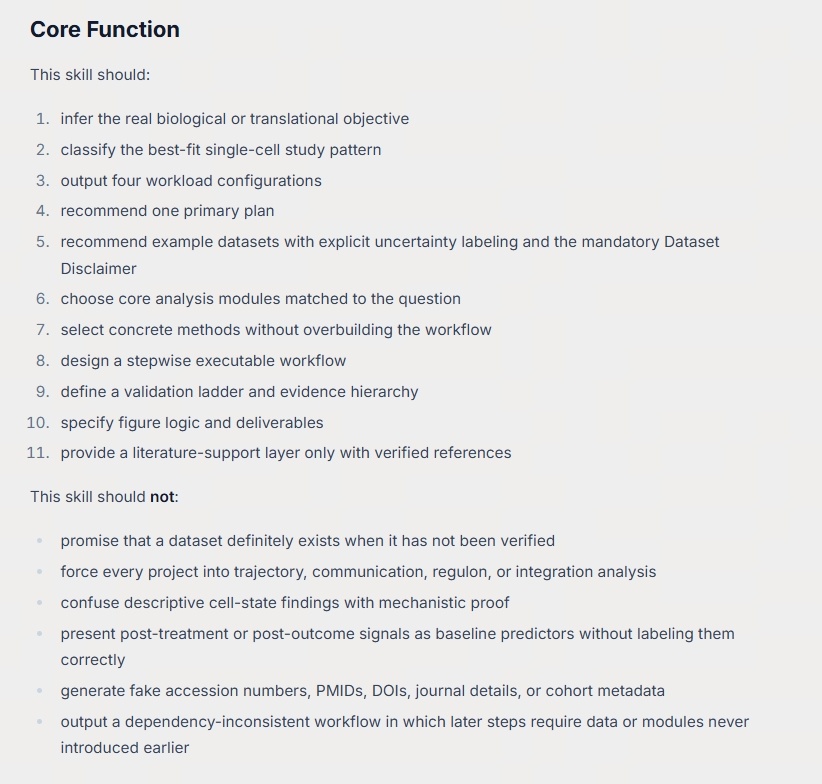
Unlike generic AI prompting systems, this skill focuses on structured and realistic study planning.
How Does it Work?
The following demo video provides a walkthrough of how the AIPOCH Single Cell Research Planner structures single-cell study planning from an initial research direction.
MedSkillAudit Evaluation Results
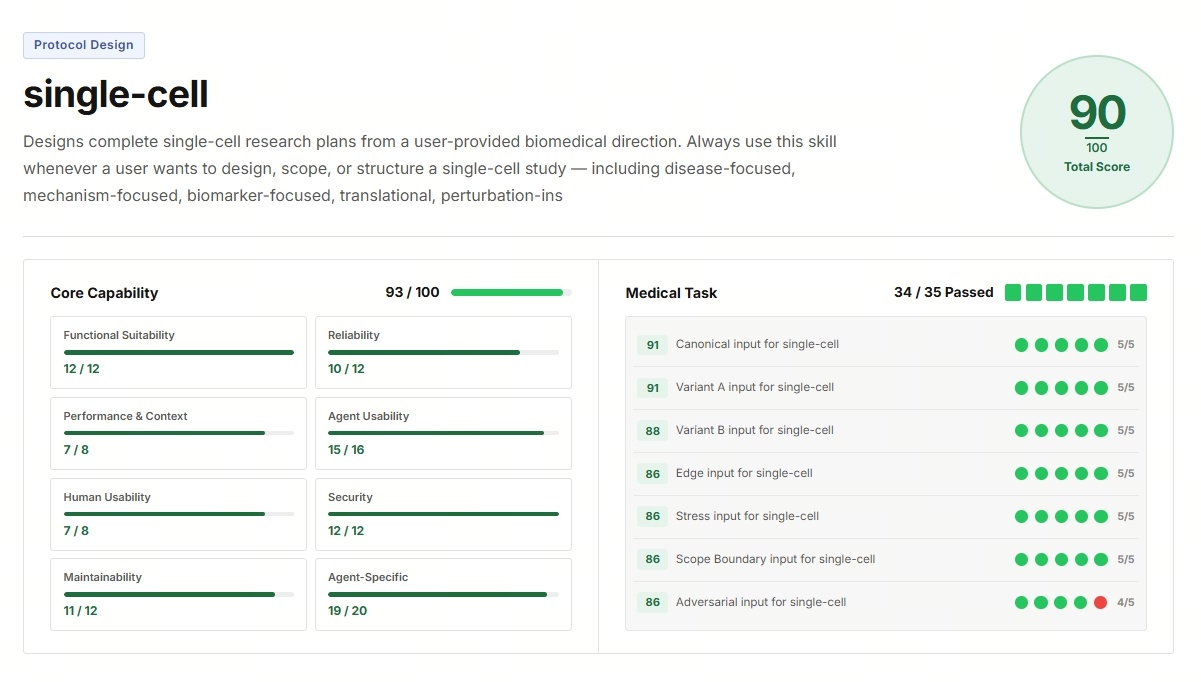
The skill was evaluated using MedSkillAudit, a framework designed for evaluating medical research agent skills before deployment.
- Explore the framework on GitHub: Skill Auditor
- Learn more about the framework: How AIPOCH Evaluates Medical Research Agent Skills
Core Capability Results
| Dimension | Score |
|---|---|
| Functional Suitability | 100% |
| Reliability | 83% |
| Performance & Context | 88% |
| Agent Usability | 94% |
| Human Usability | 88% |
| Security | 100% |
| Maintainability | 92% |
| Agent-Specific | 95% |
Overall Core Capability Score
| Metric | Score |
|---|---|
| Core Capability | 93 / 100 |
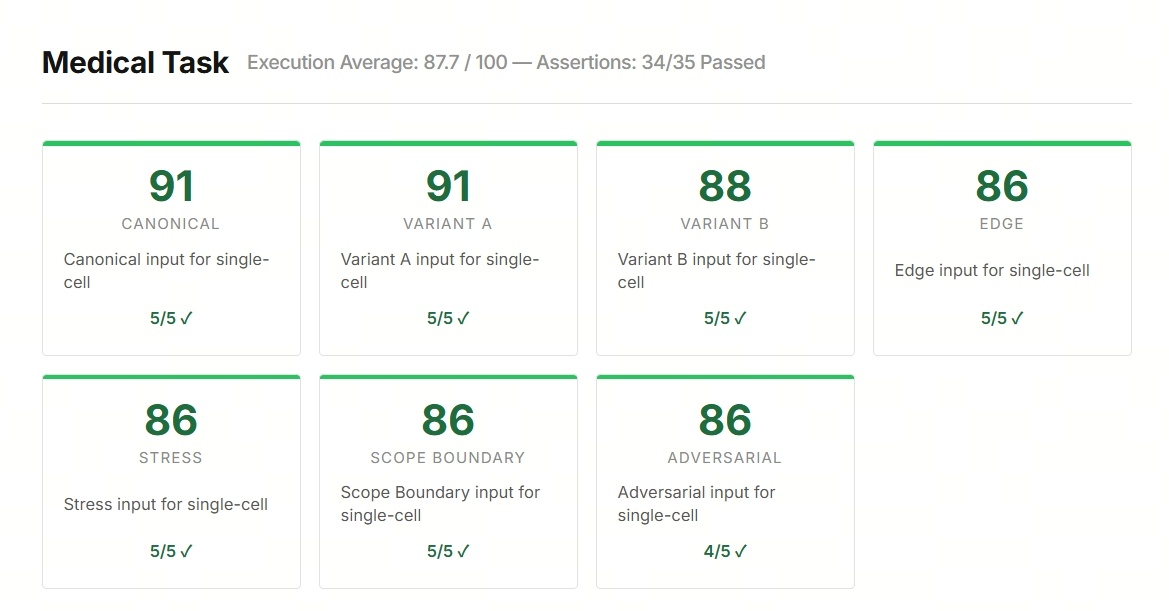
Medical Task Evaluation
Final Evaluation Score
| Evaluation Metric | Score |
|---|---|
| Final Overall Score | 90 / 100 |
The evaluation results suggest that the skill performs particularly strongly in:
- Study pattern selection (disease-characterization/mechanism-focused/biomarker-discovery/validation-aware) before analysis module specification prevents generic pipeline outputs
- Reference dataset recommendations as candidates only with explicit uncertainty labeling prevents false resource claims
- Mandatory Dataset Disclaimer before any workflow section mentioning datasets
- Four workload configurations (Lite/Standard/Advanced/Publication+) provide broad practical scalability
Explore the Skill
Explore More AIPOCH Medical Research Skills
AIPOCH provides a curated collection of Medical Research Agent Skills designed for workflows across:
- Evidence Insights
- Protocol Design
- Data Analysis
- Academic Writing
Rather than isolated prompts, these skills are designed for structured execution and reproducibility.
Explore more:
If you find this repository useful, consider giving it a star! ⭐ It helps more researchers discover Medical Research Agent Skills and supports the continued development of this library.
Recommended Reading
- AIPOCH Awesome Medical Research Skills
- What is AIPOCH?
- Methods Analysis Agent Skills Comparison
- Peer Review Agent Skills Comparison
Disclaimer
This AI-assisted content is provided for informational purposes only and does not constitute medical advice, clinical guidance, or publication recommendations.
AIPOCH Medical Research Agent Skills are designed to support research planning and workflow organization, not replace human scientific judgment or expert review.
Researchers should independently verify all datasets, references, interpretations, and scientific conclusions before use in academic, clinical, or publication settings.