AI for medical research: Top 3 AIPOCH Agent Skills for Researchers
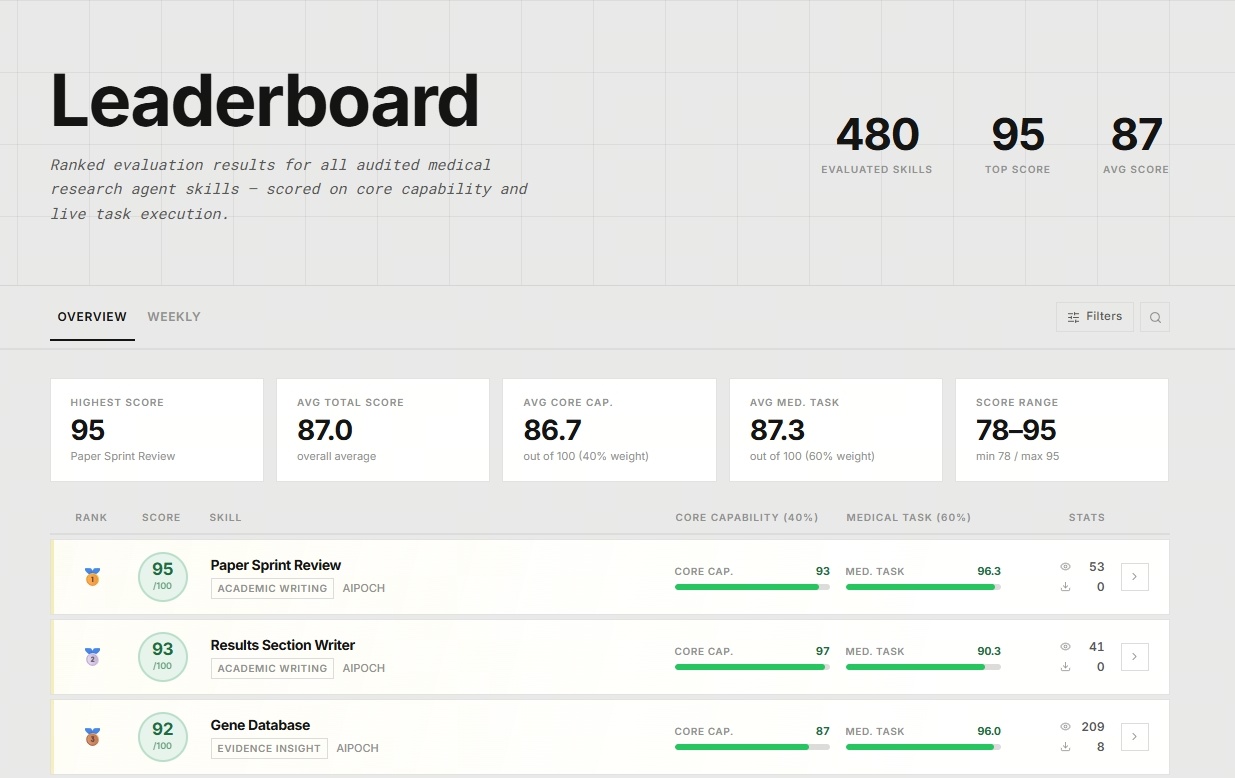
Discover the highest-ranked AIPOCH medical research agent skills evaluated by MedSkillAudit, including Paper Sprint Review, Results Section Writer, and Gene Database.
 Medical research workflows are becoming increasingly complex. Researchers are expected to process large volumes of literature, organize evidence, draft publication-ready manuscripts, and navigate specialized biomedical databases — often under significant time pressure.
This is where structured AI agent skills are beginning to support medical research tasks.
At AIPOCH, medical research agent skills are evaluated using MedSkillAudit, a layered framework assessing skill release readiness before deployment.
In this article, we highlight the Top 3 AIPOCH Agent Skills with the highest scores in MedSkillAudit testing.
#1 AI Agent Skill: Paper Sprint Review
What the AI Agent Skill Can Do?
PaperSprint is designed for paper review, revision, and R&R workflows. Scrum-inspired paper review, revision, and R&R workflow. Handles docx/tex/md/PDF in English or Chinese. Auto-detects manuscript stage, estimates sprint count, runs multi-lens review (Contribution/Rigor/Writing/Editor), generates prioritized revision backlog, exports MD/DOCX/PDF/HTML reports. Use when asked to review a paper, revise based on reviewer comments, handle R&R, respond to peer review, plan paper revision sprints, or when user types /ps or /papersprint.
When to Use This Agent Skill?
- Review an academic paper and identify issues
- Revise a manuscript based on reviewer comments
- Respond to reviewers (R&R)
- Estimate revision workload
- Plan paper revision sprints
- Export review reports (MD/PDF/DOCX/HTML/LaTeX)
Paper Sprint Review MedSkillAudit Performance
| Evaluation Area | Score |
|---|---|
| Core Capability | 93 |
| Medical Task | 96.3 |
| Final Score | 95 |
The combination of strong structural quality and high medical task execution likely contributed to its #1 ranking.
Why Paper Sprint Review Ranked #1
Paper Sprint Review achieved the highest overall MedSkillAudit score among tested AIPOCH skills.
- Exemplary progressive disclosure: every reference file has named trigger conditions, keeping SKILL.md concise while the full workflow depth lives in references/
- Robust escape hatches: Input Validation refusal, 3 explicit Escape Hatch categories, and human-only Submission Gate form a coherent safety layer
- Strong venue calibration: MISQ, ECIS, Nature Human Behaviour lens configurations are correctly applied from review.md
- Gate prerequisite guards prevent out-of-order execution with specific, actionable error messages
- Adversarial and scope-boundary inputs handled with explanation rather than flat refusal, improving user experience while maintaining scope
#2 AI Agent Skill: Results Section Writer
What the AI Agent Skill Can Do?
Writes the full Results section of a biomedical manuscript from a sufficiently clear result structure, figure inventory, or analysis summary while preserving evidence boundaries and result hierarchy.
MedSkillAudit Performance
| Evaluation Area | Score |
|---|---|
| Core Capability | 97 |
| Medical Task | 90.3 |
| Final Score | 93 |
Why this agent skill Ranked #2
Results Section Writer ranked second overall, achieving one of the highest Core Capability scores among all evaluated skills.
- Explicit upstream composability with Results Section Structurer via dedicated handoff-to-structurer-rule.md — the most clearly defined inter-skill handoff in the Academic Writing category* Section C three-way writing readiness decision (ready/partially ready/not ready) makes the go/no-go logic transparent to the user — unique design feature
- Hard rule 10 ('do not hide missing coherence behind polished prose') directly addresses the most dangerous AI writing failure mode
- Section I (Upstream Skill Recommendation) is a unique output section that explicitly surfaces the structurer handoff as a constructive alternative rather than a refusal
- Eight reference files covering both writing (full-results-writing-rules, boundary, citation) AND non-writing paths (clarification, upload, handoff, logic) — dual-mode reference architecture
#3 AI Agent Skill: Gene Database
What the AI Agent Skill Can Do?
Query the NCBI Gene database via E-utilities and the NCBI Datasets API; use it when you need to search genes by symbol/ID and retrieve annotations (RefSeq, GO, location, phenotype) for single or batch gene lists.
When to Use this Agent Skill?
- You have a gene symbol (e.g., BRCA1) and need the correct NCBI Gene ID for a specific organism.
- You have an NCBI Gene ID and need consolidated metadata (aliases, RefSeq accessions, genomic location, GO, literature links).
- You need to annotate a gene panel (dozens to thousands of genes) with consistent identifiers and core annotations.
- You want to search genes by biological context (GO terms, phenotype/disease keywords, pathway terms) and then retrieve details for the hits.
- You are building a pipeline that must respect NCBI rate limits and handle retries for transient API failures.
MedSkillAudit Performance
| Evaluation Area | Score |
|---|---|
| Core Capability | 87 |
| Medical Task | 96 |
| Final Score | 92 |
What are the Key Features of this agent skill?
- Symbol/name search with organism scoping using **E-utilities (ESearch)**.
- Gene record retrieval by ID using E-utilities (EFetch/ESummary) in JSON/XML/text-oriented outputs.
- Streamlined, gene-focused retrieval using the NCBI Datasets API (metadata + sequences/links in a single workflow).
- Batch lookup utilities with basic rate-limit awareness and output aggregation.
- Supports common annotation fields: nomenclature/aliases, RefSeq transcripts/proteins, genomic location, GO annotations, phenotype/disease keywords, and related literature references.
The Bigger Shift: From Prompts to Structured Research Skills
Traditional prompting often struggles with:
- consistency
- reproducibility
- long-context reasoning
- scientific boundary control
Agent skills attempt to solve this problem through modular workflows.
AIPOCH medical research skills function as reusable procedural units designed specifically for medical research scenarios.
Rather than asking a general-purpose AI model to improvise every workflow from scratch, researchers can apply predefined research-oriented logic.
Explore More AI Agent Skills for Research
AIPOCH provides a growing library of medical research agent skills covering:
- Evidence Insights
- Academic Writing
- Protocol Design
- Data Analysis
Researchers can explore:
through the AIPOCH official platform.
Researchers and developers can also explore the official open-source repository:
Disclaimer
This AI-assisted content is intended for informational purposes only and does not constitute medical advice, clinical guidance, diagnostic recommendations, treatment decisions, publication acceptance recommendations, or formal scientific peer review outcomes.
MedSkillAudit Evaluation results may change as skills are updated, expanded, or re-evaluated.
AIPOCH agent skills are intended to support researchers, not replace human scientific judgment, domain expertise, institutional review processes, or editorial decision-making.
References to third-party databases, APIs, repositories, journals, organizations, or external research resources do not imply endorsement, affiliation, partnership, or official validation by the respective owners or institutions.
Researchers should independently verify all outputs, evidence interpretations, annotations, citations, manuscript revisions, and scientific conclusions before use in academic, clinical, regulatory, or publication settings.