How to Write Journal Cover Letters With AI?
Learn how AIPOCH Cover Letter Drafter helps researchers create structured submission letters.
Researchers increasingly use AI tools to speed up manuscript submission workflows. But one part of the process still tends to be difficult for generic AI writing systems:
the journal cover letter.
Many AI-generated cover letters look polished at first glance, yet still introduce issues that can reduce credibility with editors:
- Overstated novelty claims
- Generic journal-fit language
- Unsupported assumptions about editorial preferences
- Reviewer suggestions that were never provided by the author
- Abstract-like summaries pasted into letter format
- Missing compliance or declaration language required by some journals
This is the gap AIPOCH’s Cover Letter Drafter agent skill was designed with in mind.
What Is AIPOCH Cover Letter Drafter?
The AIPOCH Cover Letter Drafter is a specialized medical research agent skill designed to draft journal-ready cover letters for manuscript submission.
It is part of AIPOCH Awesome Med Research Skills, a curated collection of 102 specialized medical research agent skills built for real-world research workflows.
The skill activates for prompts like:
- “Write a cover letter for my paper”
- “Draft a submission cover letter”
- “Help me write to the editor”
- “Cover letter for [journal name]”
You can explore the full skill description and download the Cover Letter Drafter here:
You can also browse the complete AIPOCH agent skill library here:
Watch the Cover Letter Drafter in Action
Here’s a quick demo of the AIPOCH Cover Letter Drafter workflow.
Why Generic AI Cover Letters Often Create Problems
Most large language models are optimized for fluent writing, not publication integrity.
That becomes dangerous in medical research contexts.
A typical AI system may confidently generate:
- Fake journal acceptance assumptions
- Unsupported claims about editorial interest
- Imaginary reviewer expertise
- Inflated novelty language
- Incorrect conflict-of-interest declarations
These issues are not just stylistic problems.
They can undermine editorial trust.
This is where AIPOCH introduces something uncommon:
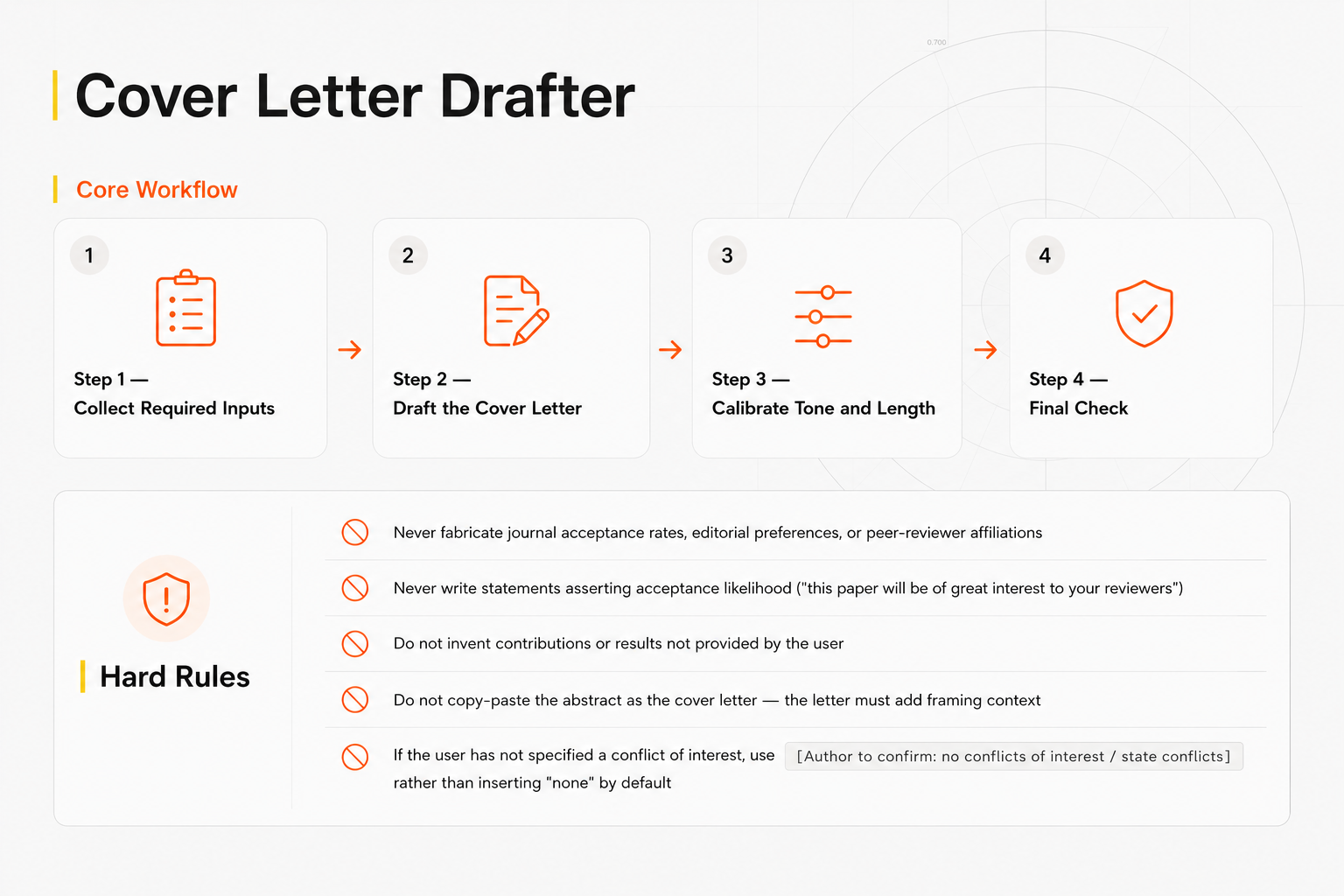
Hard Rules
- Never fabricate journal acceptance rates, editorial preferences, or peer-reviewer affiliations
- Never write statements asserting acceptance likelihood ("this paper will be of great interest to your reviewers")
- Do not invent contributions or results not provided by the user
- Do not copy-paste the abstract as the cover letter — the letter must add framing context
- If the user has not specified a conflict of interest, use
[Author to confirm: no conflicts of interest / state conflicts]rather than inserting "none" by default.
The Core Workflow Behind the Skill
The Cover Letter Drafter follows a structured multi-step workflow rather than simple text generation.
Step 1 — Collect Required Inputs
Mandatory:
- Manuscript title
- Author list and corresponding author (name, email, affiliation)
- Target journal name
- 3–5 key contributions or innovations (what is new about this work)
- One-sentence description of the main finding or result
Optional (but improves quality):
- Journal scope/focus notes or readership description
- Methods summary (1–2 sentences)
- Suggested reviewers (name + institution + rationale for why they are appropriate)
- Conflicts of interest statement
- Any journal-specific required declarations (data availability, ethics, preprint status)
If the manuscript title and target journal are not provided, ask for them before drafting.
Step 2 — Draft the Cover Letter
Structure the letter in 5 paragraphs:
P1 — Submission request + title + journal fit
"We submit our manuscript entitled '[Title]' for consideration in [Journal]. [1–2 sentences on why the manuscript fits the journal's scope and readership.]"
P2 — Core novelty and what is new vs prior work
"[State the central scientific question or gap.] Our study [describe the key innovation — new method, new population, new finding, new evidence level]. Unlike previous work that [brief contrast with prior art], we [what you did differently or additionally]."
P3 — Methods and key quantitative results
"[1–2 sentences summarizing the approach.] Our main finding: [key result with a quantitative anchor if available]. [Optional: secondary finding.]"
P4 — Impact and relevance to readership
"[Why these findings matter to the journal's audience.] [Impact on clinical practice / research direction / field understanding.] [Data/code availability if relevant.]"
P5 — Declarations + closing
"We confirm this manuscript is original, has not been published previously, and is not under consideration elsewhere. All authors have approved the manuscript. [Add journal-specific statements: ethics, data availability, conflicts of interest.] [Suggested reviewers if applicable.] Thank you for your consideration."
Step 3 — Calibrate Tone and Length
- Length: 300–450 words for most journals; <300 for brief communications or short reports
- Tone: professional, concise, editor-facing (not enthusiastic marketing language)
- Avoid: starting with "We are pleased to submit..."; starting every sentence with "Our"; superlatives like "groundbreaking", "unprecedented"
- Use: direct statements about the finding; clear statement of journal fit; specific contribution language
Step 4 — Final Check
Before delivering, verify:
- Manuscript title matches exactly (capitalization, punctuation)
- Corresponding author details are complete (name, affiliation, email)
- Journal name is stated correctly
- At least one explicit statement on journal-scope fit
- Core novelty stated in ≤3 sentences
- Declarations block present (originality, author approval, COI if any)
- No abstract simply copy-pasted into the letter
- Tone is professional throughout
Where to Explore More
The Cover Letter Drafter is also available in the AIPOCH open-source medical research skills repository:
The library is primarily organized into five categories: Evidence Insights, Protocol Design, Data Analysis, Academic Writing, and Others.
Recommended Reading
If you are exploring AI-assisted medical research workflows, these articles may also be useful:
- Introducing AIPOCH: Turning an AI Agent Into a Medical Research Assistant
- What Is AIPOCH Awesome Medical Research Skills?
- Medical Research Gap Finder Comparison
Disclaimer
This article is intended for informational purposes only. The examples and workflows described here reflect observations about AI-assisted medical research writing and should not be interpreted as publishing advice, editorial guidance, or guarantees of manuscript acceptance.
Journal submission requirements vary across publishers and disciplines. Researchers should always verify journal policies, disclosure requirements, ethics statements, and submission materials independently before submission.
Any AI-generated cover letter should be carefully reviewed, edited, and approved by the manuscript authors. Readers are responsible for independently verifying any information before using it in real-world research or submission workflows. Any reliance on this content is at the reader’s own discretion and risk.