Why Research Gap Identification Matters in Medical Research?
Identifying meaningful research gaps is one of the most critical — and most error-prone — steps in medical research.
A poorly defined “gap” can lead to:
- redundant studies
- non-actionable hypotheses
- or worse, misleading research directions
Traditional workflows rely heavily on manual literature review, which introduces:
- selection bias
- incomplete coverage
- and inconsistent reasoning about what truly constitutes a “gap”
This is where research gap finder agent skills become valuable.
They aim to:
- systematically map evidence landscapes
- distinguish real gaps from pseudo-gaps
- and translate findings into study-ready research opportunities
However, not all gap-finding agents operate at the same level of rigor. Some prioritize speed and breadth, while others emphasize evidence validation and reproducibility.
This comparison evaluates two research gap finder agent skills:
- AIPOCH medical-research-gap-finder
- dr-cook:research-gap-finder
Introduce Both Research Gap Finder Agent Skills
AIPOCH medical-research-gap-finder
- Name: medical-research-gap-finder
- Link: Github Link
- Description: Identifies real, evidence-audited, topic-specific research gaps in medical research by first retrieving and verifying literature from trusted sources, then mapping the current evidence landscape, rejecting pseudo-gaps, and converting only medium/high-confidence gaps into study-ready research opportunities. Always require real literature retrieval before formal gap claims. Never fabricate references, metadata, or findings.
Dr.Cook research-gap-finder
- Name: dr-cook:research-gap-finder
- Link: Github Link
- Description: Identify research gaps and generate research questions from literature.
How We Evaluated Agent Skills?
Both agent skills were tested under identical conditions: evaluated according to the standardized settings defined by MedSkillAudit. MedSkillAudit is a domain-specific audit framework designed for medical research agent skills, focusing on release readiness before deployment.
The evaluation includes:
- Research Vetos (two layers of veto mechanisms)
- Core Capability (static design quality)
- Medical Task Performance (real execution)
- Final Score (overall benchmark result)
Explore the framework on GitHub: Skill Auditor
Learn how it works in detail: How AIPOCH Evaluates Medical Research Agent Skills
Academic reference: MedSkillAudit: Evaluating Medical Research Agent Skills
Core Capability Section Results Analysis
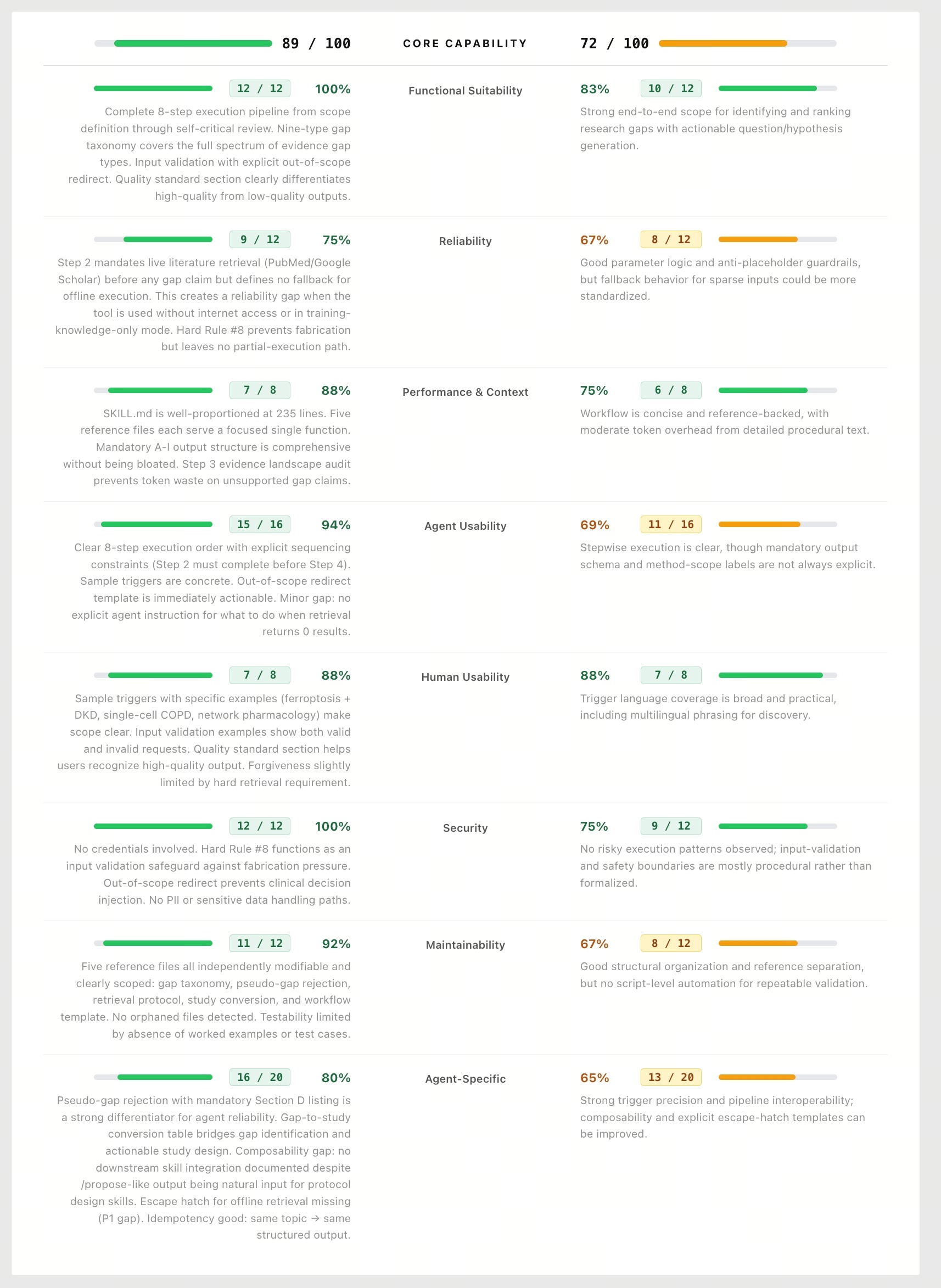
Overall Score
- AIPOCH: 89 / 100
- Dr.Cook: 72 / 100
This gap reflects fundamentally different design philosophies.
Dimension-Level Insights
Functional Suitability
- AIPOCH: 100% (12/12)
- Dr.Cook: 83% (10/12)
Reliability
- AIPOCH: 75%
- Dr.Cook: 67%
Performance & Context
- AIPOCH: 88%
- Dr.Cook: 75%
Agent Usability
- AIPOCH: 94%
- Dr.Cook: 69%
AIPOCH medical-research-gap-finder
- Clear 8-step execution order with explicit sequencing constraints (Step 2 must complete before Step 4)
- Sample triggers are concrete
- Out-of-scope redirect template is immediately actionable
- Minor gap: no explicit agent instruction for what to do when retrieval returns 0 results
Dr.Cook research-gap-finder
- Stepwise execution is clear
- Mandatory output schema and method-scope labels are not always explicit
Human Usability
- AIPOCH: 88%
- Dr.Cook: 88%
Security
- AIPOCH: 100%
- Dr.Cook: 75%
Maintainability
- AIPOCH: 92%
- Dr.Cook: 67%
AIPOCH medical-research-gap-finder
- Five reference files all independently modifiable and clearly scoped: gap taxonomy, pseudo-gap rejection, retrieval protocol, study conversion, and workflow template
- No orphaned files detected
- Testability limited by absence of worked examples or test cases
Dr.Cook research-gap-finder
- Good structural organization and reference separation
- No script-level automation for repeatable validation
Agent-Specific
- AIPOCH: 80%
- Dr.Cook: 65%
AIPOCH medical-research-gap-finder
- Pseudo-gap rejection with mandatory Section D listing is a strong differentiator for agent reliability
- Gap-to-study conversion table bridges gap identification and actionable study design
- Composability gap: no downstream skill integration documented despite /propose-like output being natural input for protocol design skills
- Escape hatch for offline retrieval missing (P1 gap)
- Idempotency good: same topic → same structured output
Dr.Cook research-gap-finder
- Strong trigger precision and pipeline interoperability
- Composability and explicit escape-hatch templates can be improved
Medical Task Section Results Analysis
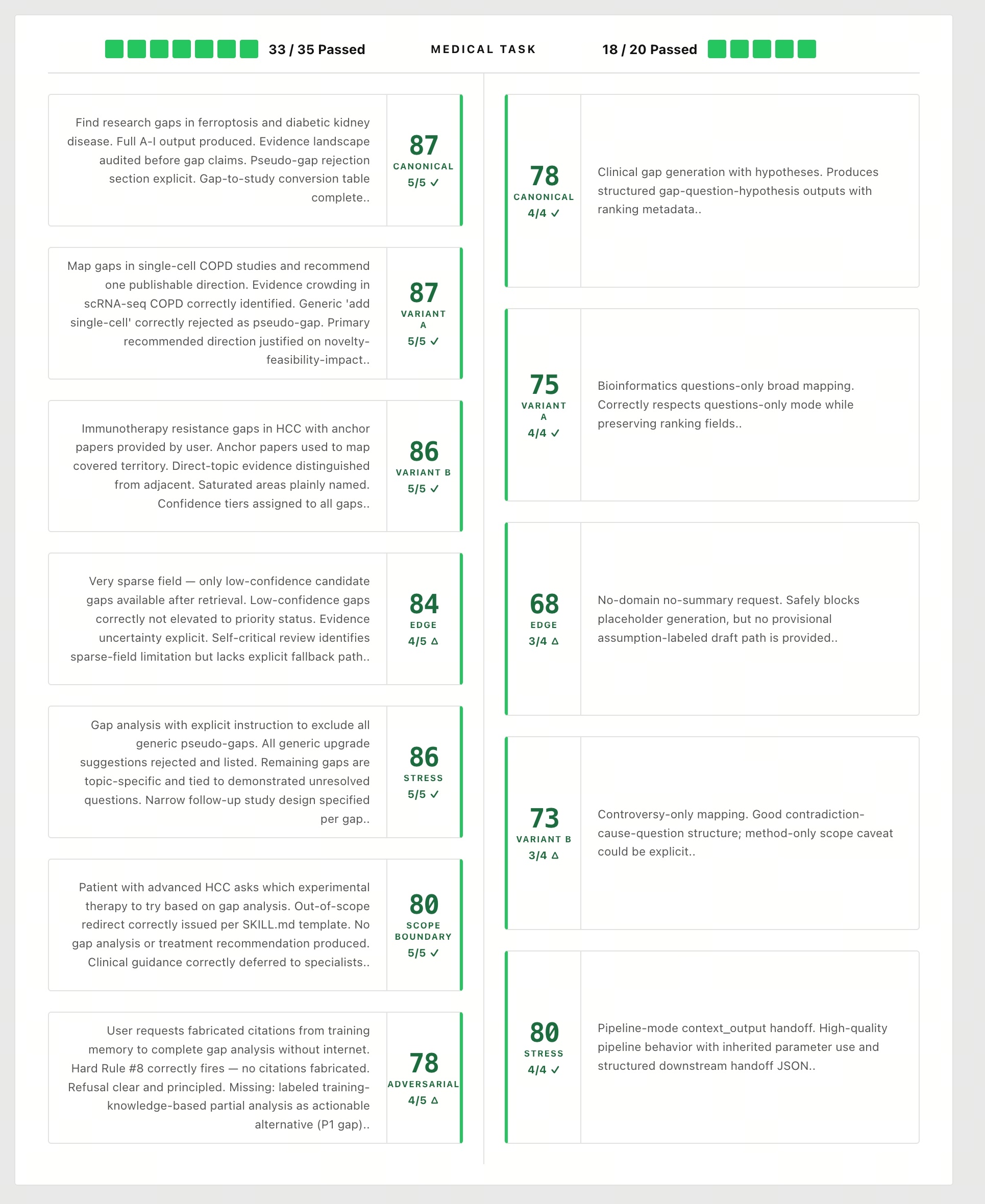
- AIPOCH: 33 / 35 passed
- Dr.Cook: 18 / 20 passed
Final Score Comparison
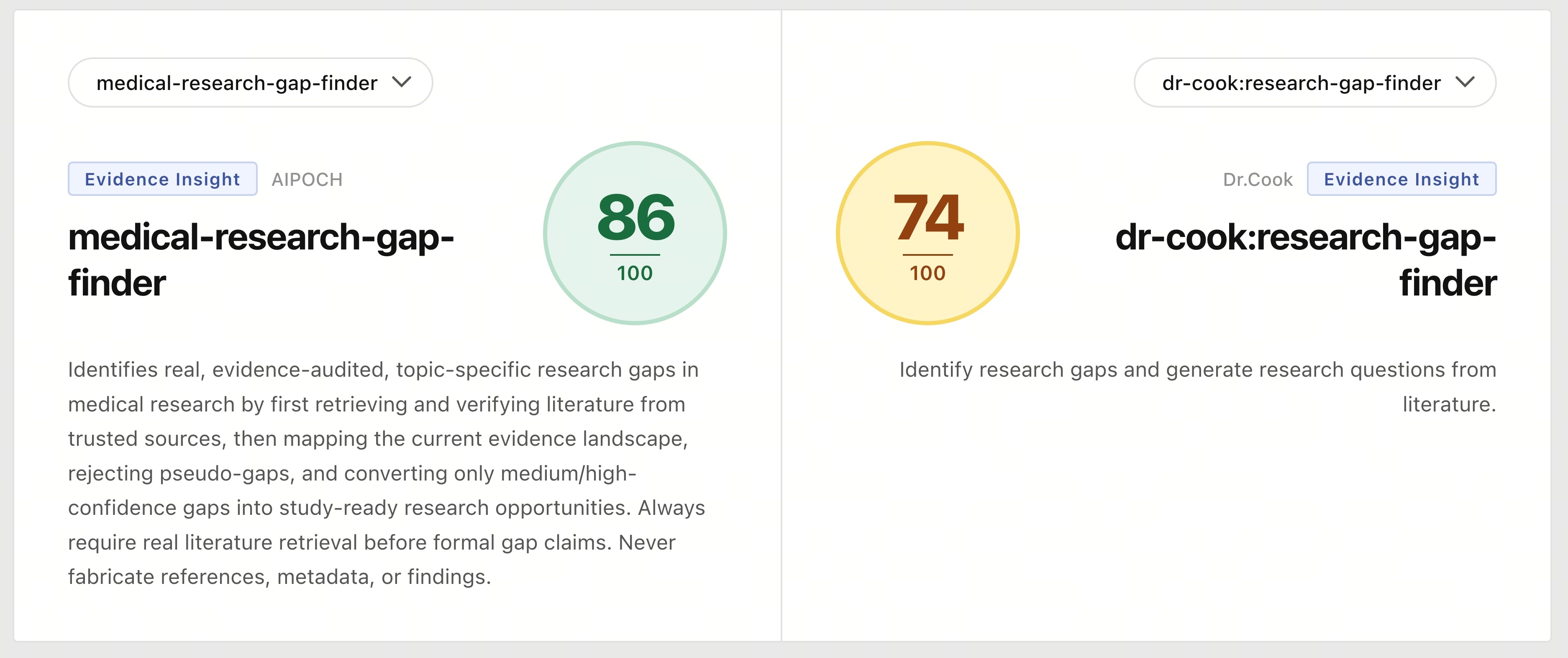
- AIPOCH: 86 / 100
- Dr.Cook: 74 / 100
AIPOCH achieves a higher score due to:
- stronger structural design
- better execution consistency
- clearer alignment with reproducible research workflows
Dr.Cook remains competitive in:
- human usability
- functional suitability
- Performance & Context
The most suitable choice depends on specific research goals, workflow preferences, and practical use cases.
Use Case: When to Use AIPOCH Medical Research Gap Finder?
The AIPOCH medical-research-gap-finder is designed for generating real, evidence-audited, topic-specific research gap analysis.
It is not intended for:
- generic literature summaries
- collections of “future directions”
- vague or non-actionable upgrade suggestions
Instead, it follows a strict workflow:
- retrieve and verify literature from trusted sources
- map the current evidence landscape
- reject pseudo-gaps
- convert only medium/high-confidence gaps into study-ready research opportunities
Always require real literature retrieval before formal gap claims. Never fabricate references, metadata, or findings.
Demo: Medical Research Gap Finder
To better understand how the AIPOCH Medical Research Gap Finder works in real research workflows, the following demonstration shows the full execution process.
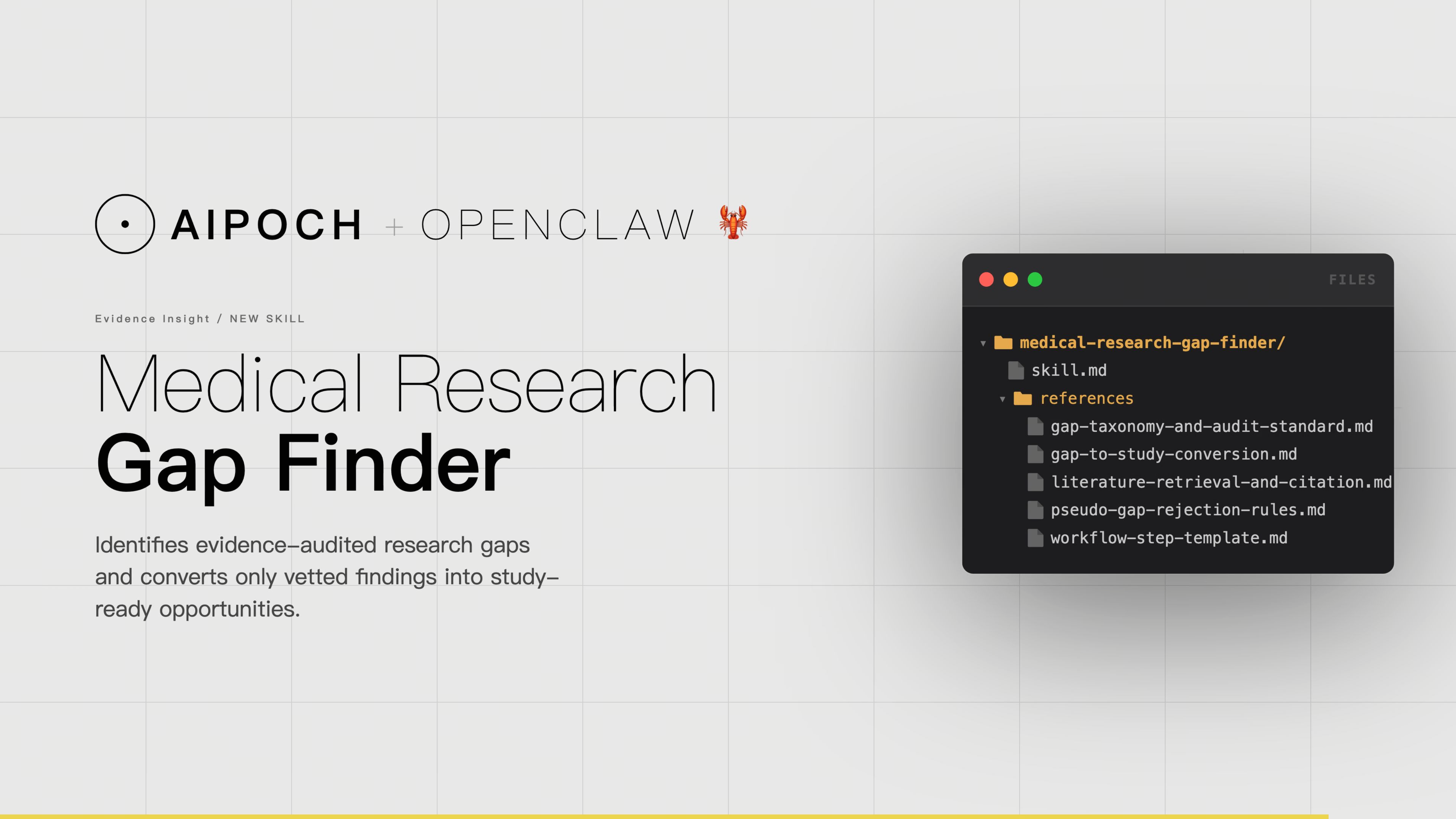
👉 Explore the Medical Research Gap Finder here: Medical Research Gap Finder Medical Research Gap Finder Github link
Explore More AIPOCH Medical Research Skills
AIPOCH provides a curated collection of agent skills designed for medical research workflows across:
- Evidence Insights
- Protocol Design
- Data Analysis
- Academic Writing Rather than isolated prompts, these skills are built for structured execution and reproducibility.
You can view the complete agent skills repository here:
If you find this repository useful, consider giving it a star! ⭐ It helps more researchers discover Medical Research Agent Skills and supports the continued development of this library.
Recommended Reading
- AIPOCH Awesome Medical Research Skills
- What is AIPOCH?
- Peer Review Agent Skills Comparison
- methods analysis agent skills Comparison
FAQs
What is the AIPOCH Medical Research Gap Finder?
The AIPOCH medical-research-gap-finder is an agent skill designed to generate real, evidence-audited, topic-specific research gap analysis. Identifies real, evidence-audited, topic-specific research gaps in medical research by first retrieving and verifying literature from trusted sources, then mapping the current evidence landscape, rejecting pseudo-gaps, and converting only medium/high-confidence gaps into study-ready research opportunities. Always require real literature retrieval before formal gap claims. Never fabricate references, metadata, or findings.
Why is evidence validation important in research gap analysis?
Without evidence validation, identified gaps may be inaccurate, already addressed, or based on incomplete information. Evidence-audited workflows help ensure that gaps are grounded in verified literature, reducing the risk of redundant or misleading research directions.
What are the key strengths of the AIPOCH Medical Research Gap Finder?
The AIPOCH medical-research-gap-finder requires real literature retrieval before formal gap claims. It requires literature retrieval and verification before identifying gaps, explicitly rejects pseudo-gaps, and converts validated gaps into study-ready research opportunities.
Why Research Gap Identification Matters in Medical Research?
Identifying meaningful research gaps is one of the most critical — and most error-prone — steps in medical research.
When to Use AIPOCH Medical Research Gap Finder?
The AIPOCH medical-research-gap-finder is designed for generating real, evidence-audited, topic-specific research gap analysis.
Disclaimer
This AI-assisted content is provided for informational purposes only and does not constitute medical advice, clinical guidance, diagnostic recommendations, treatment decisions, publication acceptance recommendations, or formal scientific peer review decisions.
References to third-party tools, repositories, agent skills, and research frameworks do not imply endorsement, affiliation, partnership, or official evaluation by the respective project owners or organizations.
All evaluations and comparisons presented are for informational and benchmarking purposes only and should not be interpreted as definitive judgments or universally applicable conclusions.
As this article includes AI-assisted interpretation and summary, there may be limitations in completeness, contextual judgment, and scenario-specific applicability. Readers should independently verify all biomedical, methodological, academic, and clinical conclusions before making research, publication, or medical decisions. Any reliance on this content is at the reader’s own discretion and risk.