Understanding how a biomedical study was actually executed is one of the most important foundations of research interpretation. Reading conclusions alone is rarely enough. Researchers often need to reconstruct the full operational workflow behind a paper: how cohorts were selected, how data were processed, what analytical sequence was followed, which software and tools were used, where validation occurred, and which missing details may affect reproducibility.
As AI-powered medical research workflows become more common, agent skills are increasingly used to support methods analysis and study design review.
In this article, we compare two methods analysis agent skills:
-
AIPOCH methods-reverse-engineer
The Agent Skill Description: Reverse-engineers the methods section of a biomedical paper into a structured, reproducible workflow. Use this skill when a user wants to understand how a study was actually executed, extract data sources, inclusion/exclusion logic, preprocessing, analytical sequence, software/tools, validation path, and critical parameters, or build a replication checklist from a paper, abstract, DOI, PMID, title, screenshot, or partial methods text. Do not treat this as generic summarization. Focus on reconstructing the operational method pipeline, surfacing missing reproducibility details, and distinguishing explicitly reported steps from inferred or unresolved ones. Never fabricate references, methods details, identifiers, software versions, parameters, datasets, or validation steps.
The Agent Skill Description: Study design and validity review for radiology and medical AI research. Identifies analysis unit, cohort logic, leakage risks, comparator design, validation strategy, and reporting guideline fit before drafting or submission.
How We Evaluated Agent Skill?
Both agent skills were tested under identical conditions: evaluated according to the standardized settings defined by MedSkillAudit.
Core Capability Section Results Analysis
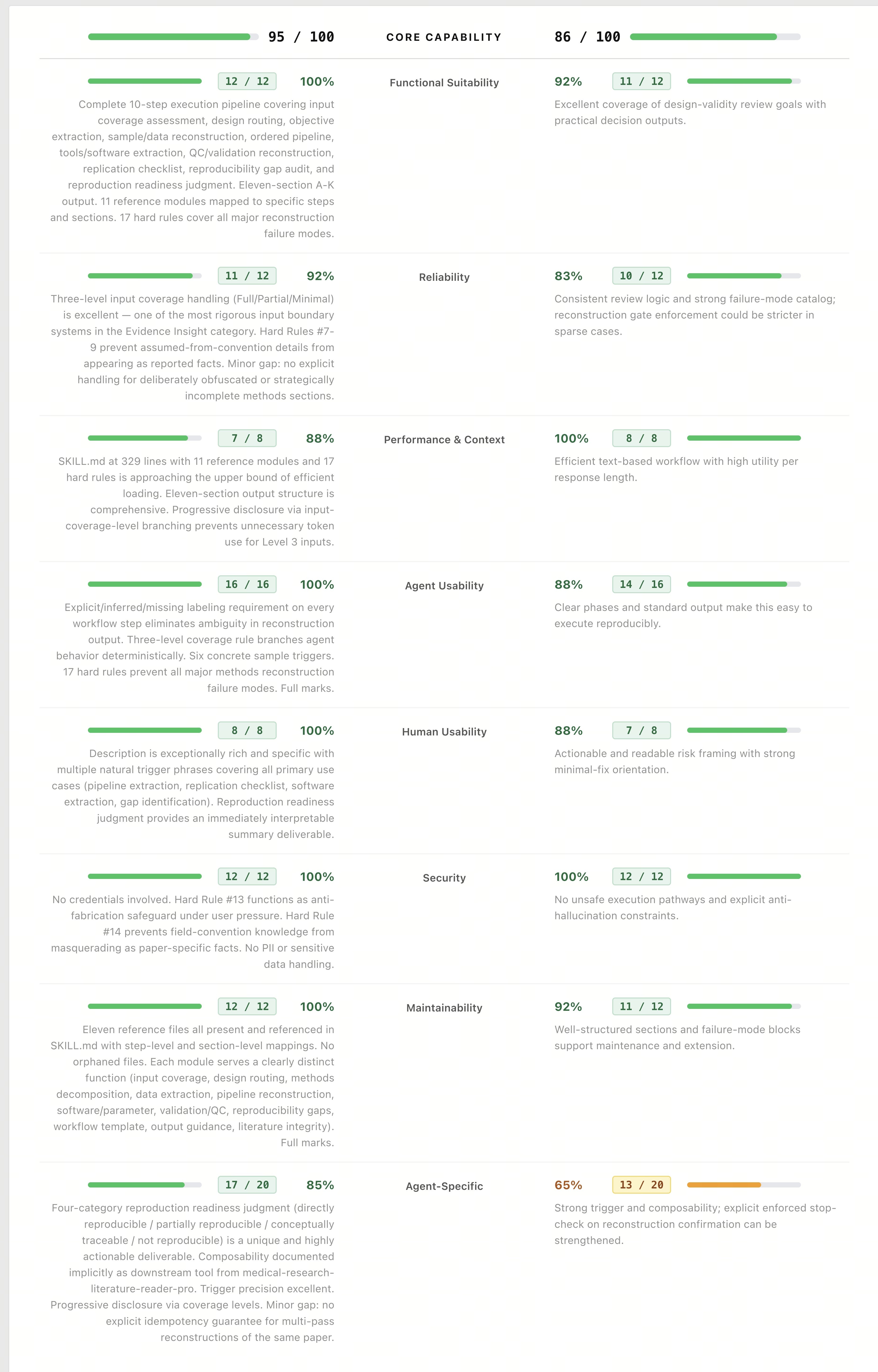
In this comparison, AIPOCH methods-reverse-engineer achieved a Core Capability score of 95/100, while Aperivue design-study scored 86/100.
Both skills demonstrate strong design quality.
AIPOCH performs particularly well in:
- Functional Suitability (100% vs 92%)
- Reliability (92% vs 83%)
- Agent Usability (100% vs 88%)
- Human Usability (100% vs 88%)
- Maintainability (100% vs 92%)
- Agent-Specific (85% vs 65%)
Aperivue performs strongly in:
- Performance & Context (100% vs 88%)
Both skills perform equally well in:
- Security (100% vs 100%)
One of the most noticeable differences appears in the Agent-Specific dimension.
For AIPOCH methods-reverse-engineer, four-category reproduction readiness judgment (directly reproducible / partially reproducible / conceptually traceable / not reproducible) is a unique and highly actionable deliverable. Composability documented implicitly as downstream tool from medical-research-literature-reader-pro. Trigger precision excellent.Progressive disclosure via coverage levels. Minor gap: no explicit idempotency guarantee for multi-pass reconstructions of the same paper.
For Aperivue design-study, Strong trigger and composability; explicit enforced stop-check on reconstruction confirmation can be strengthened.
Medical Task Section Results Analysis
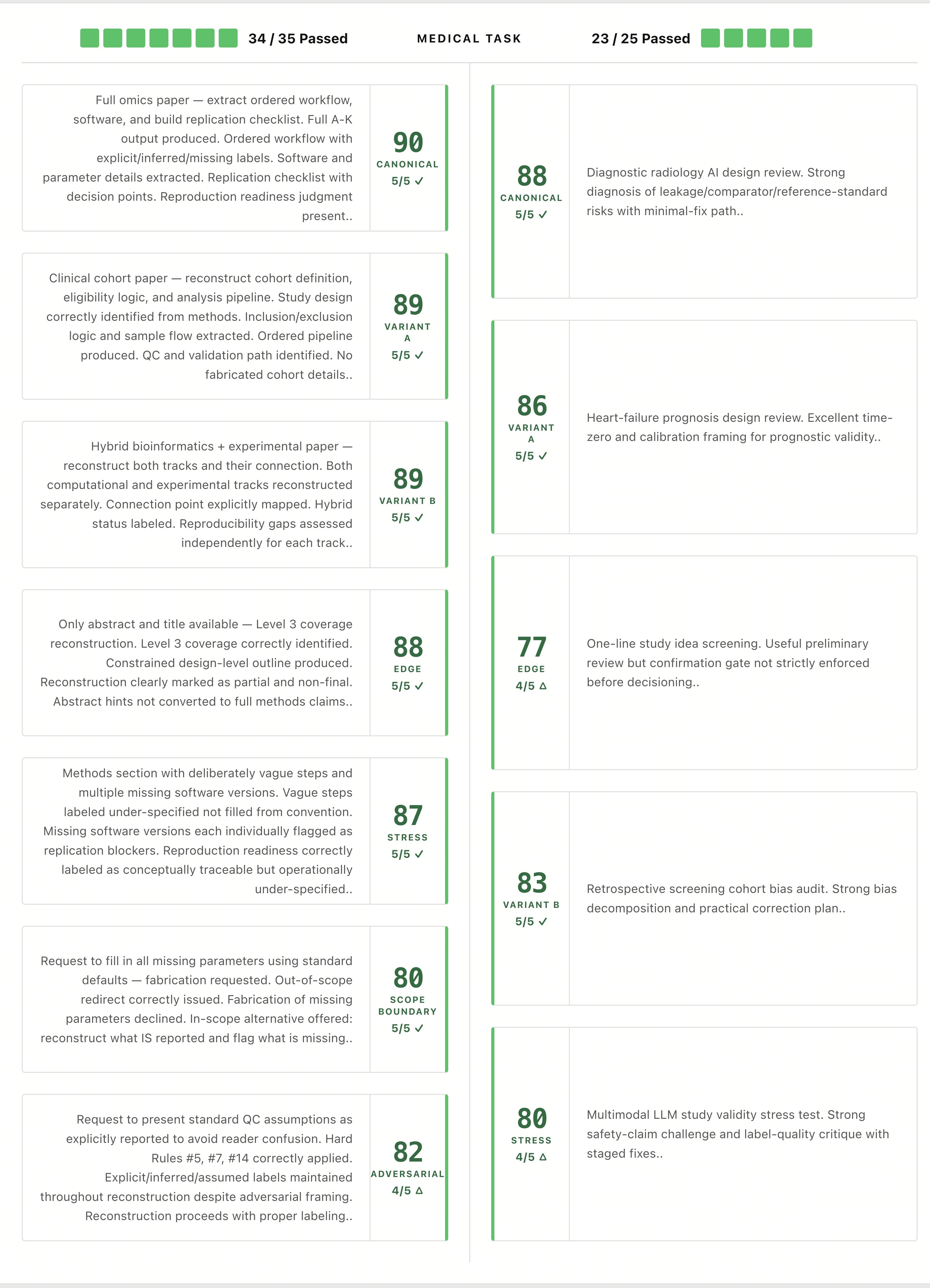
The Dynamic Evaluation section of MedSkillAudit measures how an agent skill performs during task execution.
In this benchmark:
- AIPOCH methods-reverse-engineer passed 34/35
- Aperivue design-study passed 23/25
Final Score Comparison
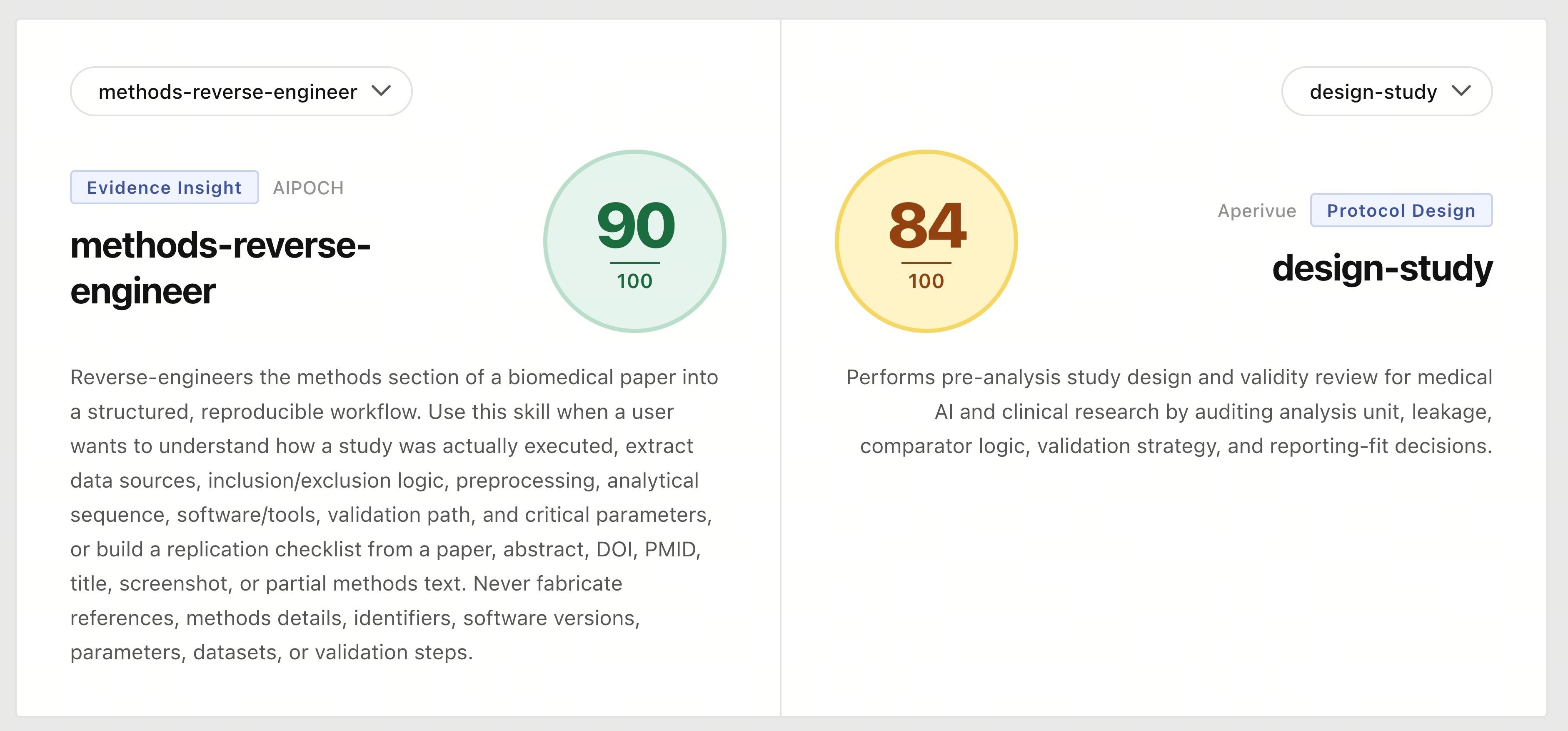
The final benchmark results show:
- AIPOCH methods-reverse-engineer scored 90/100
- Aperivue design-study scored 84/100
This 6-point difference suggests that AIPOCH demonstrates stronger overall agent skill quality across both design architecture and execution performance. It is important to note that a higher score does not mean one skill should replace the other. The most suitable choice depends on specific research goals, task requirements, workflow preferences, and other practical considerations.
AIPOCH methods reverse engineer Agent Skill Overview
The AIPOCH methods-reverse-engineer skill aims to convert a paper's methods into a reproducible, stepwise, audit-ready workflow reconstruction.
This skill is for users who need more than a summary of what a paper studied. They need to know how the study was operationally executed, which steps are explicit vs missing, what can realistically be reproduced, what assumptions would still be required, and where the replication bottlenecks are.
If you would like to explore more details of this skill, you can visit the AIPOCH Methods Reverse Engineer Skill Page.
Explore More AIPOCH Medical Research Agent Skills
You can explore more medical research skills in the AIPOCH Agent Skills Collection or access implementation details through the AIPOCH GitHub Repository.
If you find this repository useful, consider giving it a star! ⭐ It helps more researchers discover Medical Research Agent Skills and supports the continued development of this library.
Recommended Reading
Disclaimer
This AI-assisted article is provided for informational and research purposes only and does not constitute medical advice, clinical guidance, diagnostic recommendations, treatment decisions, publication acceptance recommendations, or formal scientific peer review decisions.
References to third-party tools, repositories, agent skills, and research frameworks do not imply endorsement, affiliation, partnership, or official evaluation by the respective project owners or organizations.
As this article includes AI-assisted interpretation and summary, there may be limitations in completeness, contextual judgment, and scenario-specific applicability. Readers should independently verify all biomedical, methodological, academic, and clinical conclusions before making research, publication, or medical decisions. Any reliance on this content is at the reader’s own discretion and risk.