AIPOCH vs K-Dense: Which Peer Review Agent Skill Performs Better?
A data-driven comparison of AIPOCH and K-Dense peer review agent skills using MedSkillAudit.
Peer review is one of the most critical steps in academic research—but also one of the hardest to standardize.
As AI-powered academic workflows become more common, agent skills are increasingly used to support peer review tasks. However, even when the task is the same, different agent skills can produce different results depending on how they are designed.
In this article, we compare two peer review agent skills:
- AIPOCH Peer Review Skill The Agent Skill Description: Conduct professional peer reviews for papers or theses, providing structured evaluations and improvement suggestions; use when you need a pre-submission assessment, an internal review, or academic quality control.
- K-Dense Peer Review Skill The Agent Skill Description: Structured manuscript/grant review with checklist-based evaluation. Use when writing formal peer reviews with specific criteria methodology assessment, statistical validity, reporting standards compliance (CONSORT/STROBE), and constructive feedback. Best for actual review writing, manuscript revision. For evaluating claims/evidence quality use scientific-critical-thinking; for quantitative scoring frameworks use scholar-evaluation.
How We Evaluated Agent Skill Quality?
This comparison is not based on opinions or isolated examples.
We used AIPOCH MedSkillAudit, an evaluation framework designed to assess agent skills.
Both agent skills were tested under identical conditions: evaluated according to the standardized settings defined by MedSkillAudit.
Core Capability Section Results Analysis
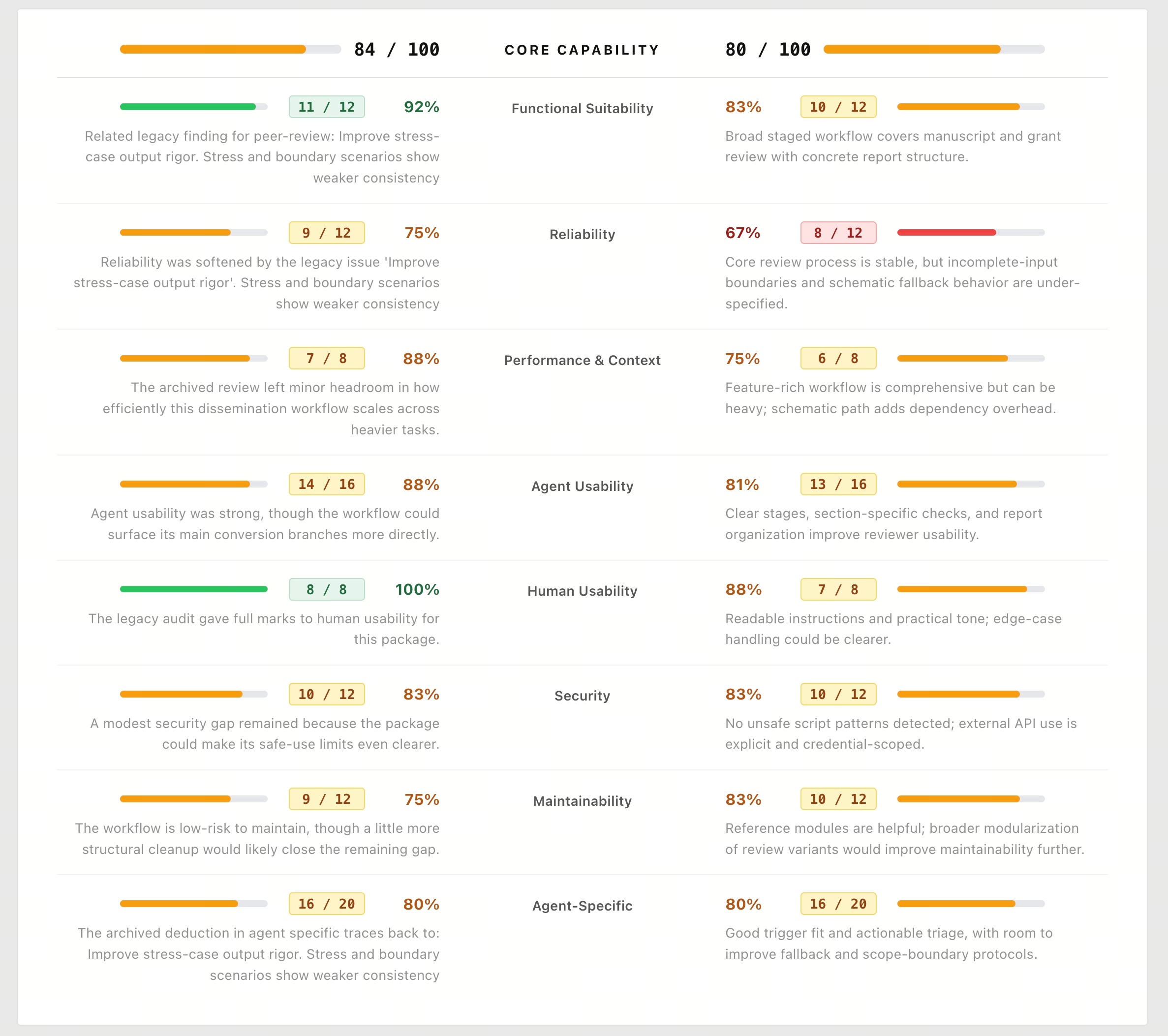
The Core Capability section of MedSkillAudit is a static quality evaluation of the agent skill itself. At this stage, MedSkillAudit evaluates how well the agent skill is designed.
It covers eight key dimensions:
- Functional Suitability
- Reliability
- Performance & Context
- Agent Usability
- Human Usability
- Security
- Maintainability
- Agent-Specific Capability
In this comparison, AIPOCH Peer Review Skill achieved a Core Capability score of 84/100, while K-Dense Peer Review Skill scored 80/100.
Although both peer review skills show strong design quality, the scoring reveals meaningful differences in how each skill is architected.
AIPOCH performs particularly well in:
- Functional Suitability (92% vs 83%)
- Reliability (75% vs 67%)
- Performance & Context (88% vs 75%)
- Agent Usability (88% vs 81%)
- Human Usability (100% vs 88%)
K-Dense performs strongly in:
- Maintainability (83% vs 75%)
Medical Task Section Results Analysis
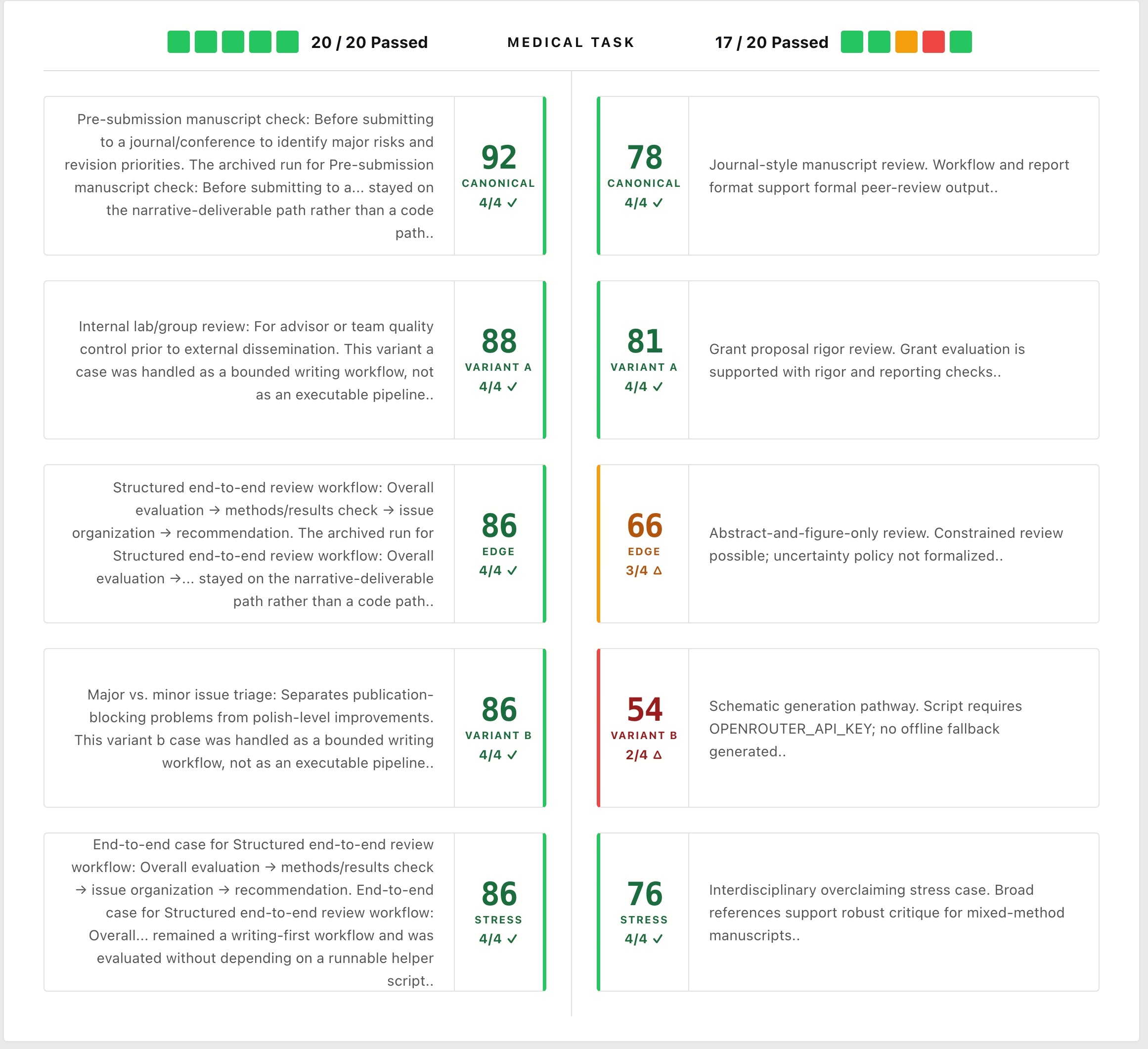
The Dynamic Evaluation section of MedSkillAudit measures how an agent skill performs during actual task execution.
In this benchmark:
- AIPOCH Peer Review Skill passed 20/20
- K-Dense Peer Review Skill passed 17/20
This result shows that AIPOCH demonstrates stronger runtime consistency and broader scenario coverage across real peer review workflows.
Final Score Comparison
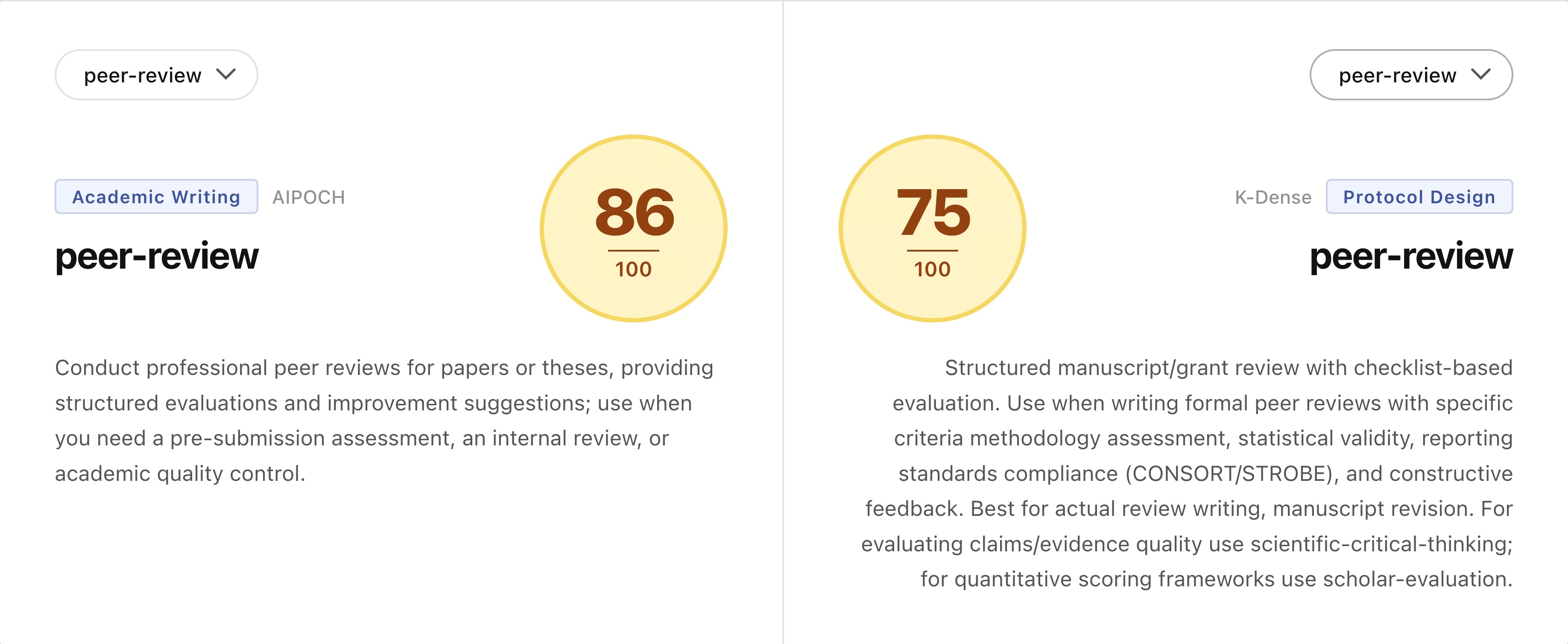
- AIPOCH Peer Review Skill scored 86/100
- K-Dense Peer Review Skill scored 75/100
This 11-point difference suggests that AIPOCH demonstrates stronger overall agent skill quality across both design architecture and execution performance.In other words, AIPOCH is not only better structured at the skill level, but also performs more effectively when applied to real peer review tasks.
It is important to note that a higher score does not mean one skill should replace the other, and the best choice depends on the reviewer’s goals, manuscript type, and review stage.
Use Case: AIPOCH Peer Review Skill Overview
To help researchers better understand how the AIPOCH Peer Review Skill works, we created a brief demonstration video that showcases its overall workflow and practical academic use cases.
Watch here:
All content is provided for research purposes only and is not intended for clinical use or medical advice. Any medical text or data shown in this video is for demonstration purposes only.
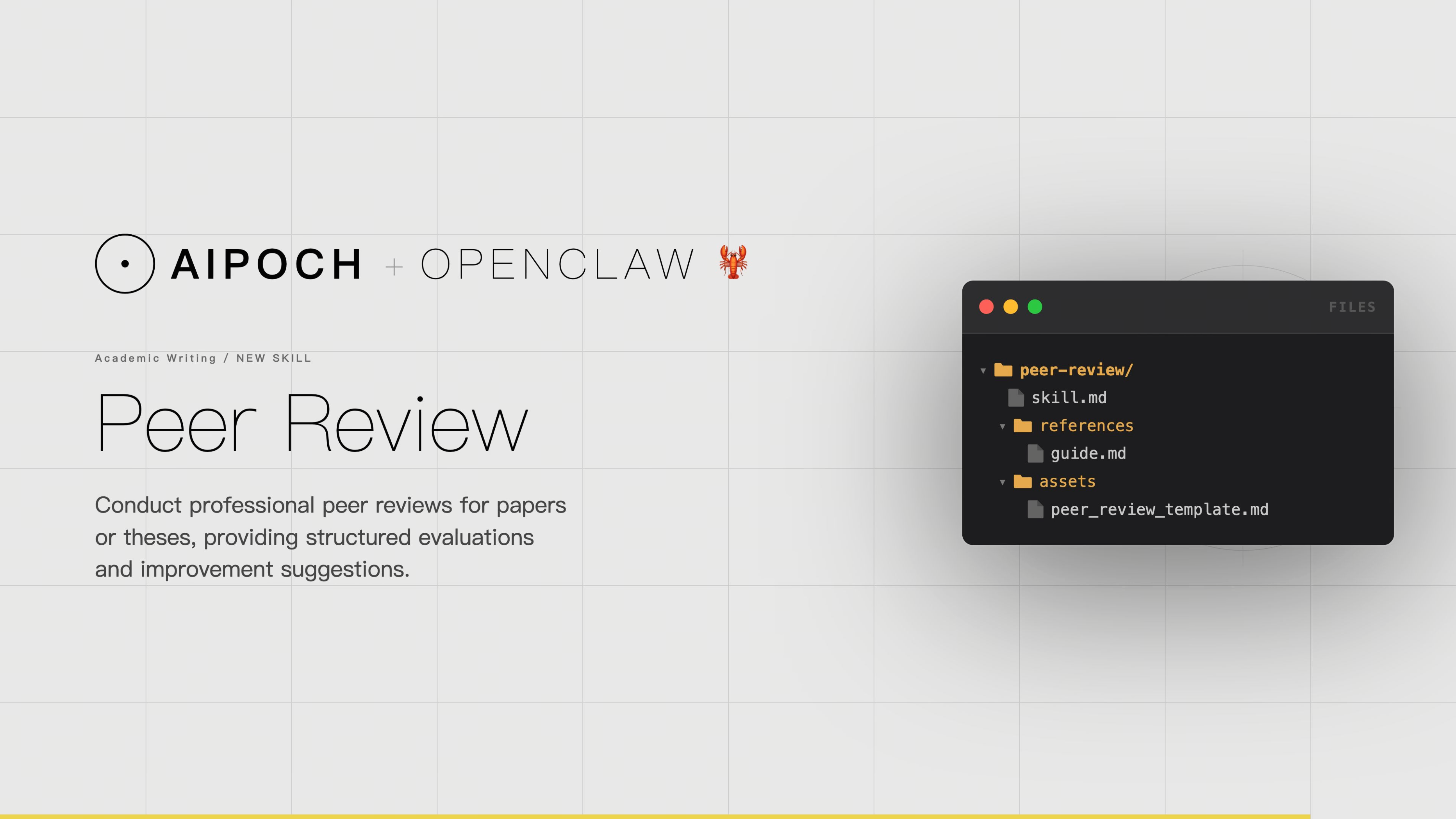
The AIPOCH Peer Review Skill is designed to conduct professional peer reviews for papers or theses, providing structured evaluations and improvement suggestions. It is especially useful when researchers need a pre-submission assessment, an internal review, or academic quality control.
Peer Review Agent Skill Key Features
Its key features include:
- Structured end-to-end review workflow: Overall evaluation → methods/results check → issue organization → recommendation.
- Major vs. minor issue triage: Separates publication-blocking problems from polish-level improvements.
- Actionable revision suggestions: Each issue is paired with concrete steps to fix or strengthen the work.
- Recommendation with rationale: Clear accept/revise/reject guidance with reasons and improvement path.
- Reusable templates and checklists: Supports consistent formatting and comprehensive coverage (see referenced files).
This makes it particularly valuable for:
- Pre-submission manuscript check: Before submitting to a journal/conference to identify major risks and revision priorities.
- Internal lab/group review: For advisor or team quality control prior to external dissemination.
- Thesis/dissertation evaluation: To assess academic rigor, structure, and defensibility before committee review.
- Revision planning after feedback: To translate reviewer/editor comments into an actionable improvement roadmap.
- Quality assurance for research outputs: To ensure methods, reporting, and conclusions meet disciplinary standards.
This practical workflow is also one of the key reasons why AIPOCH performs strongly in MedSkillAudit’s Dynamic Evaluation section.
If you would like to explore the detailed MedSkillAudit evaluation of this skill—including Core Capability, Dynamic Evaluation, and the Final Overall Score—you can view the full assessment on the AIPOCH Peer Review Skill Evaluation Report.
Explore more AIPOCH Agent Skills
You can explore more workflow-focused research skills in the AIPOCH Agent Skills Collection or access implementation details through the AIPOCH GitHub Repository.
Disclaimer
This content is provided for informational purposes only and does not constitute medical advice, clinical guidance, publication acceptance recommendations, or formal peer review decisions. MedSkillAudit is designed to evaluate the quality of agent skills, not to replace expert judgment from qualified researchers, reviewers, editors, or healthcare professionals. Users should independently verify all academic, methodological, and clinical conclusions before making research, publication, or medical decisions. Any reliance on this content is at the user’s own discretion and risk.