In a traditional Differential Expression Analysis workflow, researchers usually begin with a bulk RNA-seq count matrix or a microarray expression matrix, then manually prepare raw sample metadata, define disease and normal groups, choose an appropriate statistical method, run the analysis in R or Python, and finally generate visual outputs such as volcano plots and heatmaps.
This workflow is well established, and it remains essential. However, the traditional workflow can be time-consuming and fragile. Researchers must keep track of data format, group labels, normalization assumptions, statistical thresholds, and visualization parameters.
A general AI agent can help explain these steps or draft code, but it may still require the researcher to repeatedly describe the task, constraints, expected inputs, and desired outputs. An agent skill goes one step further: it packages a specific research workflow into a reusable capability that the agent can invoke when the task matches.
For Differential Expression Analysis, that means the agent is not starting from a blank prompt. It can follow a task-specific workflow for comparing two differential expression groups, identifying differentially expressed genes, and producing visualizations such as volcano plots and heatmaps. It can make the routine parts of bulk transcriptomics analysis more consistent, reusable, and easier to start.
Differential Expression Analysis Skill Overview
What is the Differential Expression Analysis Agent Skill?
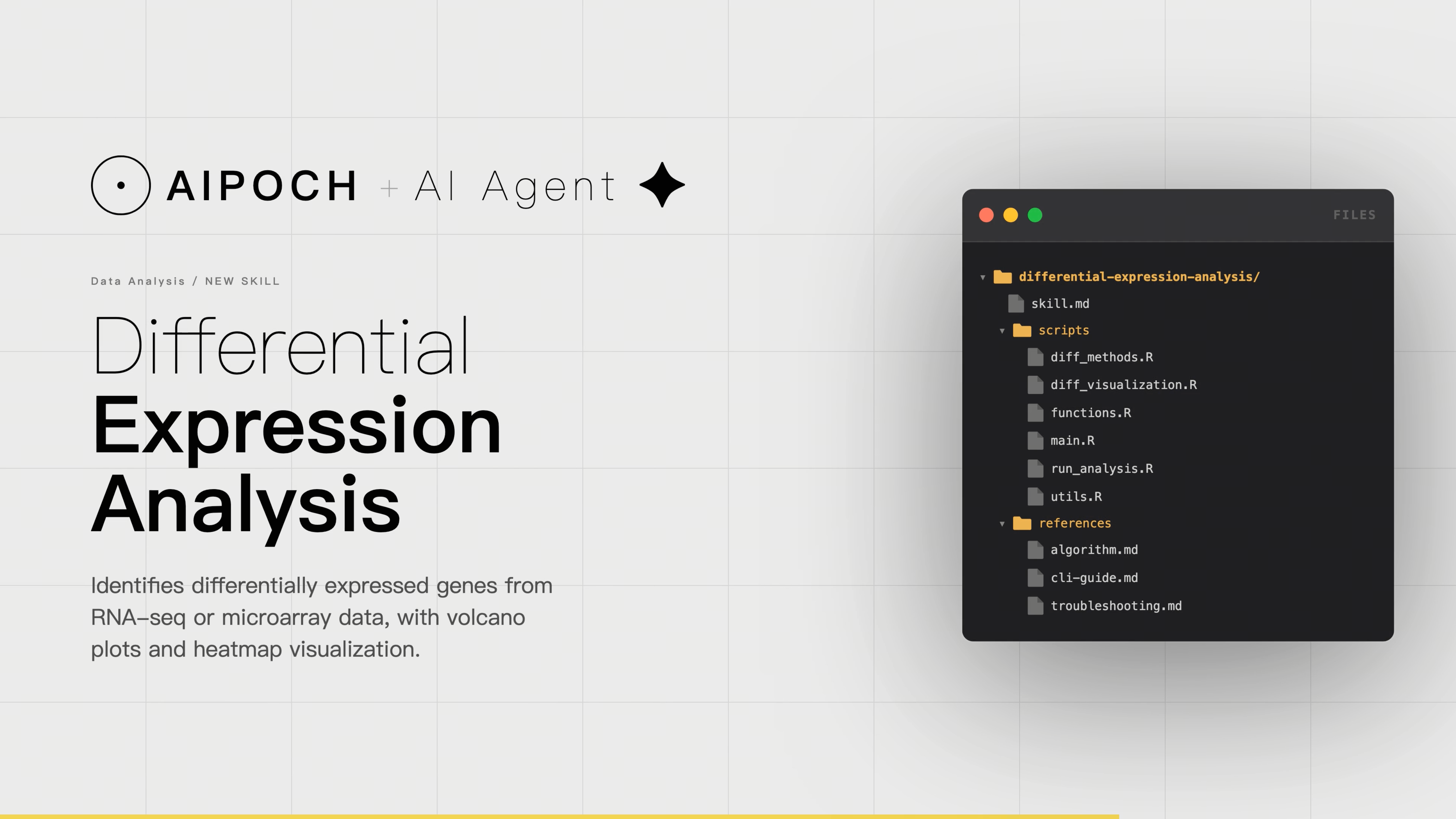
Differential Expression Analysis Agent Skill is an AI-agent workflow module that identifies differentially expressed genes between two biological groups from bulk RNA-seq or microarray expression matrices, supports differential expression analysis using limma, DESeq2, and edgeR packages, together with statistical testing methods including t-test and Wilcoxon analysis, and exports differential expression result tables, significant DEG tables, volcano plots, and heatmaps.
What is the Differential Expression Analysis Skill Designed For?
Differential Expression Analysis skill is designed to help researchers perform differential expression analysis on bulk RNA-seq or microarray expression matrices. It automatically compares gene expression differences between case and control groups and identifies significantly upregulated and downregulated genes. It supports commonly used differential analysis methods, including limma, DESeq2, edgeR, t-test, and Wilcoxon test, and generates complete differential expression result tables, significant DEG tables, volcano plots, heatmaps, and session information based on user-defined P-value and logFC thresholds. It is suitable for disease mechanism exploration, candidate biomarker screening, and DEG discovery before downstream enrichment analysis.
The Differential Expression Analysis Skill is also available in the official GitHub repository as part of the AIPOCH medical research skills collection.
Differential Expression Analysis Workflow
Step 1: Validate Input
- Check file existence
- Validate sample matching between expression matrix and group file
- Verify at least 2 samples per group
Step 2: Run Differential Expression
- limma, DESeq2, edgeR
- t-test, Wilcoxon
- logFC and p-values
- Apply multiple testing correction (Benjamini-Hochberg)
Step 3: Filter Results
- Filter by p-value and logFC thresholds
- Classify genes as Up, Down, or Not significant
Step 4: Generate Visualizations
- Volcano plot showing significance vs fold change
- Heatmap of top differential genes
Case Study: Running Differential Expression Analysis with an AI Agent
This demonstration video showcases how to perform differential expression analysis (DEG analysis) using the Differential Expression Analysis skill within the OpenClaw runtime environment.
The inputs and outputs presented in this article were for informational and demonstration purposes only.
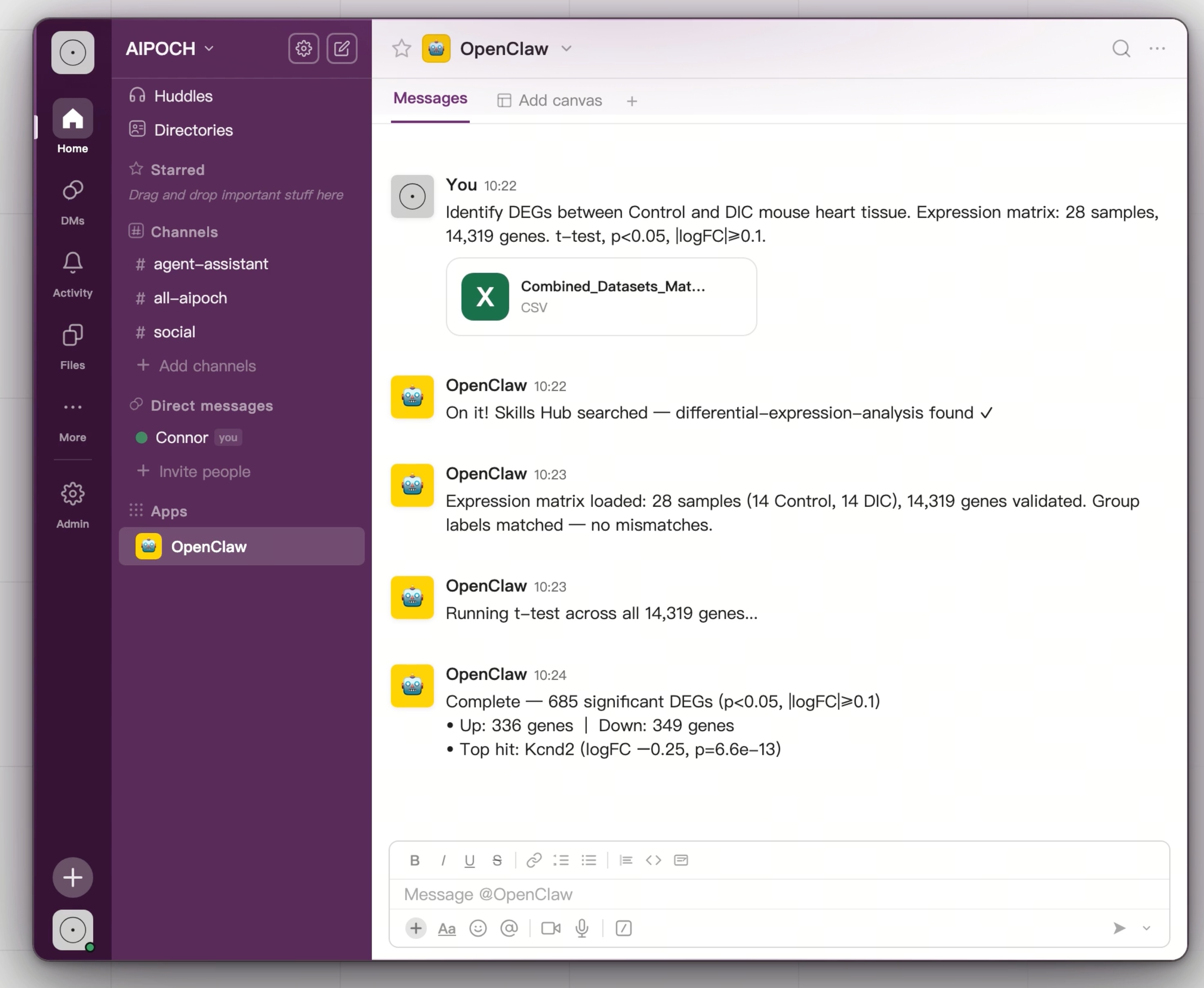
As illustrated in the screenshots below, the interaction begins with a natural language instruction requesting identification of DEGs between Control and DIC groups using a t-test with thresholds of p < 0.05 and |logFC| ≥ 0.1.
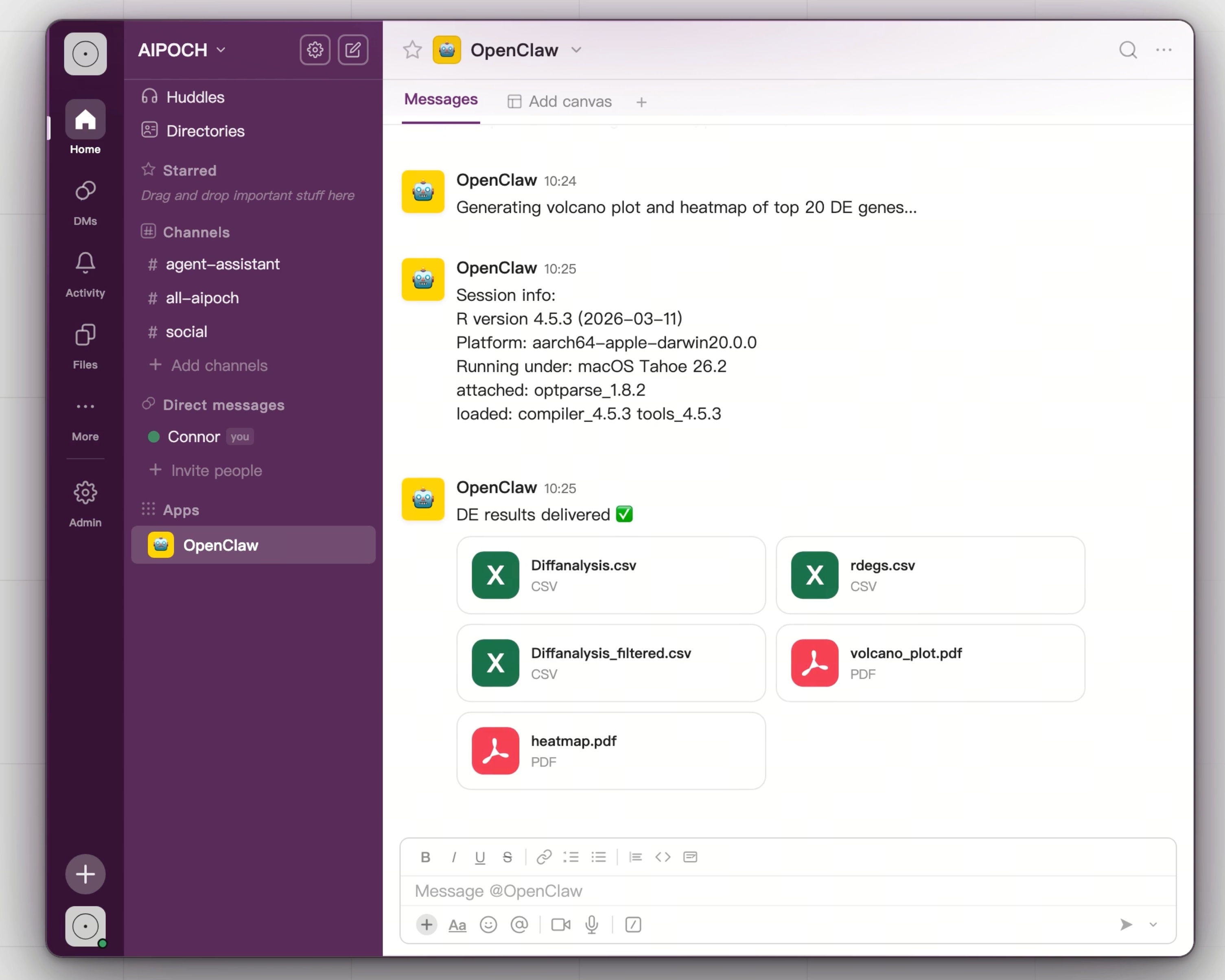
The workflow completes automatically and returns a comprehensive set of analysis outputs, including DEG result tables, filtered DEG lists, volcano plots, and heatmaps.
This case study demonstrates how AI agents can streamline transcriptomics analysis through an automated and reproducible workflow, significantly reducing manual bioinformatics effort.
Watch the demonstration here:
Why This Matters for AI for Medical Research
The future of medical research AI is not just about faster answers. It is about better workflows: clearer inputs, transparent outputs, reproducible steps, and tools that match the biological question. AIPOCH’s Differential Expression Analysis agent skill is a small but useful example of that direction. It packages a common biomedical data analysis task into a reusable agent workflow, helping researchers spend less time assembling the mechanics and more time interpreting the biology. As AI for medical research matures, agent skills like this can become part of a larger research operating system: one where literature, data, analysis, visualization, and writing are connected through structured, domain-aware workflows.
Explore More AIPOCH Medical Research Skills
Researchers and AI agents can explore the growing library of medical research agent skills through multiple resources:
- Open-Source Repository on GitHub
- AIPOCH Medical Research Agent Skills List – Browse all skills organized by category, from Evidence Insights to Academic Writing.
- Full Agent Skills Overview – Learn about the purpose, workflow integration, and capabilities of each skill in detail.
These resources make it easy to explore, validate, and experiment with AIPOCH’s growing library.
Disclaimer
This content is intended for informational purposes only and does not constitute medical advice, clinical guidance, diagnostic recommendations, treatment decisions, publication acceptance recommendations, or formal scientific peer review outcomes.
AIPOCH agent skills are intended to support researchers, not replace human scientific judgment, domain expertise, institutional review processes, or editorial decision-making.
Researchers should independently verify all outputs, evidence interpretations, annotations, citations, manuscript revisions, and scientific conclusions before use in academic, clinical, regulatory, or publication settings.