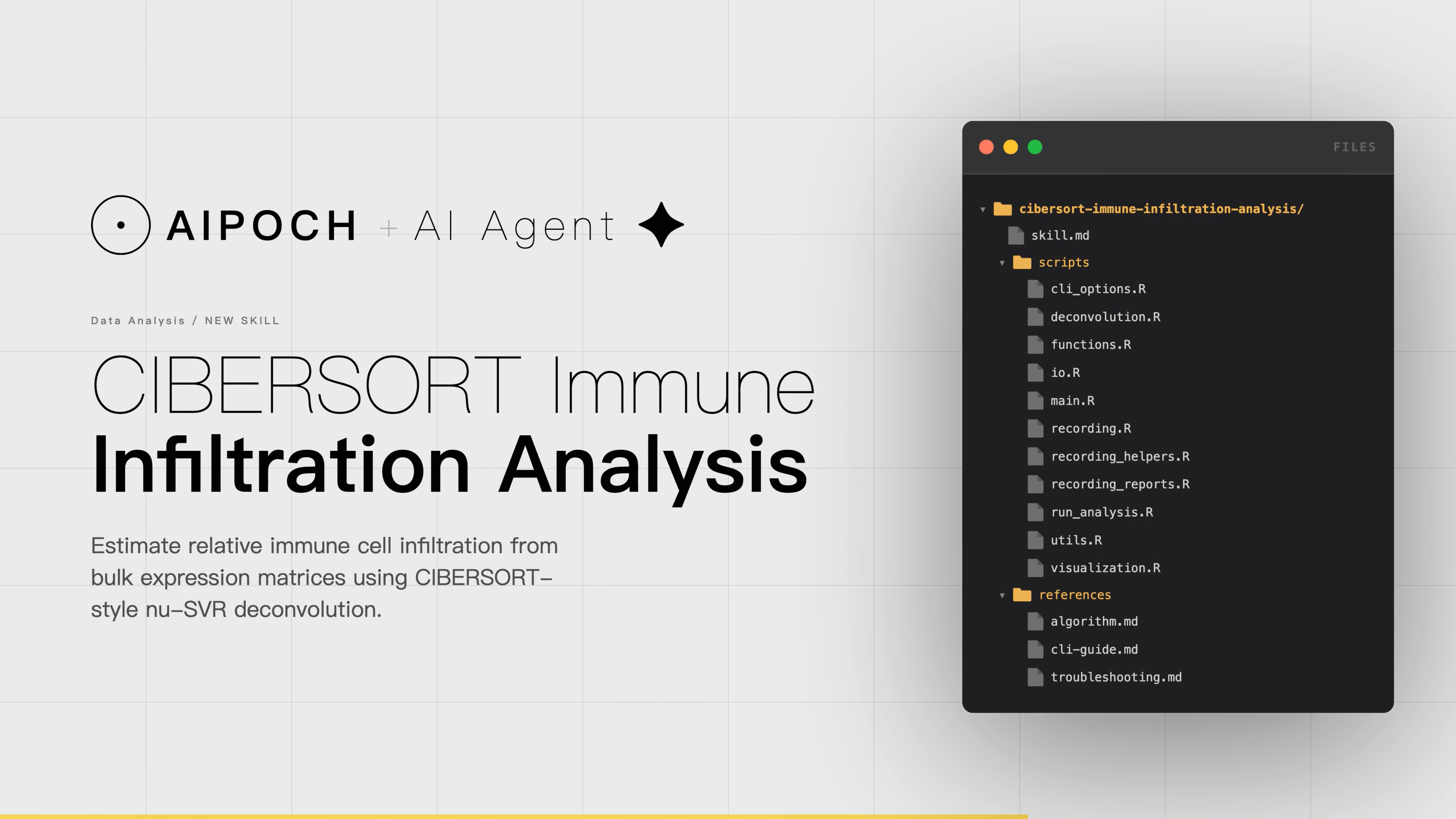
AI agents can perform CIBERSORT-style immune infiltration analysis when equipped with the appropriate agent skill. AIPOCH developed the CIBERSORT Immune Infiltration Analysis skill to help AI agents process bulk RNA expression matrices, estimate relative immune cell composition, compare case and control groups, and generate structured tables plus immune-fraction plots. Researchers can add this workflow capability to their AI agents through the AIPOCH Medical Research Skills GitHub Repository.
Immune infiltration analysis has become a common workflow in cancer research, immunology studies, and translational medicine projects. Researchers frequently use bulk transcriptomic datasets to estimate the abundance of immune cell populations within tissues. However, manually preparing expression matrices, organizing phenotype labels, running deconvolution workflows, generating plots, and compiling outputs into reproducible reports can become repetitive and time-consuming across multiple projects.
According to Nature Methods, CIBERSORT introduced a machine learning-based deconvolution framework using support vector regression to estimate immune cell composition from bulk tissue gene expression profiles. Since then, immune infiltration analysis has become widely integrated into many bioinformatics workflows.
For many research teams, the challenge is often not the algorithm itself — it is the operational burden of repeatedly executing and organizing the workflow at scale.
What is CIBERSORT Immune Infiltration Analysis Agent Skill?
A local R-based CIBERSORT-style immune infiltration analysis skill that uses an LM22 signature matrix to deconvolve bulk expression data, estimate the relative abundance of 22 immune cell types, and generate result tables, group-comparison summaries, correlation analyses, and visualization plots.
What This Agent Skill Does?
The CIBERSORT Immune Infiltration Analysis skill helps researchers perform immune infiltration analysis on a bulk RNA expression matrix, compare immune cell composition between one case group and one control group, generate CIBERSORT-style output tables, quality metrics, group-level statistical summaries, correlation matrices, and PDF plots, and preserve run records plus output manifests for reproducibility and review.
Who Can Benefit From This Skill?
This workflow may be useful for:
- bioinformaticians
- immunology researchers
- cancer research teams
- translational medicine groups
- graduate students
- computational biology teams
- sequencing analysis groups
Running CIBERSORT Immune Infiltration Analysis with an AI Agent
A workflow demonstration for this skill can be viewed here:
This demonstration showcases how to perform immune infiltration analysis using the CIBERSORT Immune Infiltration Analysis skill within the OpenClaw runtime environment.
The inputs and outputs presented in this article are for informational and demonstration purposes only.
As illustrated below, the interaction begins with a natural language instruction requesting estimation of relative proportions of 22 immune cell types across 8 bulk RNA-seq samples (4 Tumor,4 Healthy) and comparison of immune infiltration between groups.
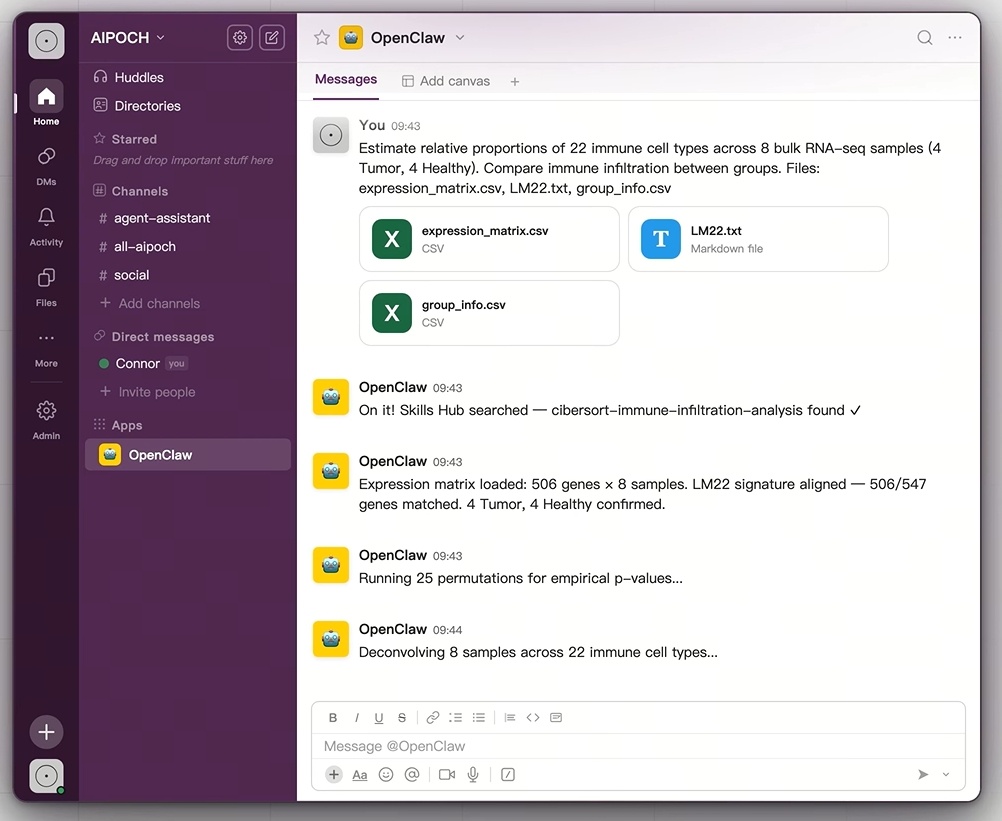
The uploaded workflow inputs include:
- expression_matrix.csv
- LM22.txt
- group_info.csv
The workflow then completes automatically and generates a comprehensive set of structured immune infiltration outputs.
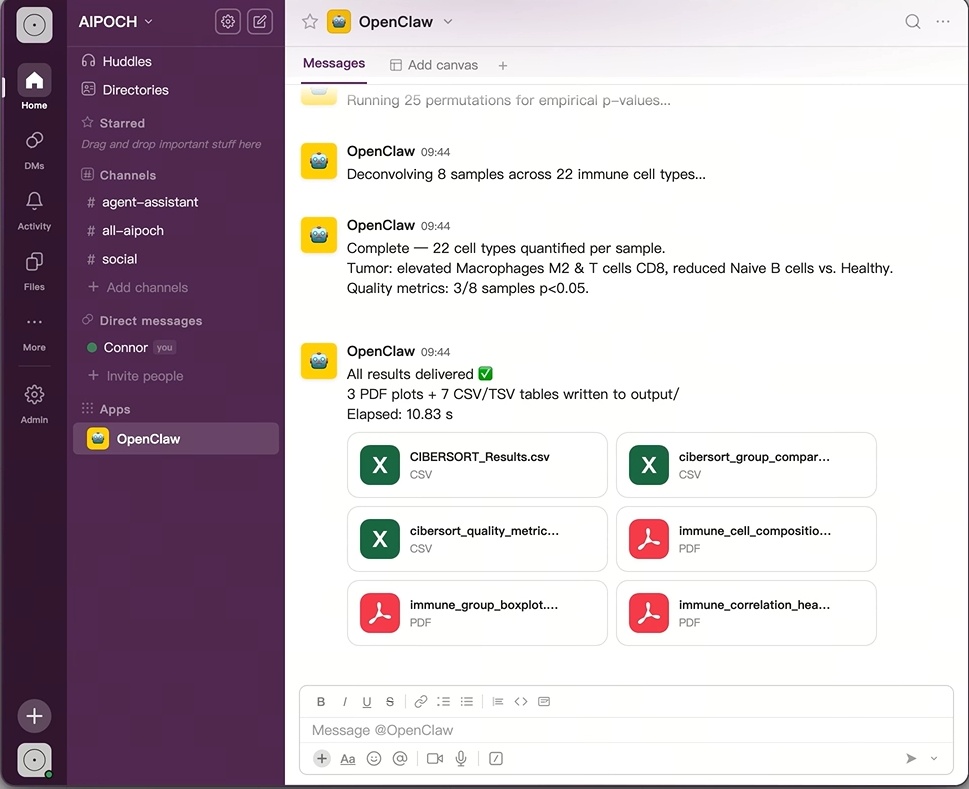
The generated outputs include:
- CIBERSORT_Results.csv
- cibersort_group_comparison.csv
- cibersort_quality_metrics.csv
- immune_cell_composition.pdf
- immune_group_boxplot.pdf
- immune_correlation_heatmap.pdf
This case study demonstrates how AI agents can streamline immune infiltration analysis through an automated and reproducible transcriptomics workflow, reducing manual bioinformatics effort while generating structured research-ready outputs.
Conclusion
CIBERSORT-style immune infiltration analysis often involves repetitive preprocessing, cohort organization, deconvolution execution, and visualization workflows. AI agents can help operationalize these steps into structured and reproducible execution pipelines that generate immune fraction estimates, statistical summaries, and workflow-ready outputs more efficiently.
AIPOCH provides Medical Research Agent Skills designed for AI-assisted research workflows across evidence synthesis, protocol design, data analysis, and academic writing tasks. The CIBERSORT Immune Infiltration Analysis skill represents one example of how AI agents can help researchers organize and execute complex transcriptomic workflows more consistently across large-scale research projects.
Disclaimer
This content is intended for informational purposes only and does not constitute medical advice, clinical guidance, diagnostic recommendations, treatment decisions, publication acceptance recommendations, or formal scientific peer review outcomes.
AIPOCH agent skills are intended to support researchers, not replace human scientific judgment, domain expertise, institutional review processes, or editorial decision-making.
Researchers should independently verify all outputs, evidence interpretations, annotations, citations, manuscript revisions, and scientific conclusions before use in academic, clinical, regulatory, or publication settings.