FastQC Report Interpretation: How AI Agent Skills Help Interpret FastQC Reports?
Learn how AI agent skills support FastQC report interpretation for NGS quality control analysis. Discover how the AIPOCH FastQC Report Interpreter helps researchers analyze FastQC quality metrics, identify sequencing QC issues, and organize RNA-seq, DNA-seq, and ChIP-seq quality assessment workflows.
Learn how AI agent skills support FastQC report interpretation for NGS quality control analysis. Discover how the AIPOCH FastQC Report Interpreter helps researchers analyze FastQC quality metrics, identify sequencing QC issues, and organize RNA-seq, DNA-seq, and ChIP-seq quality assessment workflows.
According to the official FastQC documentation, FastQC is a widely used quality control tool for high-throughput sequencing data. It generates modular QC reports that help researchers evaluate sequencing quality before downstream bioinformatics analysis.
As sequencing projects grow in scale, manually reviewing FastQC outputs across multiple samples and sequencing runs can become repetitive and difficult to standardize. Researchers often need to compare multiple QC modules, identify potential sequencing artifacts, and determine which quality issues require additional investigation.
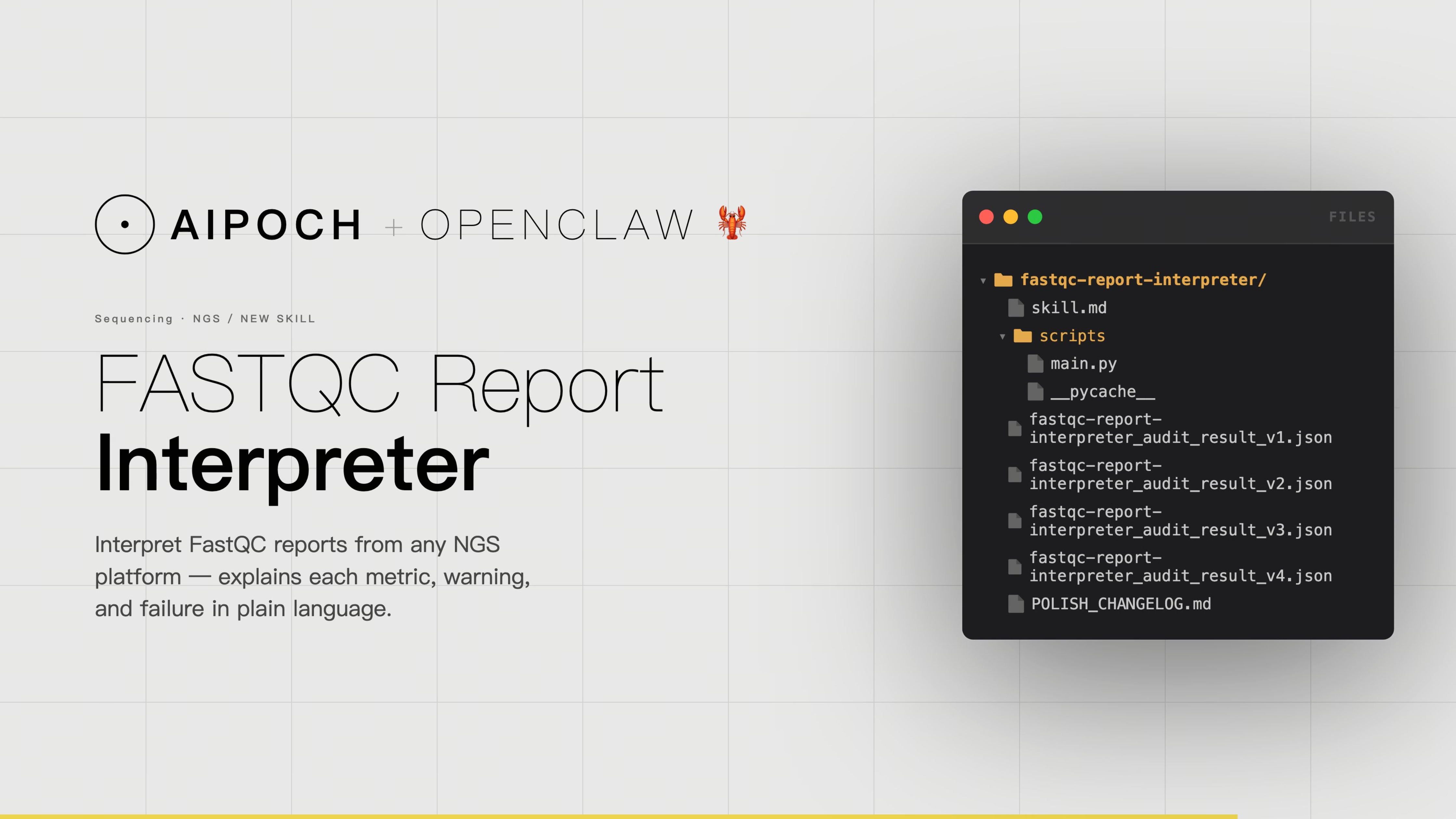
The FastQC Report Interpreter from AIPOCH is an AI agent skill designed to analyze FastQC quality control reports for Next-Generation Sequencing (NGS) data to assess data quality and identify issues.
What the FastQC Report Interpreter Skill Does
The FastQC Report Interpreter is an AI agent skill designed to help researchers review FastQC quality control reports for Next-Generation Sequencing (NGS) data. The skill can be used when reviewing FastQC reports, analyzing sequencing QC metrics, or troubleshooting quality concerns in NGS datasets. It helps interpret sequencing quality metrics and generates structured QC recommendations for RNA-seq, DNA-seq, and ChIP-seq quality assessment workflows.
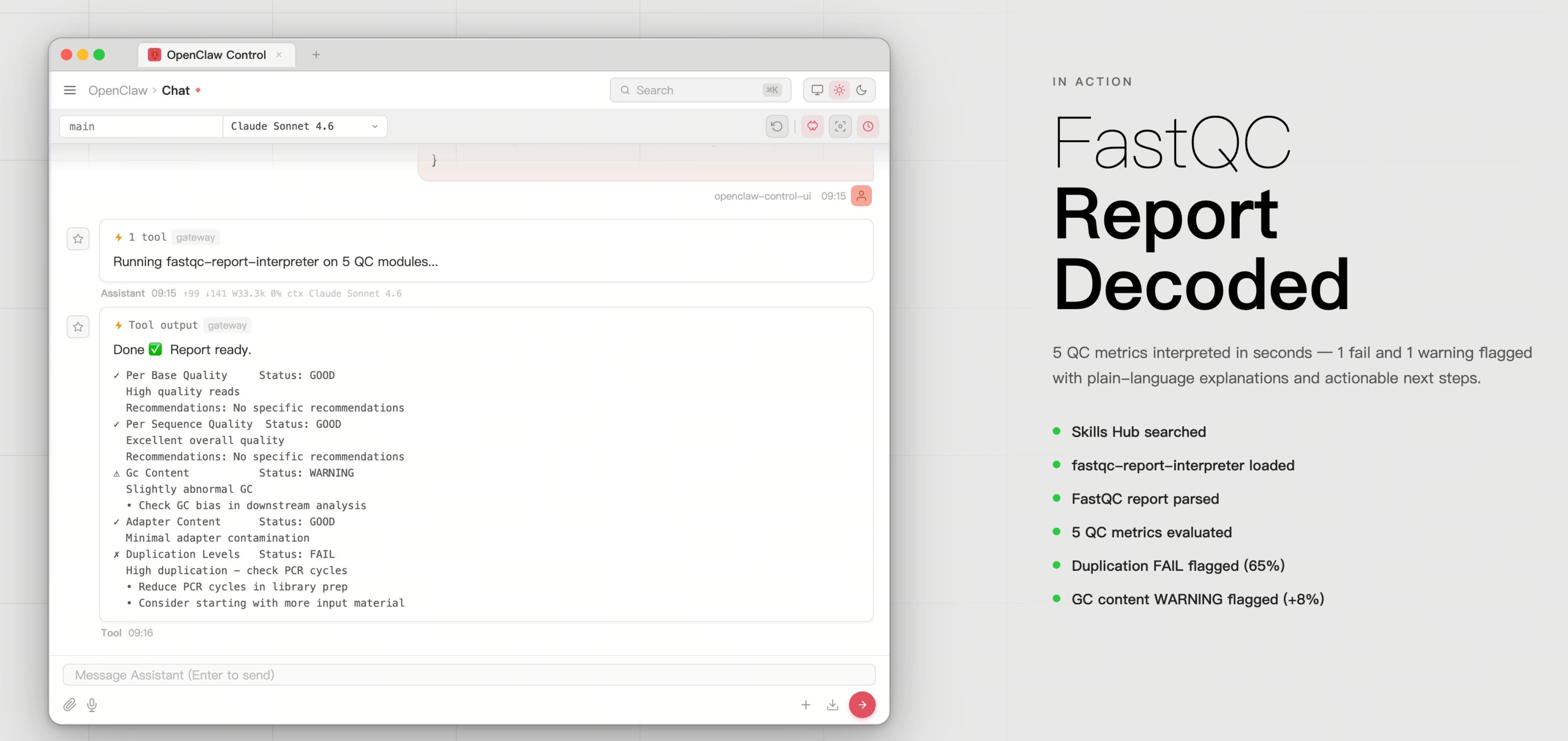
FastQC Report Interpreter Workflow Demo
Analyze FastQC quality control reports for Next-Generation Sequencing (NGS) data to assess data quality and identify issues.
Core Capabilities Of the FastQC Report Interpretation Skill
- Quality Metrics Analysis
- Sequencing QC Issue Detection
- Batch-Level QC Organization
- Structured Recommendation Generation
Step-by-Step Skill Workflow
The FastQC Report Interpreter follows a structured execution workflow for FastQC report interpretation.
- Confirm the user objective, required inputs, and non-negotiable constraints before doing detailed work.
- Validate that the request matches the documented scope and stop early if the task would require unsupported assumptions.
- Use the packaged script path or the documented reasoning path with only the inputs that are actually available.
- Return a structured result that separates assumptions, deliverables, risks, and unresolved items.
- If execution fails or inputs are incomplete, switch to the fallback path and state exactly what blocked full completion.
Explore More AIPOCH Medical Research Skills
The FastQC Report Interpreter is part of the broader AIPOCH Medical Research Skills Library. The library is primarily organized into five categories: Evidence Insights, Protocol Design, Data Analysis, Academic Writing, and Others.
The full open-source skill collection is also available on GitHub:
AIPOCH Medical Research Skills GitHub Repository
If you find this repository useful, consider giving it a star! ⭐ It helps more researchers discover Medical Research Agent Skills and supports the continued development of this library.
Conclusion
FastQC review is an important step in sequencing quality control workflows, particularly for RNA-seq, DNA-seq, and ChIP-seq projects involving large sample batches. As sequencing datasets continue to grow, manually reviewing QC reports across multiple runs can become increasingly repetitive and difficult to standardize.
AI-assisted interpretation workflows such as the AIPOCH FastQC Report Interpreter may help researchers organize sequencing QC review processes more efficiently by summarizing quality metrics, flagging potential quality concerns, and supporting structured FastQC assessment workflows.
Disclaimer
This AI-assisted content is intended for informational purposes only and does not constitute medical advice, clinical guidance, diagnostic recommendations, treatment decisions, publication acceptance recommendations, or formal scientific peer review outcomes.
AIPOCH agent skills are intended to support researchers, not replace human scientific judgment, domain expertise, institutional review processes, or editorial decision-making.
Researchers should independently verify all outputs, evidence interpretations, annotations, citations, manuscript revisions, and scientific conclusions before use in academic, clinical, regulatory, or publication settings.