How to Frame a Research Question With AI Assistance
Vague research ideas slow down literature search, study design, and evidence synthesis. See how the AIPOCH Clinical Question Clarifier agent skill helps researchers convert early-stage ideas into bounded, searchable, and testable questions.
A large share of biomedical research workflows stall before a single paper is read. The bottleneck is not data access or analytical capacity — it is question definition. Researchers frequently begin with a direction, a disease name, or a rough phenomenon, and spend hours manually narrowing that into a form precise enough to run a literature search, design a study, or brief a collaborator.
This is where the AIPOCH Clinical Question Clarifier fits into the workflow. The skill can assist researchers in converting a vague, over-broad, or partially formed clinical or biomedical research idea into a clearly bounded, searchable, and testable question — structured and ready for downstream tasks such as literature retrieval, evidence synthesis, gap analysis, or protocol planning.
The scale of the underlying problem is significant. As of March 2025, PubMed indexes more than 40 million citations and abstracts, with close to one million new records added each year. In some subfields, annual publication counts now exceed half a million articles — more than 1,300 new papers every single day. A researcher entering a literature database with a poorly defined question wastes significant review time — pulling irrelevant records, missing relevant ones, and generating fragmented evidence maps that are difficult to act on. Before retrieval, before protocol design, and before gap analysis, there is the simpler but frequently neglected task of deciding what the actual research question is.
Why This Task Matters?
Question framing is one of the most repeated, least automated steps in biomedical research. Whether a researcher is preparing a systematic review, designing a clinical study, or planning a new research project, the process almost always begins with a question — and that question almost always needs refinement before it becomes operationally useful.
The operational pain points researchers encounter repeatedly include:
- Questions too broad to search efficiently
- Questions that mix multiple question types without identifying the dominant one
- Missing boundary definitions — no population stage, no outcome specification, no comparator
- Framing models applied out of habit rather than fit
Each of these problems, left unresolved, forces researchers to restart their literature workflow or redesign their study approach mid-process.
What This Agent Skill Does?
The Clinical Question Clarifier clarifies a vague clinical or biomedical research idea into a structured, bounded, searchable, researchable, and testable question. The skill can assist researchers with:
- Classifying the question type: treatment, diagnosis, prognosis, risk/exposure, causality, mechanism, implementation, translational, or exploratory.
- Detecting missing or underspecified elements: population, disease stage or subtype, exposure/intervention, comparator, outcome, timeframe, setting, subgroup, ,evidence goal, and intended use-case.
- Selecting the best-fit framing model by question type — PICO, PECO, mechanistic framing, diagnostic framing, prognostic framing — rather than defaulting to one framework for all inputs
- Generating three clarified question versions: a plain-language clarified question, a research-ready question, and a searchable version for literature retrieval.
- Assessing answerability and next step: Assessing whether the resulting question is currently searchable, researchable, and testable, more suitable for evidence review, gap analysis, study design, or protocol development.
The skill also supports a guided focusing mode for particularly broad inputs, asking the researcher a small set of high-yield narrowing questions before producing a final formulation. In all cases, the skill provides structured outputs for researchers to review — it does not independently validate scientific conclusions or replace researcher judgment.
You can download the Clinical Question Clarifier directly from the AIPOCH Skill Library, or explore all available agent skills on GitHub.
Workflow Execution Example
A full workflow demo:
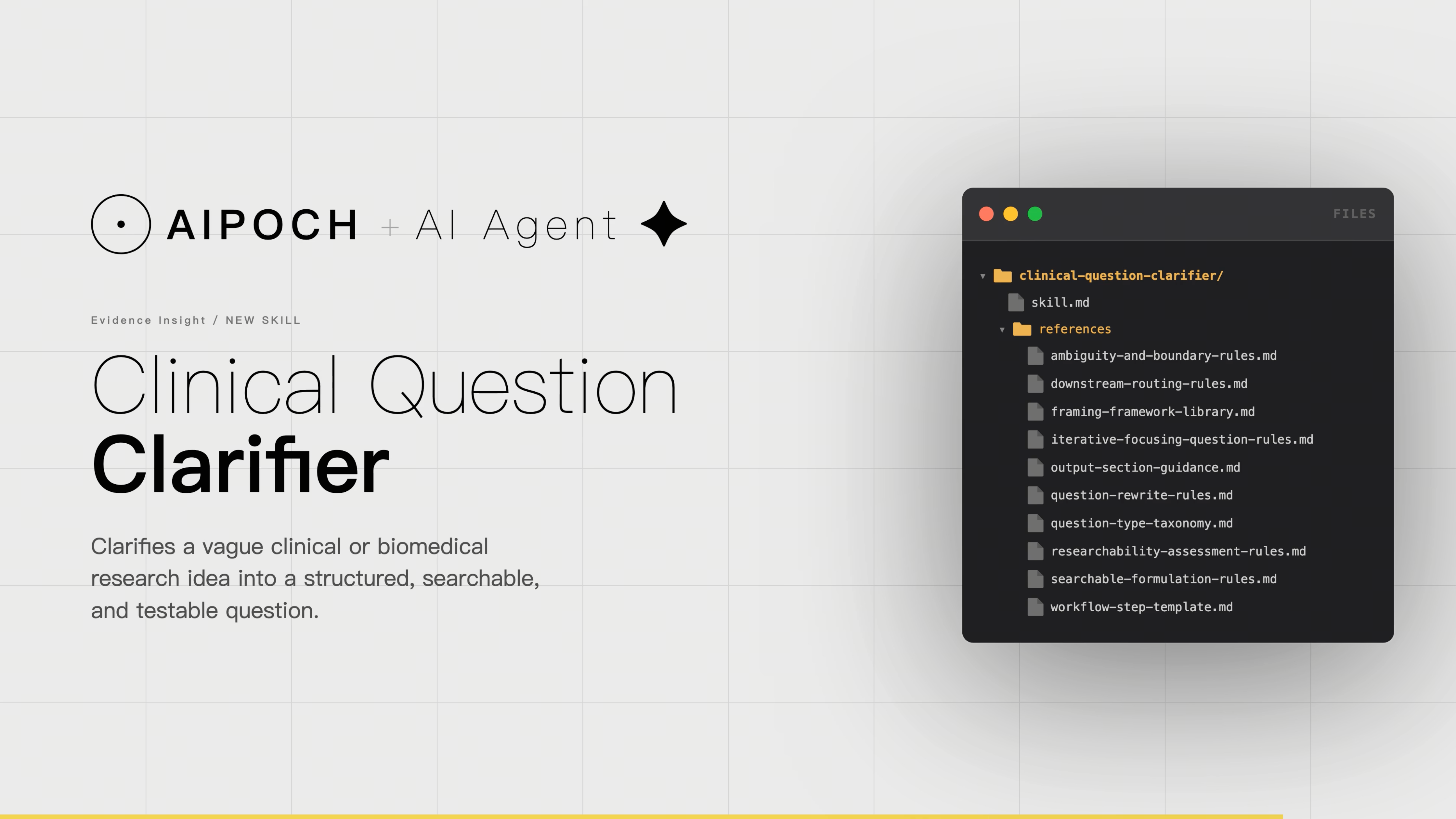
The input was a single informal sentence about lupus single-cell research — the kind of early-stage idea a graduate student or early-career researcher might bring to the start of a project.
The researcher submits one sentence:
"I want a proper research question for lupus single-cell work."
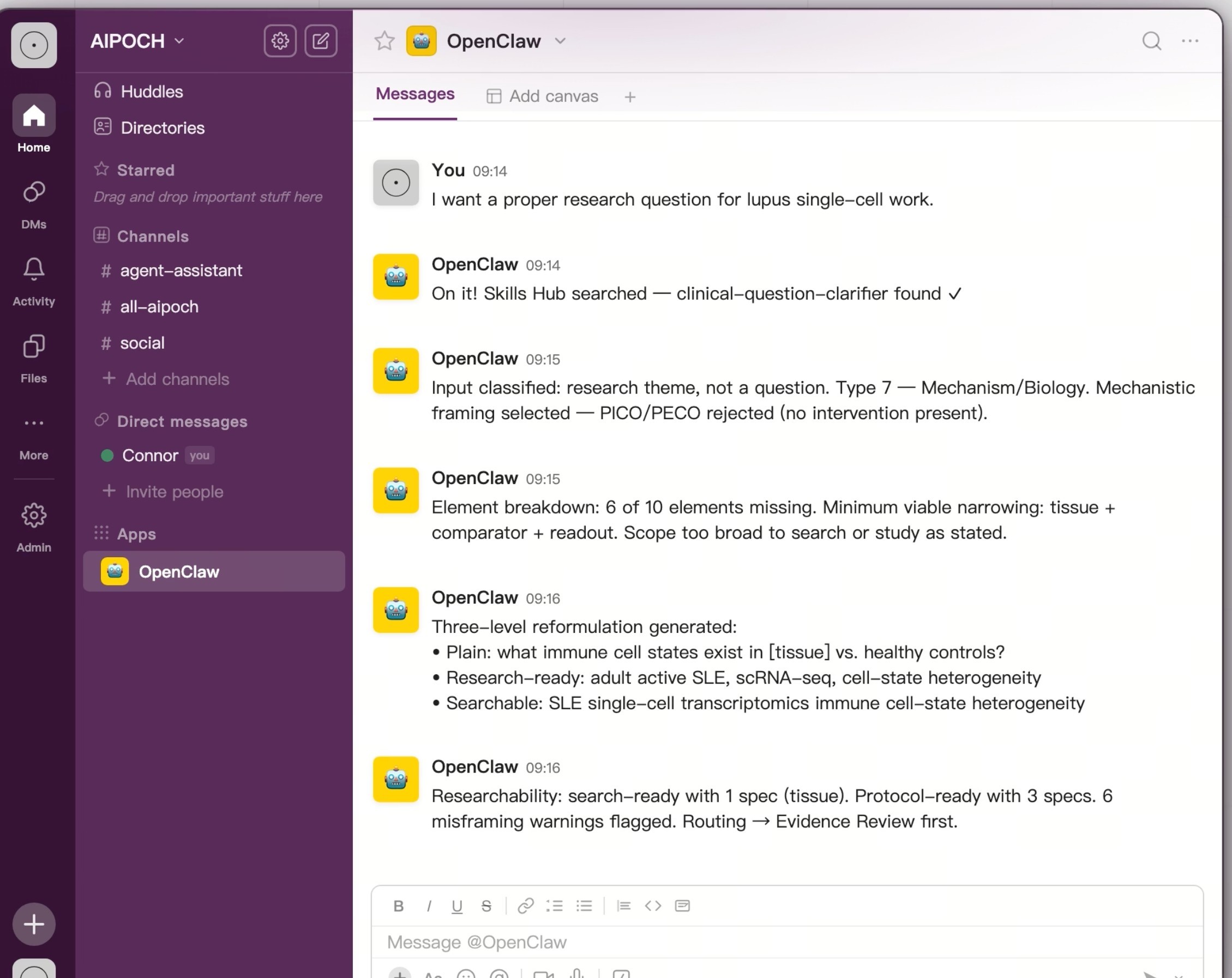
No structured framing, no defined population, no specified outcome. This represents the starting point for a large share of real early-stage research conversations.
AI agent searches its Skills Hub, matches the input to the AIPOCH Clinical Question Clarifier, and begins processing.
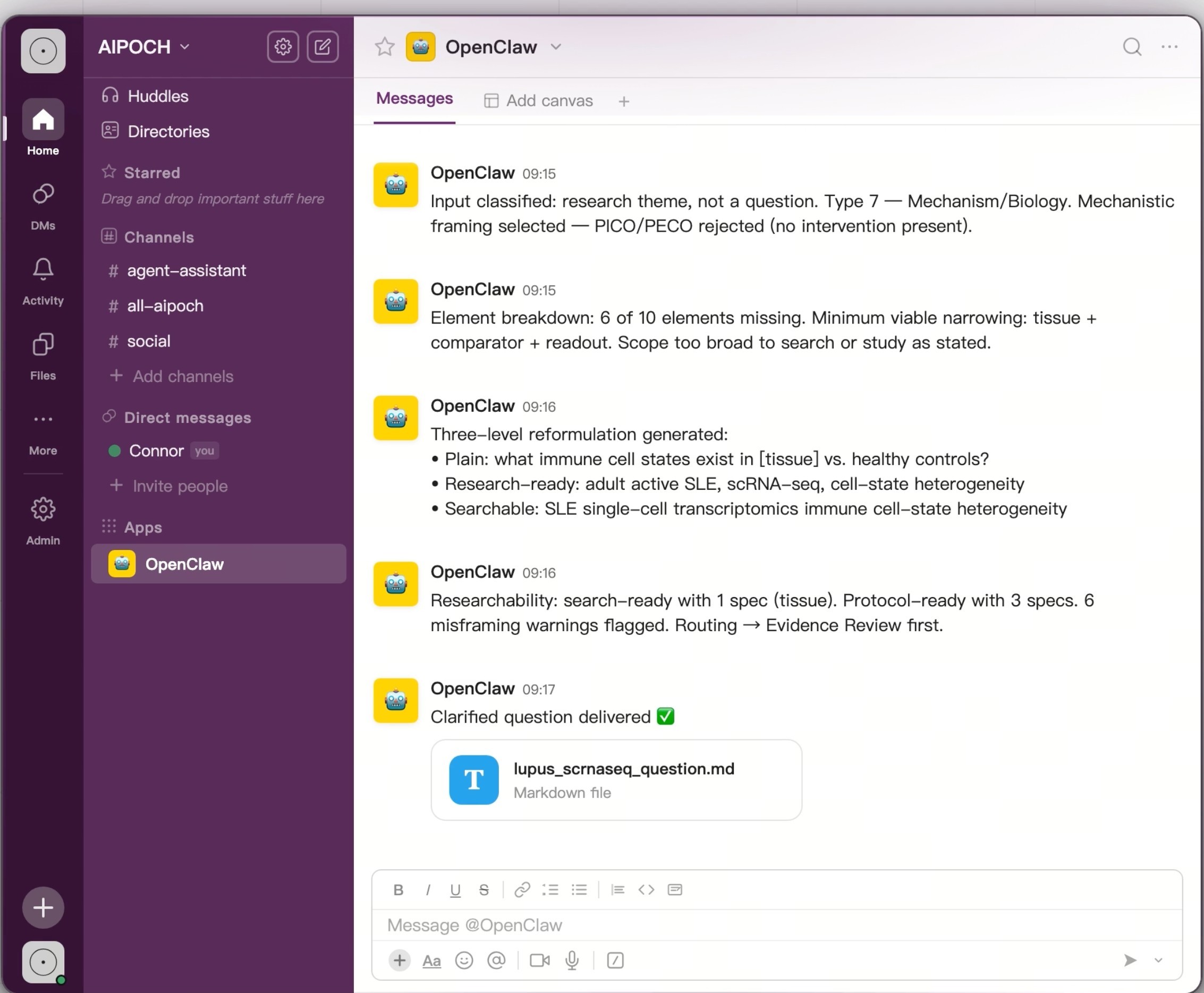
AI agent delivers the full structured output as a downloadable lupus_scrnaseq_question.md file.
Who Can Benefit From This Skill
The skill is most useful at the start of a research workflow — before literature retrieval, before study design, and before protocol planning — whenever question definition is the active bottleneck.
Conclusion
The Clinical Question Clarifier addresses a specific, recurring operational problem in biomedical research: the gap between an early-stage research idea and a question structured enough to act on. By providing classification, ambiguity detection, framing model selection, and multi-format question formulations, the skill can help researchers reduce the manual effort spent on question reformulation before any search or analysis workflow begins.
Disclaimer
This content is intended for informational purposes only and does not constitute medical advice, clinical guidance, diagnostic recommendations, treatment decisions, publication acceptance recommendations, or formal scientific peer review outcomes.
AIPOCH agent skills are intended to support researchers, not replace human scientific judgment, domain expertise, institutional review processes, or editorial decision-making. Researchers should independently verify all outputs, evidence interpretations, annotations, citations, manuscript revisions, and scientific conclusions before use in academic, clinical, regulatory, or publication settings.