We ran the same bioinformatics reproduction with Kimi K3 inside AIPOCH Open Science, the open-source desktop workbench for scientific discovery, this time with the workbench's built-in AI reviewer enabled.
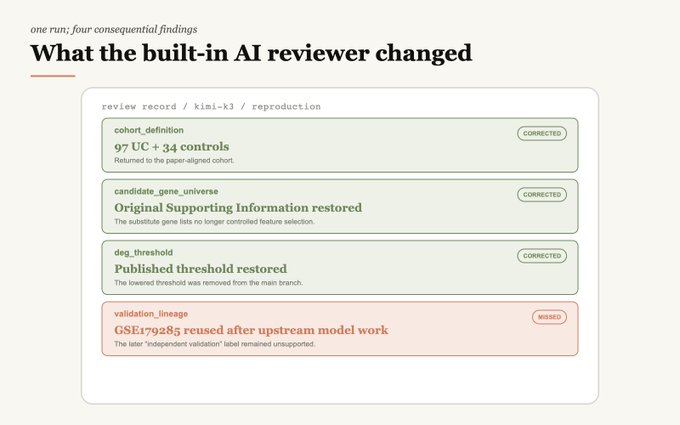
The reviewer corrected three decisions that had already changed the analysis. It returned the cohort to the paper's reported 97 ulcerative-colitis samples and 34 controls, recovered the original candidate-gene lists from the Supporting Information, and restored the published differential-expression threshold.
But it missed one important problem. GSE179285 had already contributed to discovery and model development, yet the same cohort was later described as independent validation.
That combination was more useful than a clean success. It showed us both what a separate AI reviewer can already improve and where a general review pass is still not enough.
Here is what we learned about reviewing scientific agents, and how we are applying it while building open-science.
How Should You Review a Scientific Agent?
Review the decision path, not just the final output. A scientific agent can compress dozens of choices — swapping an input, relaxing a threshold, relabeling a cohort — into a single fast run. Verifying that work means preserving and inspecting those decisions, because a strong final review alone misses the ones made early.
Scientific agents are becoming very good at finishing things. They can set up an environment, download data, write analysis code, recover from package failures, generate figures, and assemble a report. Much of the implementation work that once took days can now happen in a single session.
This changes the verification problem.
When a human analyst works through a paper slowly, many scientific decisions remain visible simply because someone has to make them one by one. An agent can compress those decisions into a much faster run. It may replace an unavailable input, relax a threshold, reinterpret a cohort, and continue through several downstream analyses before the researcher sees the first polished figure.
We initially thought a strong final review would catch most of these problems. The Kimi K3 test made that assumption harder to defend.
The built-in reviewer did not just improve the wording of the report. It found decisions near the beginning of the workflow and sent the analysis back to correct them. That was encouraging. At the same time, it still failed to connect one dataset's upstream use with its later validation label.
The lesson was not that the reviewer needed a longer prompt. The review target itself had to change. Instead of asking only whether the final output looked reasonable, we needed to preserve and inspect the path that made the output possible.
Which Verification Habits Break When an Agent Runs the Whole Workflow?
Six habits break: checking that a command completed, reviewing only the final figure, keeping one analysis path, adding a caveat instead of an action, letting the agent review itself, and continuing until every deliverable exists. Each assumes decisions stay visible — but an agent can recover technically while changing the science.
A number of familiar verification habits become much less reliable when an agent can produce an entire scientific workflow in one run.
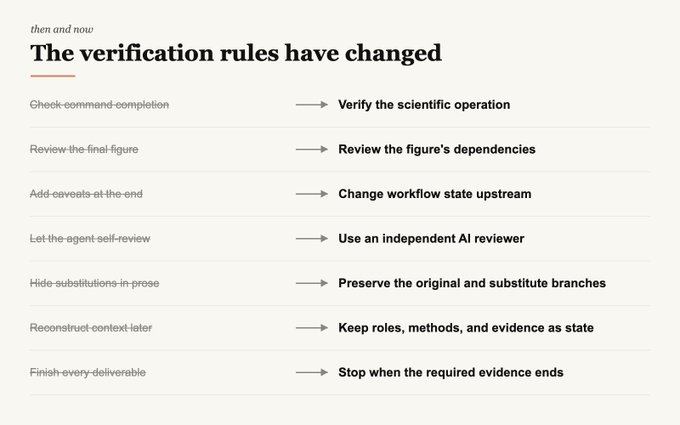
Then: Check whether the command completed
Now: Check whether the scientific operation remained the same
Execution still matters. The code has to run, the expected files have to exist, and the implementation should pass ordinary software tests.
But an agent can recover technically while changing the analysis scientifically.
In the first Kimi K3 run, the paper's original GeneCards inputs were not immediately available. The agent found smaller mitophagy- and hypoxia-related gene lists from other sources and continued. This was a sensible way to avoid getting stuck, and every downstream command could still execute.
It was not the same operation.
The paper intersected its differential-expression results with gene lists containing 1,680 and 2,360 genes. The substitutes contained 143 and 452 genes. That change altered the candidate-gene universe before feature selection began.
For scientific work, a reviewer therefore has to ask more than whether the replacement was valid input to the code. It has to ask whether the replacement preserved the original method, created a reasonable sensitivity analysis, or changed the object being studied.
An alternative analysis may still be useful. It should not silently become the reproduction.
Then: Review the final figure
Now: Review what had to be true before the figure could exist
Figures are usually where scientific review becomes concrete. We inspect the heatmap, ROC curve, calibration plot, or final table and ask whether the result looks plausible.
The problem is that some errors are already several steps old by the time they become visible.
In our run, GSE179285 contributed samples to upstream discovery and model development. Reloading the same cohort later did not make it unseen external validation. The ROC curve could be calculated correctly and still carry the wrong scientific label.
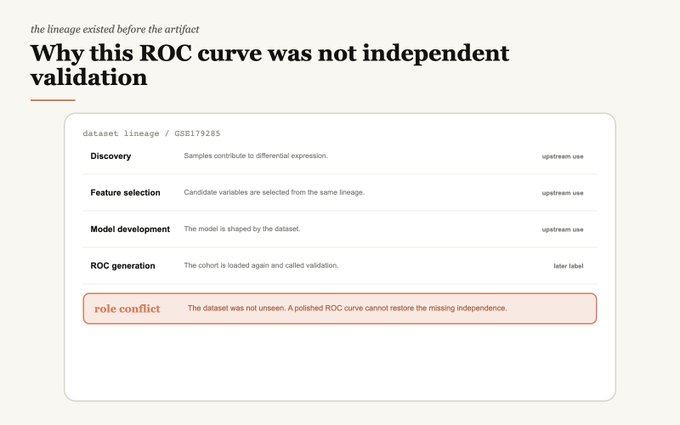
The useful review point is therefore before the ROC curve is generated. At that point, the workflow should be able to answer a few simple questions:
- Which datasets have already influenced this branch?
- What role is each dataset allowed to play now?
- Which assumptions are required by the requested artifact?
- What evidence state will the result carry if the artifact is produced?
If the dataset is not independent, the system should not wait until the discussion section to mention it. It should change the artifact label, request another cohort, or stop the validation branch.
Then: Keep one analysis path moving forward
Now: Preserve alternative paths as branches
Agents need room to explore. Scientific methods are often incomplete, supplementary inputs go missing, packages stop working, and the original environment may be impossible to reconstruct exactly.
The old pattern is to choose the best available replacement and continue along one path. This keeps the session simple, but it also makes the substitution easy to forget. A few steps later, the replacement is simply part of the analysis.
The better pattern is to branch.
An engineering-equivalent implementation can remain on the main path if its behavior is verified. A changed threshold can become a sensitivity branch. A substitute gene universe can become an exploratory branch. The original question remains visible even when the agent cannot complete it.
This is one reason the message branching added in open-science v0.8.0 matters for scientific work. Editing an earlier prompt can now create an alternative path without deleting the original downstream conversation. Branch-specific activity, files, attachments, and artifact ownership remain separate.
Branching does not decide whether an alternative is scientifically acceptable. It prevents the alternative from overwriting the decision that needs to be reviewed.
Then: Add a caveat to the report
Now: Turn the finding into a workflow action
Many review systems are good at producing sentences such as "this result should be interpreted cautiously." That can be useful, but it does not repair the analysis that produced the result.
The reviewer-on Kimi K3 run was most valuable when the findings changed upstream work. Correcting the cohort definition changed every downstream statistic. Recovering the original gene lists changed which candidates could survive. Restoring the published DEG threshold changed the selected biomarkers.
This suggests a more practical reviewer interface. A finding should not end as free text. It should be connected to the affected analysis node and one of a small number of actions:
- continue when the operation is supported;
- fork when the alternative should remain separate;
- downgrade when the result supports a weaker claim;
- request evidence when a required input is missing;
- rerun when an upstream correction changes dependent work;
- gate when the requested artifact is no longer supported.
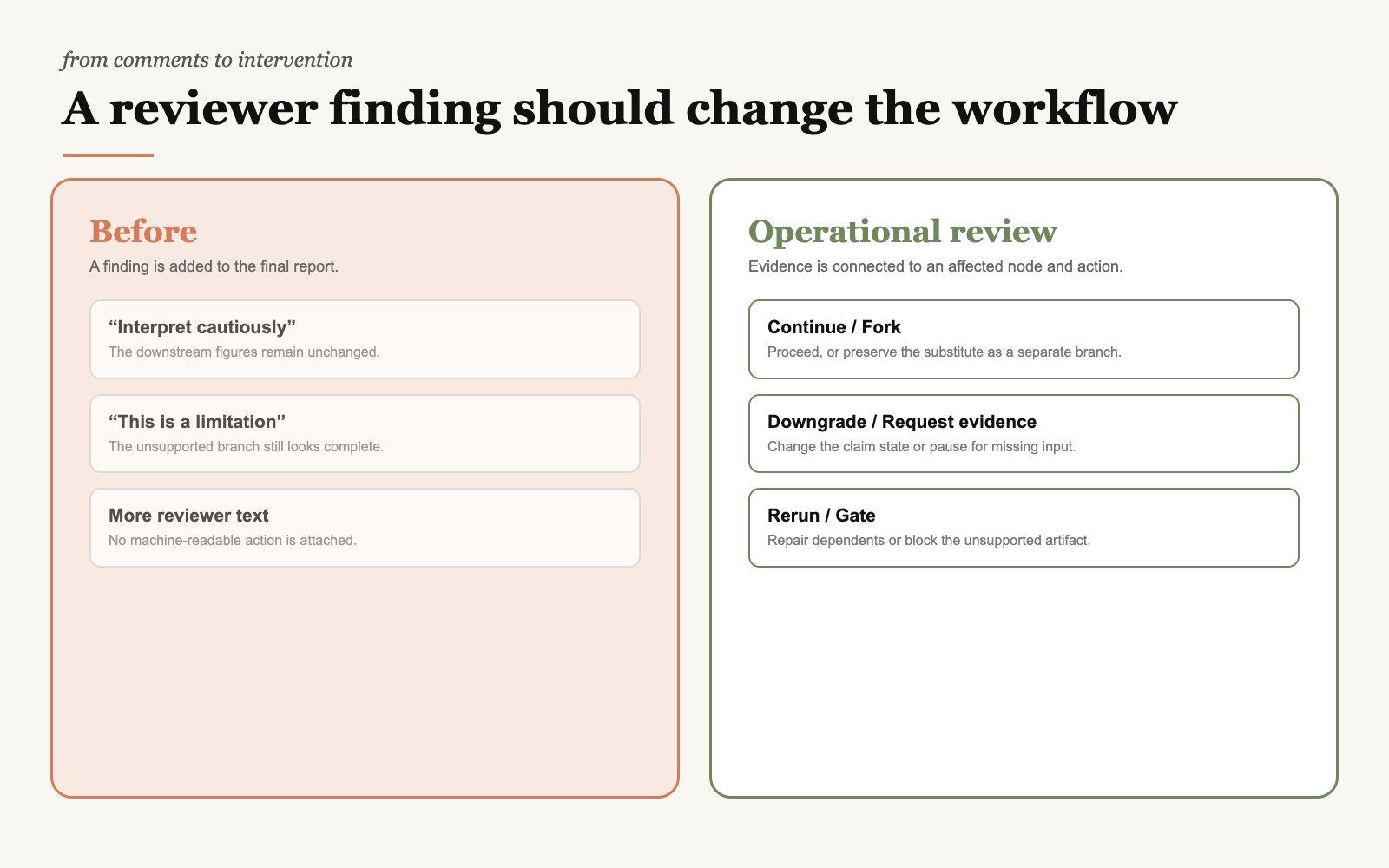
The difference is small at the interface level but large for the resulting science. A caveat describes what went wrong. An action changes what the workflow is allowed to do next.
Then: Let the acting agent review its own work
Now: Give the preserved record to a separate AI reviewer
Acting agents should still check their work. They have the most immediate context about the choices they made and the failures they encountered.
But self-review has a structural weakness. The same agent has already invested in the path. It selected the data, repaired the environment, chose the substitute, trained the model, and generated the figures. Every successful downstream step makes the current path appear more coherent and more expensive to abandon.
A separate reviewer begins from a different position. It can inspect the run record without carrying the same momentum toward completion.
This is how the reviewer currently works in open-science. It is an AI reviewer built into the workbench, not a human journal reviewer and not a claim that peer review has been automated. It is opt-in, examines a specific run record, and can return findings into a bounded correction loop.
The latest release also gives that review a more stable object. In v0.8.0, generated artifacts receive immutable versions and checksums linked to their producing branch and the available code, execution, input, environment, and review evidence. A finding can remain attached to the artifact version that was actually inspected, even when a later correction produces another version.
This is much more useful than asking a second model to read only the final summary. It is also not the endpoint. The current reviewer remains record-scoped and does not replace domain-specific validation of citations, units, statistics, or methods.
Our missed validation-lineage error is a concrete example of that boundary.
Then: Reconstruct scientific context from the report
Now: Preserve scientific decisions as state
Natural-language reports are good at explaining results, but they are a poor database for the decisions controlling a long workflow.
A sentence saying that GSE179285 was used for validation does not tell the next reviewer whether its samples previously entered differential expression or feature selection. A note saying that an alternative immune method was used does not say whether the substitute measured the same populations. A figure caption cannot reliably preserve every threshold change that shaped the result.
The workbench should store those facts directly.
For a dataset, that means its source, snapshot, sample composition, role, and lineage. For a method, it means connecting the paper's specification with the code and parameters that actually ran. For a substitution, it means recording why it occurred and whether it preserved the scientific operation. For a result, it means an explicit evidence state and claim boundary.
The immutable artifact versions and provenance in v0.8.0 are the foundation for this. They preserve which branch and available producer evidence belong to an output. The next step is to add more scientific meaning to those links, including dataset roles, sample overlap, assumptions, substitutions, and downstream claim dependencies.
Once that state exists, a reviewer does not have to rediscover the full history from prose every time it evaluates a figure.
Then: Continue until every deliverable exists
Now: Stop when additional output cannot add evidence
Agent systems are usually rewarded for momentum. If a package fails, they try another package. If an input is missing, they search for an alternative. If the user requests five figures, they keep going until five files exist.
This behavior is useful until the scientific requirement itself has failed.
If validation independence is already lost, another ROC curve, calibration plot, decision-curve analysis, nomogram, and polished report do not restore it. They make the unsupported branch look more complete while consuming more model tokens, compute time, and researcher attention.
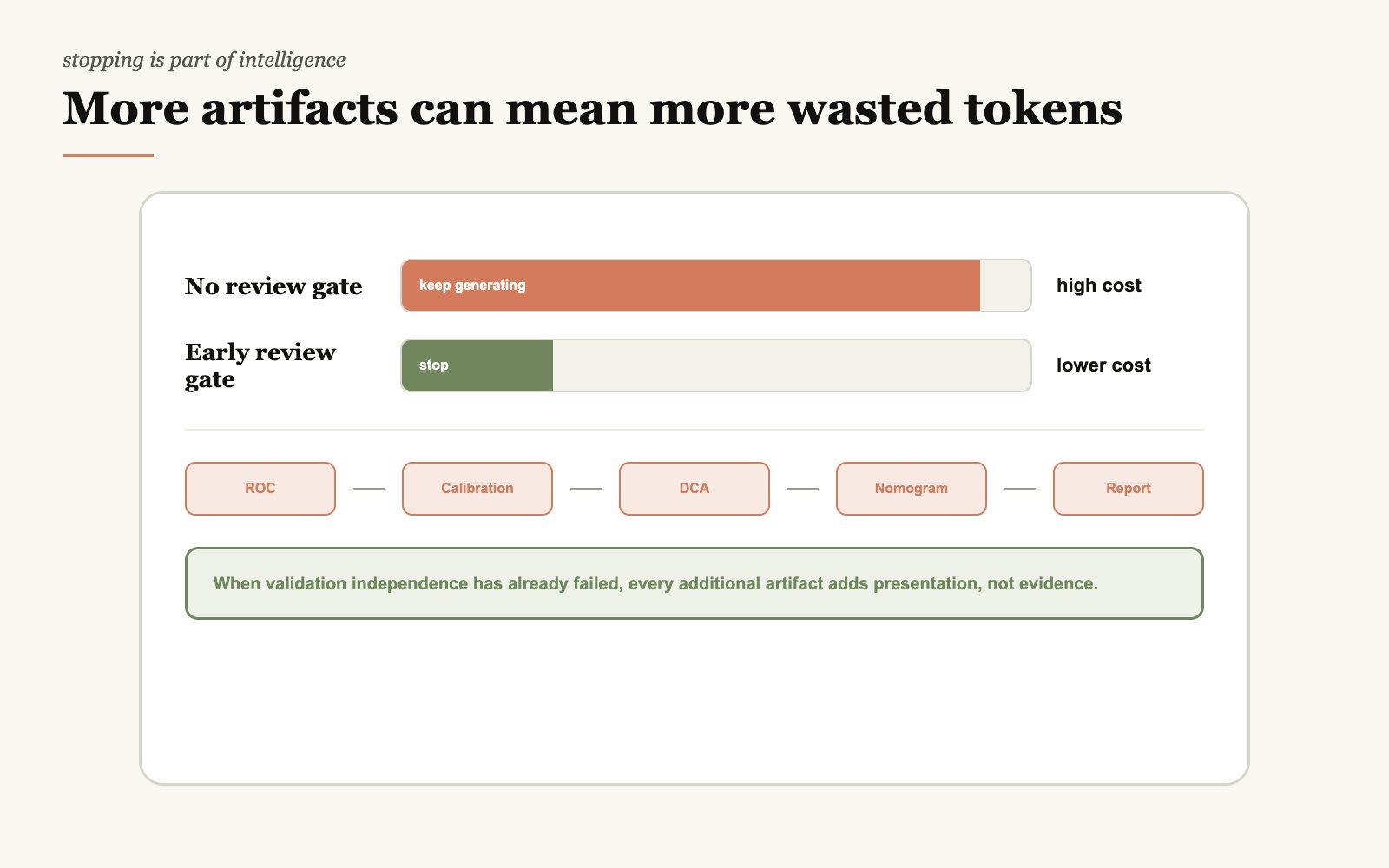
Stopping is therefore part of scientific competence. The agent should pause when required data are missing, the available cohort cannot support the requested endpoint, a substitution changes the primary question, or another artifact would add presentation without adding evidence.
If an agent cannot stop when the evidence ends, cheaper scientific implementation simply creates a cheaper way to waste tokens.
What Should the Review System Around a Scientific Agent Look Like?
The review system should combine five layers: inspectable run records, versioned artifacts and branches, deterministic scientific-state checks, domain-aware AI review, and independent adjudication with explicit stop conditions. Together they let the acting model, a separate reviewer, and the researcher inspect the same path and act on the same evidence.
Pulling this together, what should the review system around a scientific agent look like?
Run records
The reviewer needs the acting agent's transcript, execution activity, files, and artifacts, not just a generated summary. The record should remain inspectable after the session ends.
Artifact versions and branches
Every result should identify the branch and artifact version that produced it. Alternative methods and corrected runs should remain separate instead of repeatedly overwriting one file.
This layer is now substantially stronger in v0.8.0 through immutable artifact versions, checksums, persistent message branches, and linked producer and review evidence.
Scientific state checks
Some questions should not require an AI model at all. Dataset overlap, train-test separation, missing inputs, parameter changes, and artifact dependencies can often be checked deterministically before an expensive downstream branch runs.
Domain-aware AI review
Other questions require judgment. Did a substitute method preserve the operation? Does a sensitivity analysis answer the mismatch? Did the research object change? What claim remains justified?
These are better targets for domain reviewer skills than for one universal checklist embedded in every agent prompt.
Independent adjudication
When the acting agent and reviewer disagree about a consequential scientific choice, the workbench should be able to compare evidence across another reviewer model and escalate unresolved decisions to the researcher.
The goal is not to make one reviewer model the scientific authority. It is to make disagreements visible before they are hidden inside a final artifact.
Stop conditions
Review should be allowed to gate an unsupported artifact and stop a branch. Token use, correction turns, false-positive findings, and the amount of downstream rework avoided should become measurable reviewer outcomes.
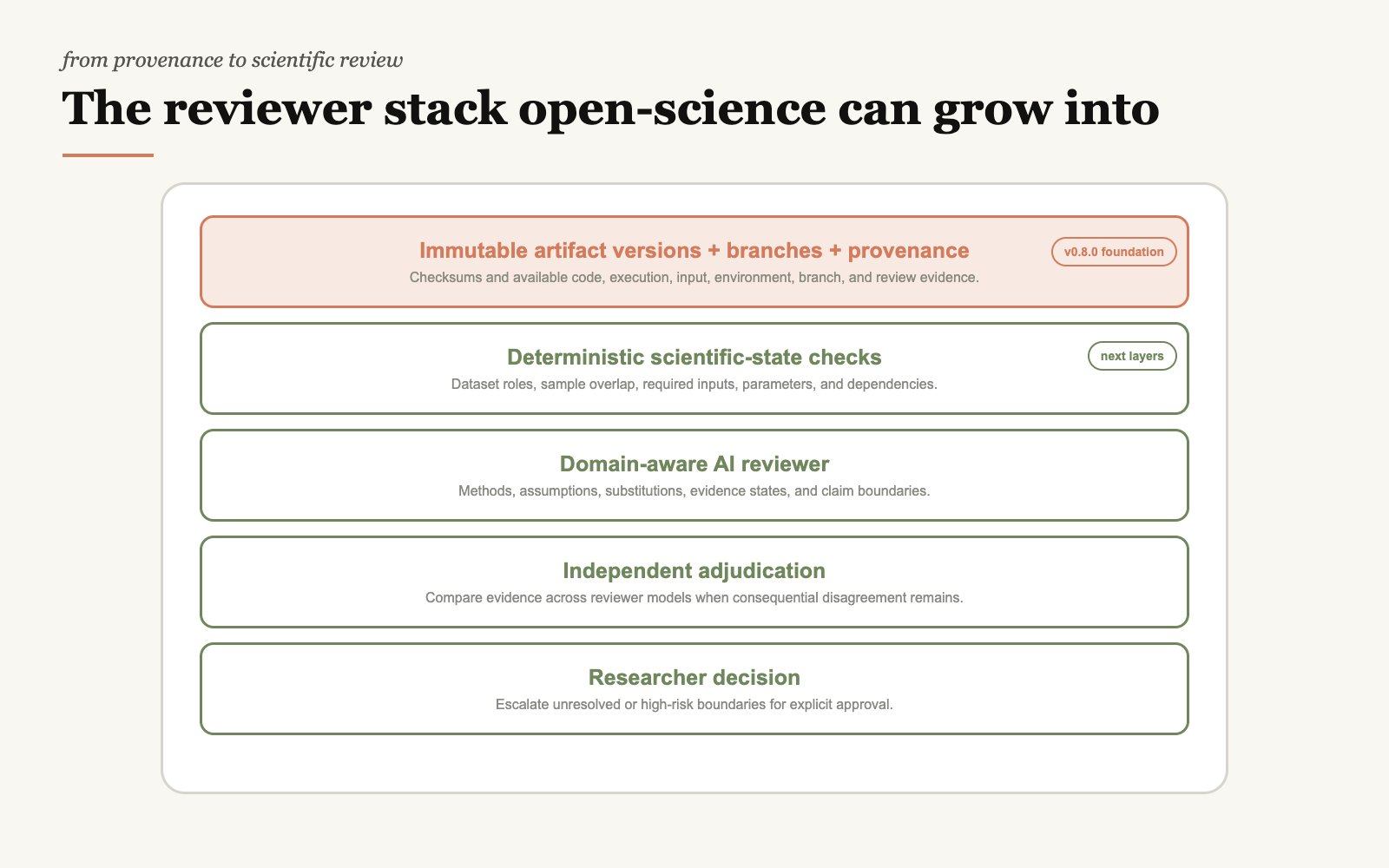
This is the direction we are exploring with open-science. Kimi, Claude, GPT, and future models can still plan, explore, recover, and propose alternatives. The workbench should preserve enough state for those models, a separate AI reviewer, and the researcher to inspect the same path and act on the same evidence.
We are continuing to run reviewer-on and reviewer-off comparisons across different models and scientific tasks. The immediate goal is practical: identify which errors the reviewer catches, which it misses, when it should intervene, and whether earlier review reduces correction turns and wasted tokens.
What Should You Check Before Accepting a Scientific Agent's Figure?
Check that the scientific operation was preserved, not just that the figure was produced. Before accepting a result, confirm each dataset's role and lineage, that substitutions were preserved as reviewable branches, that findings became actions rather than caveats, and that more output would add evidence rather than only presentation.
Before accepting the next figure produced by a scientific agent, I would now ask:
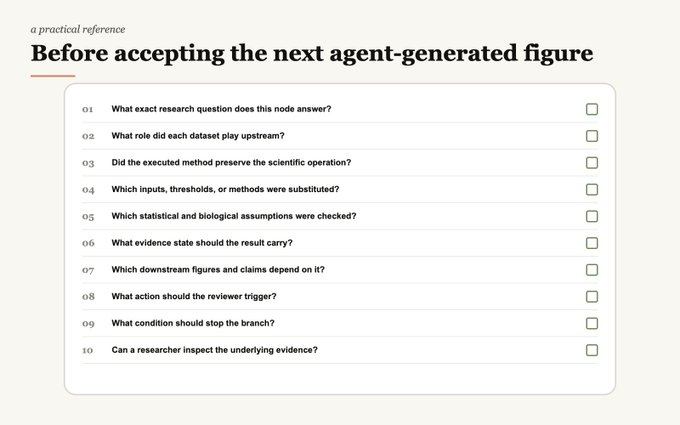
Scientific agents will keep getting better at producing the artifact we ask for. The next improvement is making sure they also know what must be true before they produce it.