Read the documentation

Open-Science
AI Research Workbench

Open-Science is an open-source, local-first, model-agnostic AI research workbench for scientific discovery. It brings coordinator and specialist agents, Python and R execution, scientific Connectors, Reviewer checks, and traceable research artifacts into one desktop workspace for macOS, Windows, and Linux.

View on GitHub
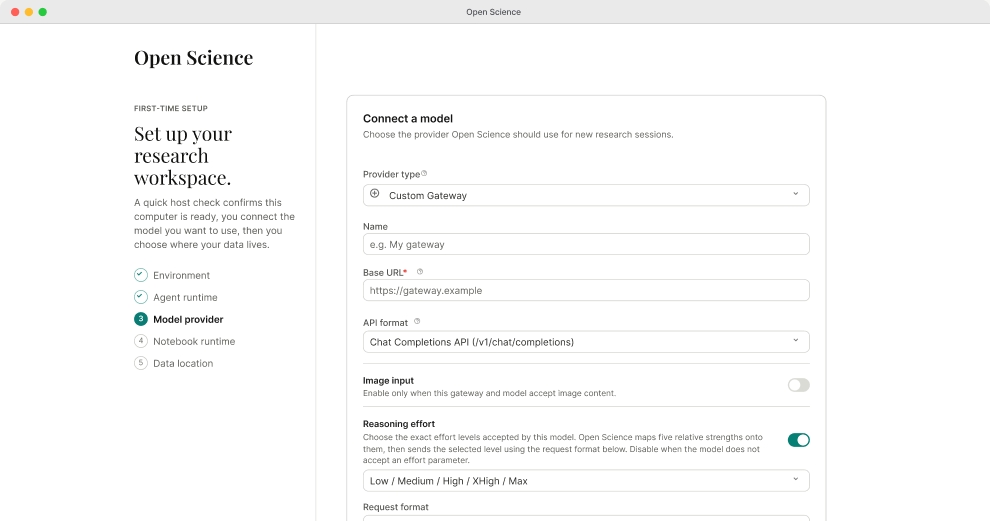
Open-Science first-time setup — connect a model to your research workspace
One workspace

One workspace from research question to traceable artifact

Open-Science keeps research questions, project files, code execution, outputs, and review evidence together inside persistent projects. Agents can continue multi-step investigations and use specialized capabilities without separating the reasoning interface from the execution environment.

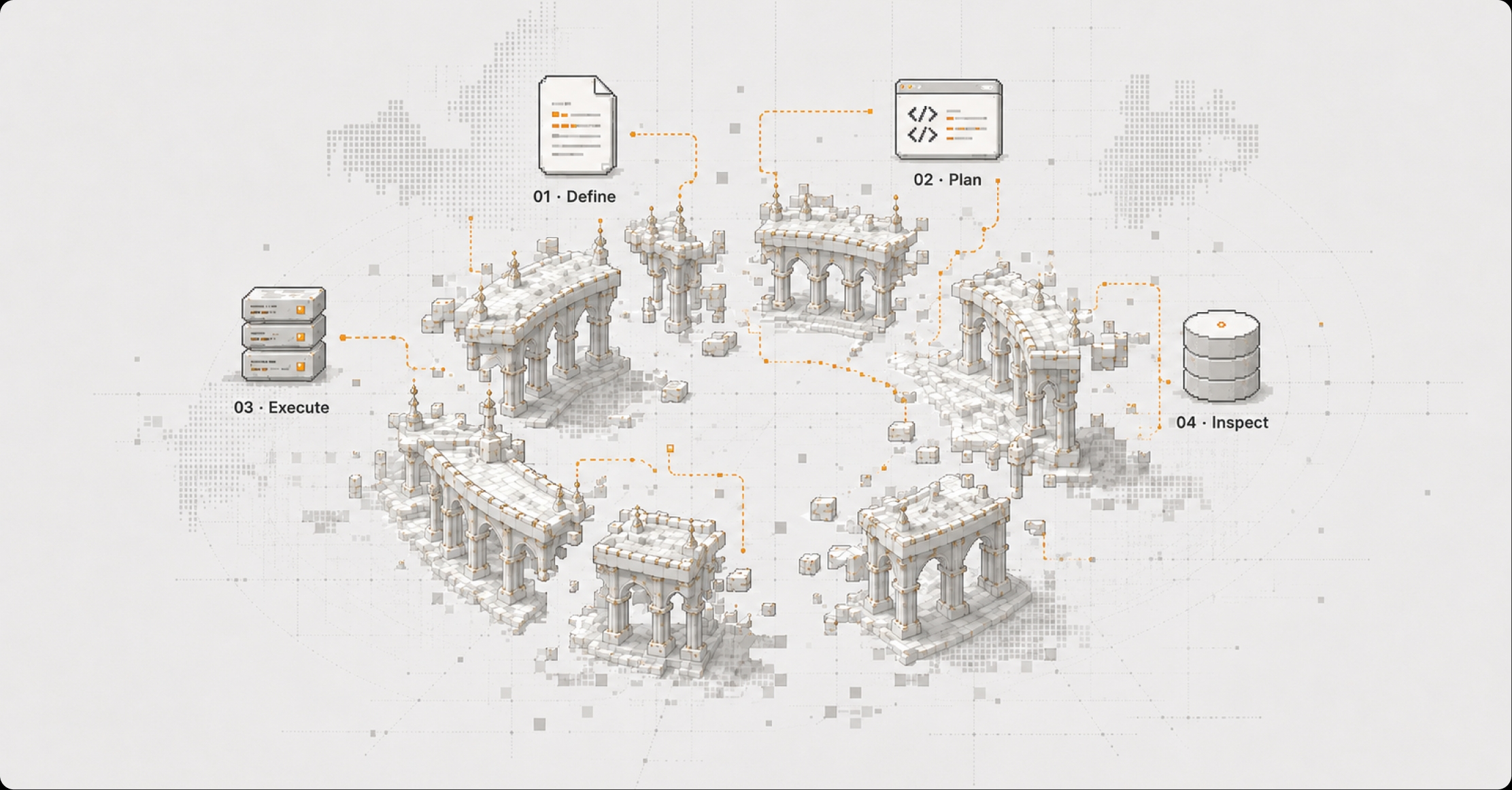
Research workflow connecting Define, Plan, Execute and Inspect
  1. Define

    Define a research question and provide the relevant files or context.

  2. Plan

    Let an AI agent plan the work and delegate scoped tasks to Specialists or subagents when appropriate.

  3. Execute

    Search approved sources, inspect datasets, and run Python, R, shell commands, or research tools.

  4. Inspect

    Create reports, tables, figures, and notebooks, then inspect them alongside execution records, provenance evidence, and optional Reviewer findings.

How it works

Research agents that can work inside the research environment

Open-Science connects agent reasoning with executable tools, scientific resources, persistent project context, and traceable outputs. The following capabilities work together inside the same research workspace.

01 · EXECUTION & COMPUTE

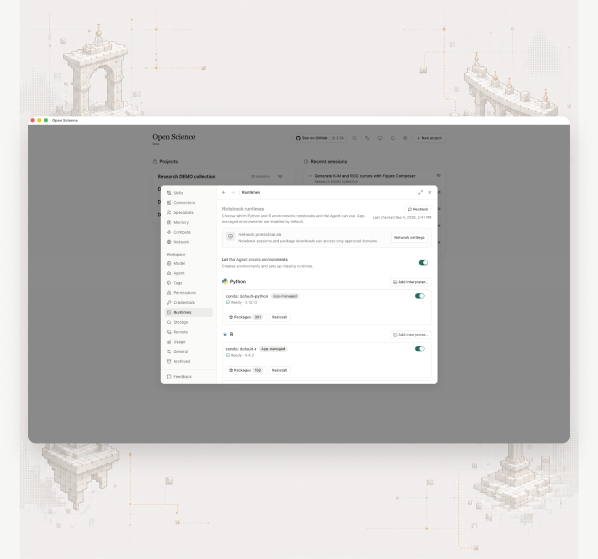
Run Python, R, shell commands, and research tools

Open-Science provides persistent Python and R kernels, stateless shell execution, and supported remote SSH compute in one research workspace.

Persistent kernels let researchers and agents maintain variables and analytical state across related steps. Shell commands support file operations, scientific tooling, and reproducible workflows, while environment and package information makes computational assumptions more visible.

When local resources are insufficient, supported SSH workflows can submit and manage research jobs on registered remote compute hosts.

  • Persistent Python and R kernels

  • Stateless shell execution with recorded history

  • Supported remote SSH compute
Run Python, R, shell commands, and research tools — Open-Science workspace

02 · SPECIALISTS, SKILLS & CONNECTORS

Extend research workflows with scoped capabilities

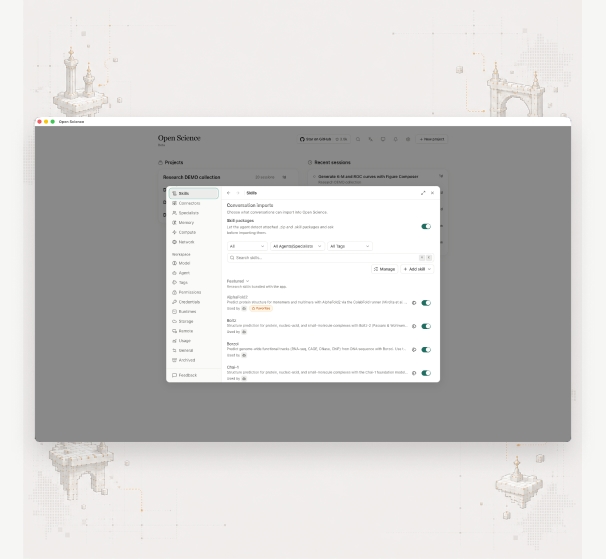
Open-Science combines Scientific Connectors, purpose-scoped Specialists, and reusable Skills so research agents can use domain-specific capabilities without bypassing workspace permissions.

  • Scientific Connectors

    Open-Science includes 24 built-in Scientific Connectors covering scientific literature, biomedical databases, genomics, chemistry, clinical research, and related resources. Connector and tool access remains governed by workspace permissions, and researchers can add compatible custom connectors.

  • Specialists

    Specialists are purpose-scoped AI agent profiles configured with selected instructions, Skills, Scientific Connectors, and permissions. The main agent can delegate scoped work to a Specialist, but Specialists cannot bypass the researcher’s permission settings.

  • Reusable Skills

    Open-Science includes featured Skills for literature review, computational biology, biomolecular modeling and design, environment and package workflows, and remote compute. Researchers can also use Personal and imported Skills through the Skills system.Manage Skills in Settings →

Extend research workflows with scoped capabilities — Open-Science workspace

03 · TRACEABILITY & REVIEW

Traceable research workflows in Open-Science

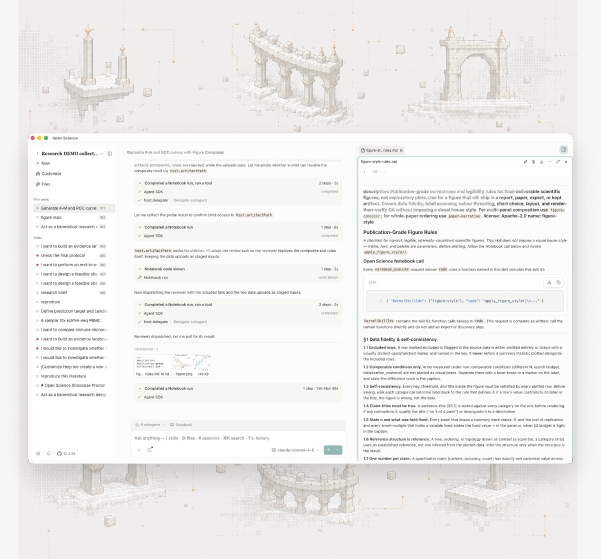
Traceability is a core design principle in Open-Science. Instead of treating reports, tables, figures, and notebooks as isolated chat outputs, the workbench preserves them as versioned research artifacts connected to the available evidence behind their creation.

  • Versioned artifacts

    Preserve changes to reports, figures, tables, notebooks, and other research outputs.

  • Provenance records

    Connect an artifact to available inputs, producer code, execution history, environment details, and the conversation branch that produced it.

  • Reviewer checks

    Compare completed agent work with available transcripts, execution records, and artifacts to identify unsupported claims, inconsistencies, or missing evidence.

  • Explicit evidence gaps

    Show when provenance information is unavailable instead of reconstructing or guessing what happened.

Traceable research workflows in Open-Science — Open-Science workspace

04 · MODELS, DATA & ACCESS

Local-first research with explicit external access

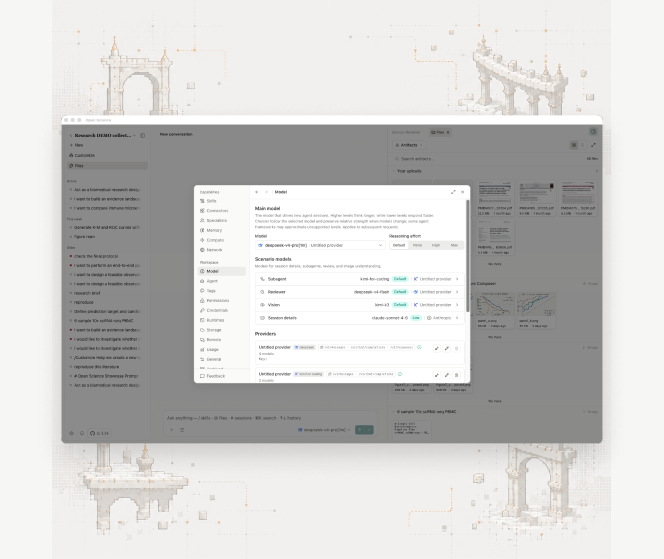
Open-Science stores project state, sessions, uploads, notebook history, and generated artifacts on the user’s computer by default. Data may leave the device when a researcher invokes a configured model provider, Scientific Connector, web search, or remote compute host. These external calls are governed by the active approval and permission settings, while provider-specific retention and training policies may still apply. Review Permissions & Runtimes before using sensitive or regulated data.

Permissions & runtimes →
Local-first research with explicit external access — Open-Science workspace

Reviewer findings and provenance records improve transparency and auditability, but they do not certify scientific correctness or replace expert validation.

Model agnostic

Can Open-Science use the latest AI models?

Open-Science supports multiple model providers and agent backends. Connect a built-in provider, a compatible custom gateway, or an eligible Claude, Codex, or xAI subscription. Available models depend on your account, selected agent backend, API protocol, region, and installed Open-Science version.

OpenAI

Codex subscription

API · Codex Subscription

Available models vary by account

xAI (Grok)

xAI (Grok) OAuth

API · OAuth

Available models vary by account

Compatible API

Compatible models

Custom gateway

Self-hosted or third-party

Anthropic

Anthropic

API · Claude Subscription

Available models vary by account

Also available

  • DeepSeek

    API

  • Bailian

    API · Plan

  • Zhipu AI (GLM)

    API · Coding Plan

  • Kimi (Moonshot)

    API · For Coding

  • MiniMax

    API

  • StepFun

    API · Step Plan

  • Xiaomi MIMO

    API

  • SenseNova

    API

  • Volcengine Ark

    API

  • Tencent

    TokenHub · Coding Plan · Token Plan

  • NVIDIA

    API

  • OpenCode

    Go · Zen

  • OpenRouter

    Aggregation Gateway

  • Apodex

    API

Get to know
Open-Science

What is Open-Science?

Open-Science is AIPOCH’s open-source, local-first and model-agnostic AI research workbench. It combines scientific AI agents, executable research tools, scientific data connectors and traceable artifacts in one desktop workspace.

Is Open-Science free and open source?

Yes. The software is distributed under the Apache License 2.0 and does not require a seat license. External AI models, scientific services or compute providers may charge separately.

Which AI models can Open-Science use?

The workbench supports multiple providers, compatible gateways and available subscription-based agent backends. Specific capabilities depend on the selected model, provider, API protocol and agent framework.

Is Open-Science a replacement for scientific judgment?

No. Open-Science supports research, analysis and research record-keeping. Researchers remain responsible for methods, data governance, interpretation, validation and final decisions.

Where can I download the latest release?

Visit the latest Open-Science release page for current installers, compatibility information, release notes and known limitations.

Open-Science / open source

Start building inspectable research workflows with Open-Science.

Bring scientific AI agents, executable analysis and traceable research artifacts into one local-first workspace.

Open-Science is an independent, open-source project from AIPOCH. It is not affiliated with or endorsed by Anthropic; references to Claude Science describe Anthropic's own public presentation of that product and are included here for context.