AI Agent vs MCP Server: What Is the Difference?
Learn how AI agents and MCP servers differ, how they work together, and when to choose an agent, an MCP server, both, or a direct API in AI system design.
The diagrams in this article are illustrative architecture references, not screenshots or validated research outputs.
AI Agent vs MCP Server: The Short Answer
An AI agent works through a goal; MCP is the protocol used to connect AI applications to capabilities, and an MCP server exposes those capabilities through the protocol. In an AI agent vs MCP server comparison, the agent belongs to the task-orchestration layer, while the server belongs to a capability boundary.
The two are usually complementary. An agent may decide that an eligible tool is needed, but the host application controls which capabilities are available and what requires approval. An MCP server normally fulfills protocol requests within its declared capability boundary; it does not by itself own the host application's entire user task.
AIPOCH Open Science shows how the layers can be combined in research software. Open Science is an open-source, local-first AI research workbench for inspectable and reproducible research workflows. Its Agent workflow can use permissioned built-in or custom Connector tools, while researchers remain responsible for approvals, source evaluation, and interpretation.
What Does an AI Agent Own?
An AI agent owns or participates in task progression: it interprets a goal, works within instructions, selects among permitted actions, and uses results to decide what to do next. The surrounding runtime—not the language model alone—provides state, permissions, tools, and control flow.
The OpenAI Agents SDK documentation describes an agent as an LLM configured with instructions, tools, and optional behavior such as handoffs, guardrails, and structured outputs. Frameworks differ, but an agent commonly can:
- interpret a user's goal and constraints;
- select eligible tools and use their results;
- hand off work when the runtime supports it; and
- produce a response or file, stop, or wait for approval.
“Agent” describes an operating component, not a universal wire protocol. Application code, tool availability, policy, guardrails, and user approval bound its actions.
What Do MCP and an MCP Server Provide?
Model Context Protocol is an open protocol for connecting AI applications to external systems. An MCP server is a program that makes defined capabilities available to an MCP client, while an MCP host coordinates one or more clients inside the AI application.
The current MCP architecture defines three participants:
- Host: the AI application that coordinates one or more MCP clients;
- Client: the component that maintains a dedicated connection to one MCP server; and
- Server: the local or remote program that provides capabilities to the client.
MCP servers can expose three core primitives:
| Primitive | What it provides | Example use |
|---|---|---|
| Tools | Schema-defined executable functions | Call an API, query a database, or modify a file |
| Resources | Context data for the application | Read a document, record, schema, or API response |
| Prompts | Reusable interaction templates | Structure a recurring model interaction |
The MCP server concepts guide describes tools as model-controlled, resources as application-driven, and prompts as user-controlled. These are general MCP primitives; a product does not necessarily expose all three through the same interface or permission model.
The 2026-07-28 protocol revision is also explicitly stateless. Each request carries the protocol version and relevant capabilities so it can be processed independently. A server implementation may still keep application state in a database, cache, task record, or explicit handle outside the protocol exchange.
AI Agent vs MCP Server: Side-by-Side Comparison
The central difference is ownership: an agent advances a task, while an MCP server publishes a capability boundary. The host application connects those roles and applies runtime policy.
| Dimension | AI agent | MCP server |
|---|---|---|
| Primary role | Works through a goal using instructions and capabilities | Exposes declared capabilities through MCP |
| Task ownership | Often owns or participates in the task loop | Does not normally own the host application's entire task |
| Next-step selection | May choose among permitted actions | Normally fulfills protocol requests within its boundary |
| Interface | Consumes tools directly or through integrations | Publishes discoverable protocol operations and schemas |
| Context | May receive task, conversation, session, or application context | Receives the arguments, metadata, and other context sent through its client connection |
| State | Runtime or session state depends on the framework | MCP is stateless; the server program may maintain application state outside the exchange |
| Control | Constrained by the host, runtime, policy, and approval settings | Must enforce its own authentication, authorization, validation, and data controls |
| Output | Produces responses, decisions, handoffs, or files for review | Returns tool results, resources, prompts, or supported protocol responses |
Can an MCP server contain agent logic? Yes. A server may wrap a model-backed service or workflow engine, but its external role remains an MCP server when it presents capabilities through MCP. The label describes its system boundary, not every implementation detail inside it.
How Do an Agent and MCP Server Work Together?
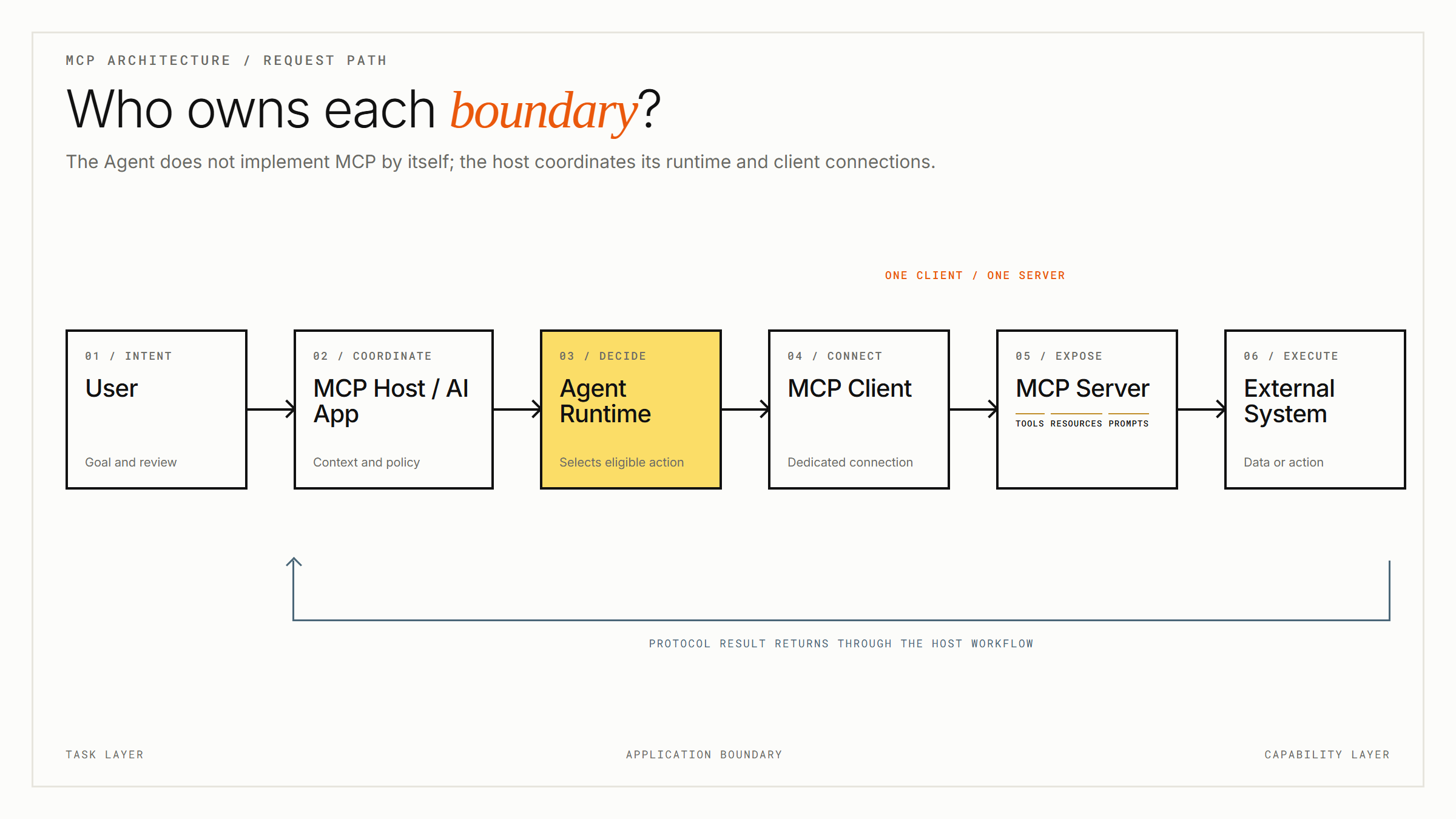
An agent and MCP server work together through the host application. The agent runtime decides that an available capability is relevant; the host routes the structured request through the client associated with that server; the result then returns to the workflow.
- The user gives a goal to the AI application.
- The host supplies instructions, relevant context, and permitted capabilities to the Agent runtime.
- The Agent runtime selects an eligible external action.
- The host's MCP client sends the request to its corresponding MCP server.
- The server interacts with the external system and returns a protocol result.
- The host and Agent use the result to continue the task, subject to policy and review.
The MCP architecture specifies one client per server connection, but it does not dictate how an AI application manages an LLM or the context it receives. MCP therefore does not automatically define or transmit an application's full conversation. The host decides which arguments, resource requests, metadata, or other context are sent through each connection, and a server can receive sensitive information if the host or user includes it.
When Should You Use an Agent, an MCP Server, Both, or a Direct API?
Use an agent for goal-oriented work, an MCP server for a reusable protocol-facing capability, both when the agent needs governed external access, and a direct API when one application needs a fixed integration.
| Need | Starting point | Reason |
|---|---|---|
| Interpret an open-ended request and choose among steps | Agent | The system needs task progression and decision logic |
| Offer a tool or data source to compatible AI applications | MCP server | The capability needs a standard discovery and invocation boundary |
| Let an agent work across several external systems | Agent + MCP servers | The agent handles the goal while servers provide focused capabilities |
| Execute one predictable operation in one codebase | Direct function or API | A protocol or agent loop may add unnecessary operational work |
| Provide reusable guided interaction | MCP prompt or application template | The need is structured guidance rather than a new task-owning agent |
How Does Open Science Combine Agents and MCP Connector Tools?
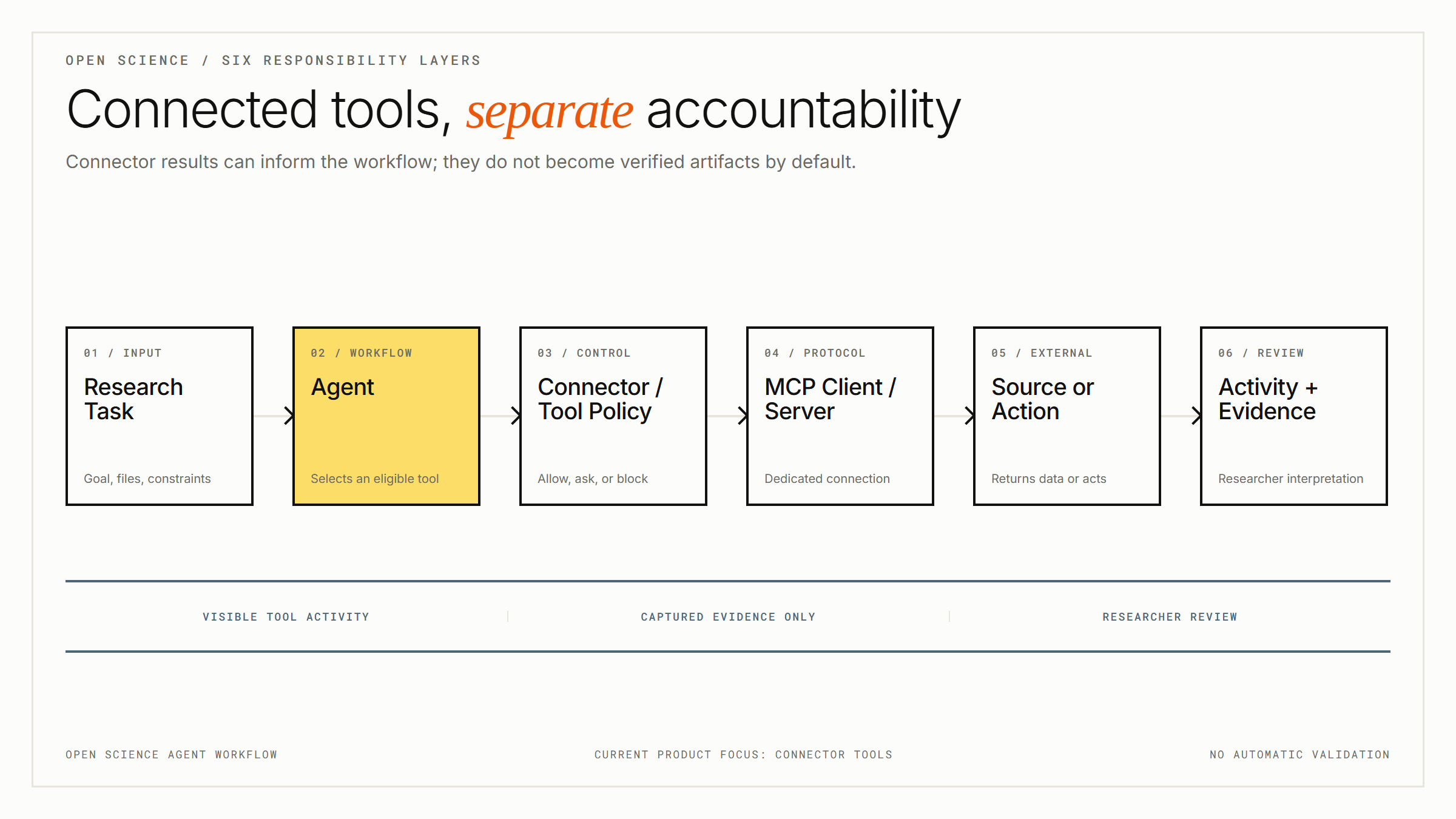
Open Science currently exposes built-in and custom Connector tools to its Agent workflow. The product does not present Agents and MCP Connectors as rivals: the Agent works through the research task, Connectors make approved external operations available, and the application applies Connector- and tool-level policy.
The Open Science v0.18.2 release and repository documentation confirm persistent projects and sessions, permissioned scientific Connectors, custom MCP Connectors, visible tool activity, approval controls, and immutable artifact versions with available provenance evidence. In a literature workflow, an enabled Connector's returned data may inform the Agent response while Open Science records visible call activity.
Connector returns and artifacts should remain separate concepts. A tool result does not automatically become an independent artifact, and artifact provenance should not be read as a guarantee that every item of evidence from an external service was captured. Researchers still need to inspect source quality, query parameters, methods, and any conclusions produced from returned data.
What Security Boundaries Matter?
MCP provides a standard interface, not a complete security system. Safety responsibilities exist on both sides of the connection, and neither an agent request nor an MCP server response should be trusted merely because it uses the protocol.
- Host and application: control capability exposure, user confirmation, tool policy, logging, and the context placed into each request.
- Server and service: enforce authentication, authorization, scope validation, input validation, credential protection, data handling, tenant isolation where relevant, and operation auditing.
The MCP authorization specification defines transport-level authorization requirements for protected remote servers, while application-specific controls remain outside the protocol. Open Science adds approval profiles and per-Connector or per-tool policies on the host side. Its local-first design does not mean remote Connector or model traffic stays local; configured services receive the information necessary for approved requests.
Conclusion
AI Agent vs MCP Server is a comparison between task orchestration and capability exchange. The agent works through a goal, MCP defines the connection protocol, and the MCP server exposes declared capabilities without owning the host application's complete task.
AIPOCH Open Science demonstrates the combined pattern in a research workbench: Agent workflows can use permissioned Connector tools, while activity records, artifact evidence, application policy, and researcher review remain distinct responsibilities.
Frequently Asked Questions
What is the difference between MCP and an MCP server?
MCP is the protocol; an MCP server is a program that provides capabilities through that protocol.
Is MCP an AI agent?
No. MCP standardizes capability exchange and does not define an agent's task loop, instructions, or decision process. An MCP server may contain model-backed logic, but that does not make MCP itself an agent.
Can an agent use multiple MCP servers?
Yes, when the host application supports multiple MCP connections. The MCP architecture creates one MCP client for each connected server.
Does MCP replace an agent framework?
No. MCP defines how capabilities are exchanged, while an agent framework manages model behavior, instructions, state, tool selection, guardrails, and task progression. A system can use both.
How does Open Science use MCP?
Open Science supports permissioned built-in Connector tools and custom local or remote MCP Connectors. Its Agent workflow can use allowed tools while Open Science applies approval and tool policies and records visible activity for researcher review.
Disclaimer
This article is intended for informational purposes only and does not constitute medical advice, clinical guidance, diagnostic recommendations, treatment decisions, or validated scientific conclusions. The structural diagrams are illustrative and do not represent a validated research finding or real-world result.
Open Science is a research workflow tool. It does not replace researcher judgment, and researchers remain responsible for evaluating the accuracy, completeness, and appropriateness of generated outputs. All outputs require independent verification and expert interpretation before use in a research context.
References and external links are provided for informational purposes. AIPOCH does not endorse and is not responsible for third-party content.