How Does Claude Science Handle Scientific Reproducibility? A Technical Breakdown
A technical breakdown of how Claude Science's storage model approaches scientific reproducibility — versioned Artifacts, provenance capture, execution logs, and where the system's limits lie.
This article is AIPOCH's independent technical analysis of Claude Science's reproducibility. Claude Science reproducibility is built into the storage layer — not bolted on afterward. This article is a technical walkthrough of that design. Rather than reviewing Claude Science as a product, I'll focus on one question: **how does its storage model try to make scientific results easier to reproduce? ** For context on how an open, model-agnostic research environment approaches the same problem, see AIPOCH Open Science.
Every researcher has had a version of this moment. A reviewer asks you to reproduce Figure 3B, and you open a folder containing final_plot.py, final_plot_v2.py, and final_plot_FINAL_use_this.py. Reconstructing exactly which script, parameters, and input data produced the published figure turns out to be much harder than expected. For a hands-on look at how this plays out in practice, see our Claude Science bioinformatics paper reproduction review. This isn't necessarily because researchers are careless. A single figure can evolve through dozens of iterations—changing colors, refining labels, updating statistical tests, or rerunning analyses with new data. Over time, the connection between the final output and the process that created it can become surprisingly difficult to recover. Modern tools such as Git, workflow engines, and environment managers help, but they still depend on people using them consistently. Under the pressure of day-to-day research (especially in bioinformatics), provenance is often fragmented across commits, notebooks, environment files, and manually named outputs. Claude Science starts from a different assumption. Instead of treating provenance as something that must be reconstructed later, it treats it as part of the artifact itself.
What Is an Artifact in Claude Science?
In Claude Science, anything you save into a project is an Artifact — a figure, a processed dataset, an HTML QC report, a notebook, a config file. The important design choice is that Artifacts are stored append-only. When your code regenerates a figure that already exists, the system does not overwrite the old file; it writes a new Version and keeps the previous one, addressable by version number. This is a critical design choice for scientific research. A "final" figure is rarely final. It may go through dozens of iterations—changing colors, refining labels, updating statistical tests, or rerunning analyses with updated data. During peer review, researchers often need to answer questions like, "What changed between version 3 and version 7?" Traditional file management relies on users to manually save files as Figure_v3, Figure_final, or Figure_final_final. Versioned storage eliminates that burden by making every revision part of the system automatically. Artifacts support Markdown references. Within notebook or report Markdown cells, users can embed references such as @artifact:volcano_plot:v3. When the document is rendered, the reference is automatically replaced with the corresponding version of the figure. As a result, the narrative is always tied to a specific artifact version, avoiding situations where a figure changes but the report unintentionally references a different revision.
How Claude Science Captures Provenance
Provenance is Claude Science's systematic approach to scientific reproducibility. Each time an Artifact version is created, Claude Science freezes five things alongside it.
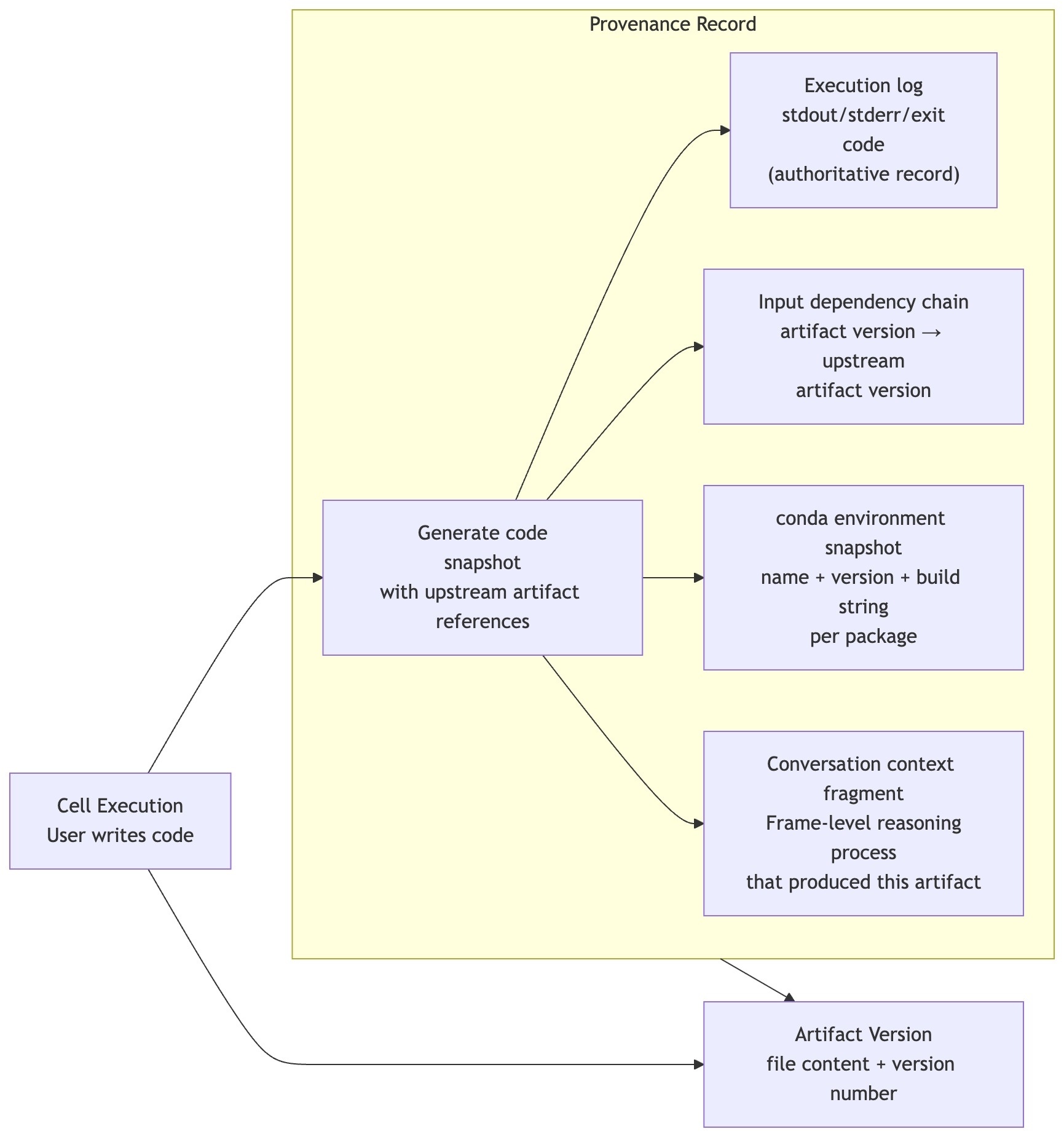
The exact code that ran, not the code that currently happens to sit in a cell. References to upstream inputs are resolved to concrete version numbers rather than loose filenames, so a snapshot says "built from the normalized matrix v1," not "built from data.csv."
The execution log
stdout, stderr, and the exit code from the run itself. This one carries a rule worth stating plainly. If the code snapshot and the execution log ever disagree, the log is treated as authoritative. The reasoning is that code can be edited after the fact, but the log is an immutable record of what actually happened at runtime. It's like a lab notebook, where the original record carries more authority than the report prepared afterward. Most workflows keep the code and discard the log, which means they preserve the retelling and throw away the recording.
The input dependency chain
A given version records which upstream Artifact versions it depended on — a differential-expression table v2 might point back to the normalized matrix v1 and the sample metadata v3. These links form a directed acyclic graph, so when an upstream input changes, the system can tell you every downstream result now out of date.
A conda environment snapshot
Every package is pinned down to its exact name, version, and build string—for example, numpy==1.24.3 py311h08b1b3b_0 rather than the loosely specified numpy>=1.24. For bioinformatics this precision isn't pedantry; a minor version difference in a tool can shift numerical results. This is the same principle behind conda-forge, the community-driven channel that provides consistent, reproducible package builds across platforms.
A conversation-context fragment
The frame-level reasoning that surrounded the analysis. This is the record of why you ran this analysis, why you chose this method, why you set these parameters. I'll come back to what this can and can't do.
Two Tiers of Reproducibility in Claude Science
The system provides two levels of reproducibility.
The Convenience tier
you can download a self-contained Python or R script with the upstream Artifact references and parameters embedded, and run it on its own. It's the right tool for a collaborator who just wants to rebuild your plot. It's worth noting that the script may be truncated because of context window limits.
The authoritative tier
the execution\_log, which is never discarded and can be replayed precisely. This serves as the authoritative evidence for reproducibility, making it suitable for peer review, regulatory compliance, or research audits.
Reproducing the Why, and Where That Breaks Down
Even a perfect technical replay — same code, same environment, same inputs, identical output — only answers how a result was produced. Science also depends on why: why this normalization was appropriate, why those samples were excluded, why this comparison is the meaningful one. A method choice is often more fragile than the code implementing it, because you can always re-run code, but a forgotten judgment is simply gone. The conversation-context fragment in Provenance is Claude Science's attempt at what you might call cognitive reproducibility — preserving the chain of reasoning, not just the mechanical steps. But this is where honesty matters more than the pitch. Cognitive reproducibility is a project-level capability rather than a portable property of an individual artifact. If a single Artifact is moved to another system, its associated conversation context does not automatically travel with it. The complete cognitive context can only be reconstructed within the original project's Frame structure.
Claude Science Reproducibility: Shifting the Burden from Users to the System
One theme runs through these design choices: information that is often managed manually becomes part of the storage system itself. Version history is maintained automatically instead of relying on manually named files. Provenance is captured whenever an Artifact is saved rather than reconstructed later. Dependency relationships are recorded as part of the project graph instead of being inferred after the fact. None of these ideas are entirely new. Version control, workflow engines, and data lineage systems have addressed similar problems for years. What's distinctive here is that Claude Science brings these capabilities together around the Artifact abstraction, making them part of the everyday research workflow rather than separate infrastructure that researchers must assemble and maintain.
Whether this approach ultimately improves reproducibility in practice will depend on adoption and day-to-day use. But as a storage design, it reflects a clear philosophy: preserving provenance by default instead of asking users to reconstruct it later.
Explore AIPOCH's Medical Research Agent Skills
AIPOCH's Agent Skills library is a growing collection of structured, versioned skills for medical and bioinformatics research — covering areas like survival analysis, immune infiltration, pathway enrichment, and Mendelian randomization, among others. The full library is open-source and available on GitHub.