DeepSeek Harness for Scientific Agents: What's Still Missing
DeepSeek Harness makes agent runtimes composable. This architecture review examines the added controls scientific workflows need for plans, artifacts, provenance, branching, and review.
DeepSeek released DeepSeek Harness, an open-source developer preview built on Cordis around one clear architectural idea: everything is a plugin. The model adapter, tool registry, session log, agent loop, sandbox, approval policy, and interface can all participate in the same compositional system.
This article is an architecture review based on public documentation, not a benchmark or interoperability test between DeepSeek Harness and AIPOCH Open Science. Open Science is an open-source, local-first, model-agnostic, self-hosted AI research workbench for reproducible scientific discovery. When DeepSeek released DeepSeek Harness on August 13, 2026—a developer preview that drew unusually large attention on GitHub within days—the conversation shifted from raw model capability to the system around the model.
That release is a useful moment to ask: when the work is science rather than only coding, what controls does a general agent runtime need around it? This article uses DeepSeek Harness as an example of a composable general harness, then proposes a working definition of the scientific control layer that sits above it. Open Science v0.16.0, published on August 16, 2026, provides a concrete case study of several such controls.
What Is DeepSeek Harness?
DeepSeek Harness is an open-source developer preview released by DeepSeek under the MIT License on August 13, 2026. Its architecture is built on Cordis and organized around one idea: everything is a plugin. The model adapter, tool registry, session log, agent loop, sandbox, approval policy, and interface can all be replaced or extended through the same plugin system.
The project explicitly warns that compatibility-breaking changes should be expected. Its current value is not as a finished scientific workbench, but as a demonstration that the harness itself—the system around the model—can be made composable. For research teams, that raises the next question: once the runtime is composable, what scientific controls must be added around it?
What Is a Scientific Agent Harness?
A general harness turns a language model into a sustained worker. It assembles context, exposes tools, executes code, manages files and compute, enforces permissions, persists sessions, handles failures, branches work, and decides how an agent continues across turns. DeepSeek Harness provides these capabilities in a highly modular form.
For scientific work, the same runtime needs an additional set of concerns. In this article, we use scientific control layer as a working term for the plans, artifact records, review states, permissions, and researcher decisions that sit around a general agent runtime. It is not an official DeepSeek Harness layer, nor is it a feature that any single product currently automates end to end.
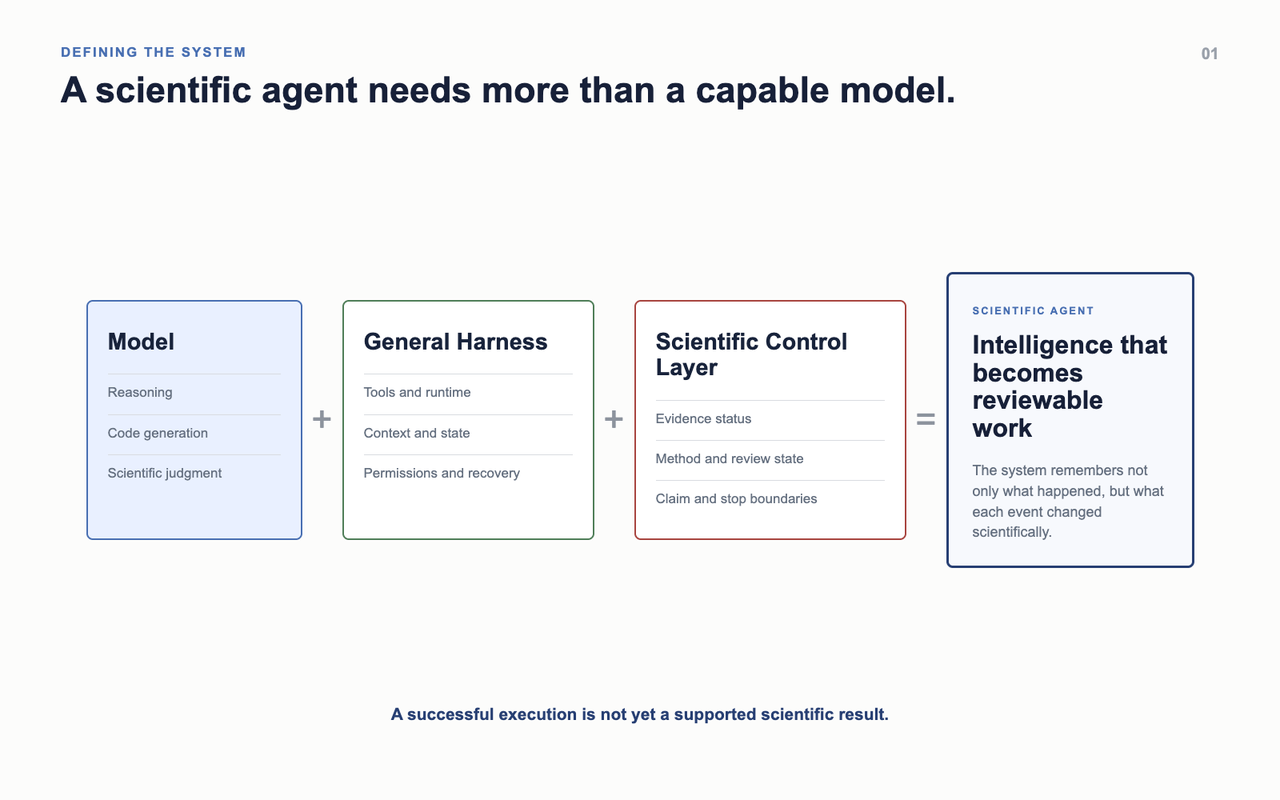
The scientific control layer is concerned with five things:
- Plans and approvals — what the researcher and agent agreed to do;
- Artifacts and provenance — what was produced, from what inputs, by which method;
- Branches and durable state — how alternatives are kept separate and recoverable;
- Role-bounded delegation and review — who performs each part and how it is checked;
- Researcher-defined validation and stop rules — when further compute is scientifically justified.
Reproducibility assessment is difficult even for structured approaches. A 2026 arXiv study of Agentic Reproducibility Assessment evaluated 213 ReScience C articles and reported 60.71% accuracy on ReproBench, compared with a previous high of 36.84%. The result suggests that structured workflow reconstruction and evaluation can materially affect reproducibility assessment; it does not isolate harness design as the sole cause.
These five controls are not plug-in replacements for human judgment. They are structures that make human judgment inspectable, interruptible, and reusable across long workflows.
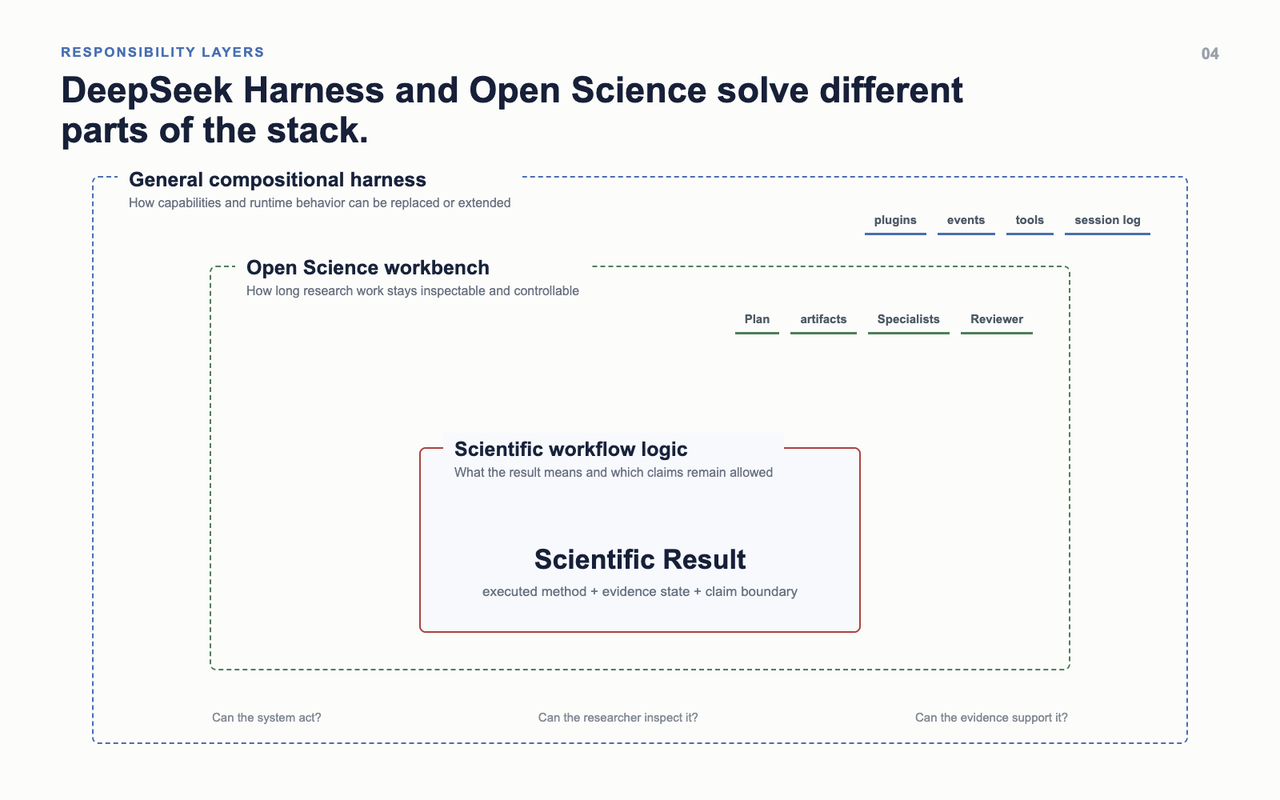
DeepSeek Harness and Open Science Solve Different Parts of the Stack
DeepSeek Harness is a general, highly compositional agent harness. Its Cordis architecture makes services, events, providers, consumers, profiles, bundles, and runtime behavior patchable through one plugin system. The model adapter, tool registry, session log, and agent loop are replaceable, and durable session events support persistence, replay, resume, and branching.
Open Science is a model-agnostic workbench for scientific discovery. It uses selectable agent backends and models while adding projects, Plans, persistent compute, artifacts, provenance, side conversations, Specialists, Skills, delegation, and opt-in review around research work.
The relationship is therefore conceptual rather than competitive:
| Layer | Primary Question |
|---|---|
| DeepSeek-style general harness architecture | How can agent capabilities and runtime behavior be composed, replaced, and extended? |
| Open Science scientific workbench | How can long research work preserve plans, artifacts, evidence context, review state, and researcher control? |
| Scientific workflow logic | What does a result mean, and which downstream claims or artifacts remain allowed? |
The general harness makes it possible to exchange components. The scientific workbench must make the consequences of those exchanges visible.
A model change should not erase the Plan. A package substitution should not lose the original method. A new agent backend should not detach existing artifacts from their provenance. A stronger Reviewer should be able to improve future checks without rewriting the historical finding that governed an earlier result.
What Does Open Science v0.16.0 Implement Today?
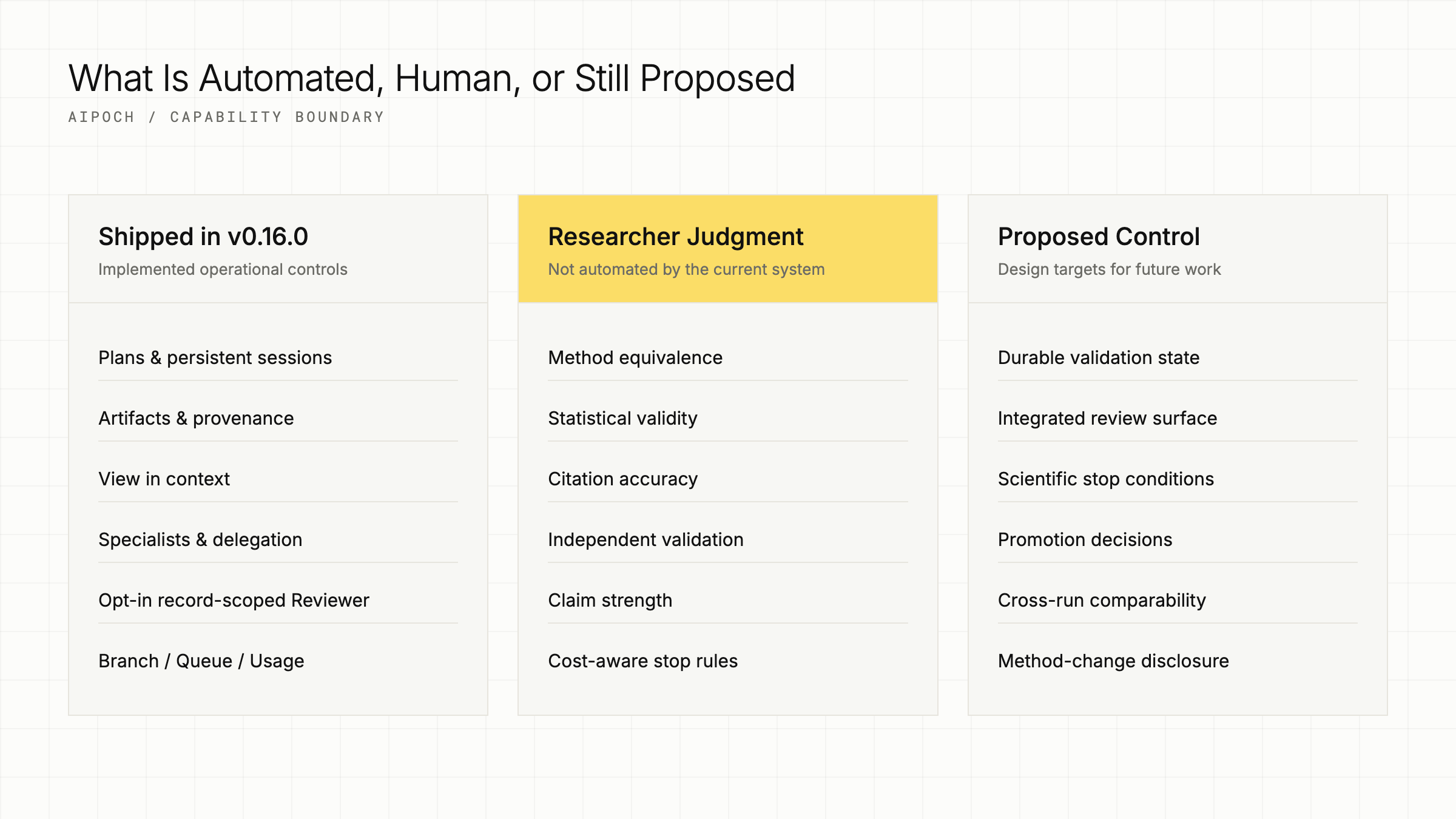
Open Science is a model-agnostic research workbench, not a general agent harness. It assumes that models and runtimes will change, and adds structures for scientific work around them. As of the v0.16.0 release, it implements several components of the scientific control layer described above.
Plans and persistent projects/sessions provide durable task structure and working record. The Plan records what was agreed, while sessions preserve the conversation graph and activity history. This is a starting point for reproducibility, not a guarantee that every scientific decision was correct.
Artifacts and provenance store research outputs together with their origin. The v0.16.0 View in context feature lets a researcher move from an artifact preview back to the session that produced it. This reduces the isolation problem, but it does not automatically interpret whether the artifact supports a claim.
Specialists and delegation provide reusable operating identities and bounded subagent tasks. A main agent can assign work to subagents while preserving messages, permissions, structured output, and artifacts. Delegation distributes execution; it does not remove the researcher's responsibility to reconcile results against the Plan.
The opt-in AI Reviewer examines the completed in-session record and can request bounded corrections. It produces pass/warn/fail signals based on the current turn's transcript, execution log, and artifacts. It is record-scoped and does not replace domain-specific statistical, clinical, citation, or biological validation.
Branching from completed agent messages, message queuing during active runs, and the Usage dashboard address continuity and cost visibility. A branch carries conversation history to a new idle session; the queue holds follow-up prompts while a turn is running; the dashboard shows token, session, and artifact summaries. These surfaces help researchers decide what to do next; they do not make those decisions automatically.
What Does Open Science Not Automate?
The current system has real boundaries that are worth stating directly. Open Science v0.16.0 does not automatically judge method equivalence, statistical validity, citation accuracy, independent validation, claim strength, whether a failed prerequisite should stop downstream work, or determine which branch should be promoted to the canonical workflow.
A package substitution, for example, is recorded in the execution history, but deciding whether it preserves the original scientific operation is a researcher judgment. A branch may produce a cleaner figure, but deciding which branch enters the accepted analysis requires evidence and a promotion decision. The Reviewer can flag detectable issues in the current record, but it cannot reliably assess whether a cohort supports an endpoint or whether a claim exceeds the evidence.
The Usage dashboard shows where tokens were spent, but it does not enforce cost-aware stop conditions based on scientific state. If most tokens were consumed after the agent discovered that a required endpoint was absent, that pattern is visible to the researcher; it is not automatically converted into a halt signal.
These gaps are not bugs. They identify where researcher judgment remains essential and where task-specific validation logic must still be supplied by the research team.
What Design Questions Face Scientific-Agent Builders?
Anyone building a scientific-agent system eventually faces a small set of design questions. These questions are present whether the system is built on DeepSeek Harness, Open Science, or a custom stack; hiding them inside prompts or tool descriptions does not remove them.
- What becomes durable state? Keeping only the final answer makes the workflow easy to display but impossible to audit. Keeping every token equally makes the record noisy. The system needs explicit objects for decisions that govern methods, artifacts, and claims.
- What counts as recovery? An engineering retry can continue automatically. A method substitution may require disclosure or approval. An evidence failure may need to block downstream work. The harness must distinguish these before recovery becomes a path to an unsupported figure.
- When does exploration become canonical? Branches preserve alternatives, but promotion into the accepted workflow needs evidence, a decision, and downstream consequences.
- Where does the reviewer sit? Reviewing isolated subagent outputs is useful but insufficient. Many scientific errors appear only after integration, so the review surface needs access to the completed record and the artifact selected for the final claim.
- When must the workflow stop spending tokens? A failed prerequisite, invalid cohort, or unresolved review finding can make further work scientifically wasteful even when more compute remains available. The stop rule should be expressed in scientific terms, not only as a budget ceiling.
Conclusion
DeepSeek Harness illustrates how a general agent runtime can become composable. Open Science shows several concrete controls that become important when the same runtime is used for long, inspectable scientific work. The two are not direct competitors: one addresses how runtime components can be composed and replaced; the other addresses how plans, artifacts, branches, review states, and researcher decisions can persist.
Open Science implements several parts of this proposed scientific control layer, including Plans, artifact provenance, branching, Specialists, delegation, and opt-in review. It does not automate the full layer, and it does not replace researcher judgment.
The model contains the intelligence. The harness turns that intelligence into sustained work. The scientific record is what must survive—and preserving it correctly still requires researcher judgment.
FAQ
What is DeepSeek Harness?
DeepSeek Harness is an open-source, MIT-licensed developer preview released by DeepSeek on August 13, 2026. It is a general agent runtime built on the Cordis plugin framework, where components such as models, tools, sessions, and sandboxes are swappable plugins.
What controls do scientific workflows need beyond a general harness?
Scientific workflows need plans and approvals, artifact provenance, branches with durable state, role-bounded delegation and review, and researcher-defined validation and stop rules. These controls do not replace researchers; they make researcher judgment inspectable and reusable across long workflows.
What does Open Science v0.16.0 implement today?
Open Science v0.16.0 implements Plans, persistent projects and sessions, artifact provenance with View in context, Specialists and delegation, an opt-in record-scoped AI Reviewer, branching from completed messages, a session-scoped message queue, and a Usage dashboard for cost visibility.
Disclaimer
This article is an architecture analysis, not a validation of any scientific result. AI-generated plans, code, reviews, and artifacts require independent verification by researchers with relevant methodological and domain expertise.
References and external links are provided for informational purposes. AIPOCH does not endorse and is not responsible for the content of third-party sources.
DeepSeek Harness claims were checked against its public *repository* on August 18, 2026. Open Science capabilities and limitations reflect the public *v0.16.0 release, published on August 16, 2026. The reproducibility assessment statistics come from a 2026 arXiv paper on Agentic Reproducibility Assessment. The scientific control layer is a working framework proposed in this article, not an official DeepSeek Harness or Open Science product layer.*