Identifying meaningful research gaps is one of the most time-consuming tasks in medical research. Before a researcher can design a novel study, they must first map what has already been done — across hundreds of papers, diverse disease models, experimental systems, patient populations, and sometimes competing mechanistic explanations — and then reason about what is still missing. At small literature scales, this is manageable. At the scale modern biomedical research demands, it becomes a significant workflow bottleneck.
PubMed now contains more than 40 million citations and abstracts of biomedical literature, maintained by the National Center for Biotechnology Information (NCBI) at the U.S. National Library of Medicine. In fast-moving fields like cell death biology, metabolic nephropathy, or omics-driven biomarker discovery, the literature relevant to a single research direction can span hundreds of papers published across multiple years. Researchers who attempt to manually synthesize this material before forming a study direction face a highly repetitive, time-intensive process — one that must be repeated each time the research scope shifts.
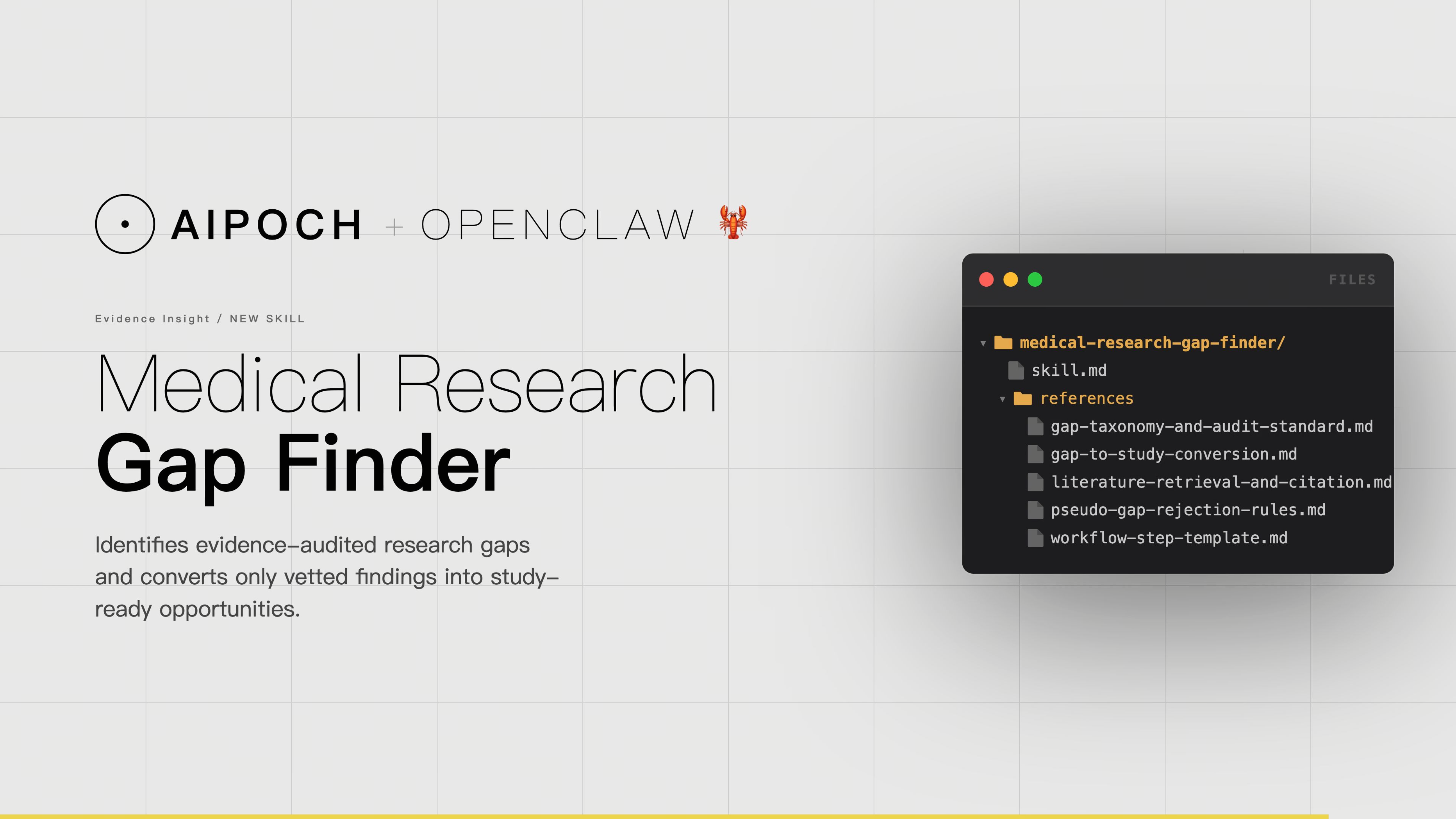
The Medical Research Gap Finder is an AI agent skill designed to support this task. It can assist researchers in identifying evidence-linked, topic-specific research gaps in medical research by first retrieving and verifying literature from trusted sources, then mapping the current evidence landscape, filtering weakly supported or redundant gap candidates, and converting prioritized gap candidates into preliminary study planning opportunities.
Why This Task Matters
Medical research gap identification sits at the foundation of hypothesis formation, grant writing, and study design. Researchers typically rely on manual PubMed searches, informal reading notes, and unstructured literature lists — methods that are difficult to reproduce and easy to overlook.
Several operational pain points characterize this workflow:
Literature fragmentation. Evidence relevant to a single research direction is often distributed across mechanistic studies, clinical cohorts, omics datasets, animal model papers, and translational biomarker reports. Assembling a coherent evidence map from fragmented sources is labor-intensive.
Inconsistent scope definition. Without a structured scoping framework, different researchers working on the same topic may draw different inclusion and exclusion boundaries — leading to inconsistent gap assessments. A 2023 meta-research study published on medRxiv found that only 4.9% of database searches in a random sample of 100 systematic reviews reported all six PRISMA-S reproducibility items — highlighting how poorly defined and documented literature scope remains a core reproducibility problem.
Redundant preliminary work. Researchers repeatedly perform overlapping literature scans when entering new sub-topics, starting collaborations, preparing grant applications, or revising study directions. Much of this effort does not accumulate into reusable structured outputs.
Evidence gap reasoning complexity. Recognizing a gap requires not only knowing what exists, but also reasoning about what type of evidence is missing — whether the gap involves directionality, model type, biomarker validation stage, population specificity, or methodological approach. This reasoning is difficult to perform consistently at speed.
What Medical Research Gap Finder Does?
The AIPOCH Medical Research Gap Finder is an AI agent skill designed to help researchers and AI agents surface literature-supported research gap candidates based on structured literature retrieval and evidence organization workflows. The skill can help organize existing evidence, highlight comparatively underexplored areas, and reduce low-value or weakly supported gap suggestions for further human evaluation.
When you want to explore which areas in a topic appear comparatively underexplored in the retrieved literature, this skill can help surface literature-supported gap candidates and summarize why they may warrant further investigation.
The skill does not replace researcher judgment or expert review, but can reduce the time required to organize the literature landscape and surface structured gap candidates for researchers to evaluate.
How Medical Research Gap Finder Works?
Execution — 8 Steps (always run in order)
- Step 1 — Define Scope Precisely
- Step 2 — Retrieve Literature Before Any Gap Claims
- Step 3 — Build an Evidence Landscape Review
- Step 4 — Generate Candidate Gaps
- Step 5 — Filter Weakly Supported or Redundant Gap Candidates
- Step 6 — Rank and Prioritize Gap Candidates
- Step 7 — Translate Prioritized Gaps into Preliminary Study Planning Directions
- Step 8 — Perform Self-Critical Review
Example Use Case
Below is an example workflow of how this Skill works in practice.
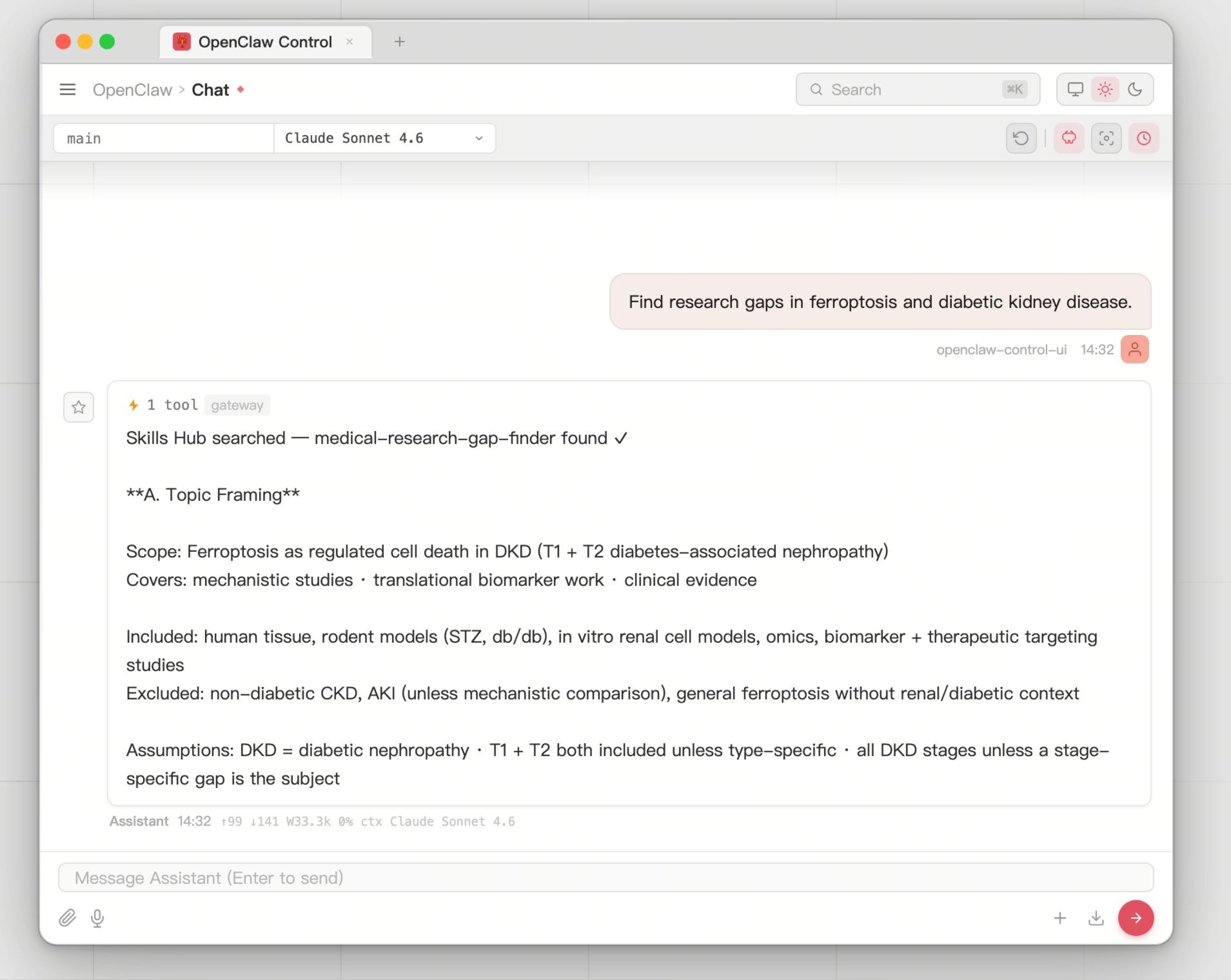
The workflow begins with a plain-language prompt. In the example shown in the workflow screenshot, the researcher enters:
"Find research gaps in ferroptosis and diabetic kidney disease."
After installing the AIPOCH medical research skills, the AI agent is able to automatically retrieve the appropriate skill and execute the corresponding workflow. In the screenshot, the medical-research-gap-finder skill was successfully found and triggered for structured workflow execution.
Users can browse and install all available AIPOCH medical research agent skills from the official Skills Hub or GitHub repository.
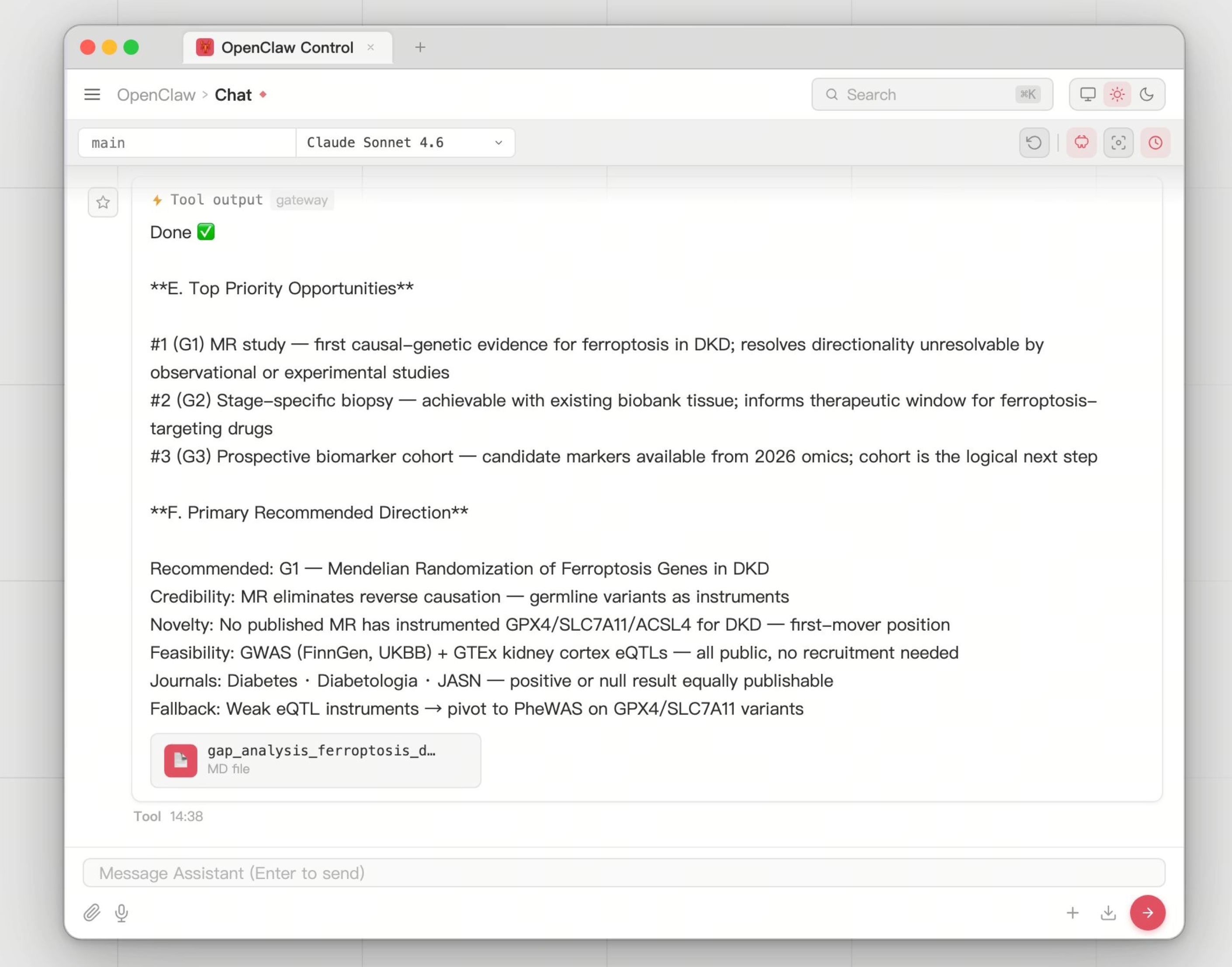
The output is delivered as a downloadable .md file (gap_analysis_ferroptosis_dkd.md), as shown in the screenshot.
The workflow is not a substitute for systematic review methodology, expert literature review, or formal evidence synthesis protocols.
Video Walkthrough
Watch the complete workflow below:
Example Research Use Cases
Systematic review scoping. A research team preparing a systematic review can use the skill to define inclusion and exclusion criteria and identify which evidence domains are already well-covered versus sparse — reducing the manual scoping burden before formal database searches begin.
Grant application preparation. A PI drafting a grant proposal can use the skill to generate a structured research gap summary supporting the innovation and significance sections — providing organized evidence rationale without starting from a blank literature review.
Entering a new sub-field. A researcher expanding into an adjacent topic can use the skill to quickly map the evidence landscape of the new area — understanding what study types exist, what model systems have been used, and what methodological gaps remain.
Dissertation topic refinement. A graduate student narrowing a dissertation direction can use the skill to compare multiple candidate topics by feasibility and evidence coverage — supporting an evidence-based topic selection process.
Collaboration planning. A team initiating a new collaboration can use the skill to generate a shared structured gap document — providing a common starting point for discussion without requiring all collaborators to independently review the same literature.
Conclusion
Medical research gap identification is a workflow task that researchers perform repeatedly — at the start of each new project, each grant cycle, and each study direction revision. It is also a task that is difficult to standardize: literature boundaries shift, evidence layers are fragmented, and the reasoning required to move from "what exists" to "what is missing" is not well supported by traditional search tools.
The AI agent skill Medical Research Gap Finder created by AIPOCH can assist researchers with structuring this medical research workflow. By accepting a plain-language research topic and producing a scoped, prioritized, and rationale-supported gap analysis report, the skill can help reduce the repetitive manual effort involved in early-stage research planning. Outputs — including ranked gap candidates, candidate study directions, feasibility assessments, and fallback strategies — are provided as structured documents for researchers to review and build on.
Explore more medical research agent skills
AIPOCH is a collection of Medical Research Agent Skills created to support AI-assisted medical research workflows across literature review, evidence organization, bioinformatics preprocessing, data analysis support, and research writing tasks.
Researchers can explore and download this skill and others from the AIPOCH skill library:
Researchers interested in moving beyond research gap identification toward executable study design may also find this skill useful: Medical Research Gap To Study Planner
Recommended Reading
Disclaimer
This content is intended for informational purposes only and does not constitute medical advice, clinical guidance, diagnostic recommendations, treatment decisions, publication acceptance recommendations, or formal scientific peer review outcomes. The workflow is not a substitute for systematic review methodology, expert literature review, or formal evidence synthesis protocols.
AIPOCH agent skills are intended to support researchers, not replace human scientific judgment, domain expertise, institutional review processes, or editorial decision-making. Researchers should independently verify all outputs, evidence interpretations, annotations, citations, manuscript revisions, and scientific conclusions before use in academic, clinical, regulatory, or publication settings.