What Changed in Open Science v0.11.0
Open Science v0.11.0: Review-gated session plans, hot-switching models and providers without reconnecting the agent process, agent-aware context replay that respects each framework's context path, prompt history navigation, and a settings keyboard shortcut — while Windows auto-update and local RPC, logger data redaction, artifact provenance binding, and notebook process-group cleanup are hardened across the board.
Open Science v0.11.0: Review-gated session plans, hot-switching models and providers without reconnecting the agent process, agent-aware context replay that respects each framework's context path, prompt history navigation, and a settings keyboard shortcut — while Windows auto-update and local RPC, logger data redaction, artifact provenance binding, and notebook process-group cleanup are hardened across the board.
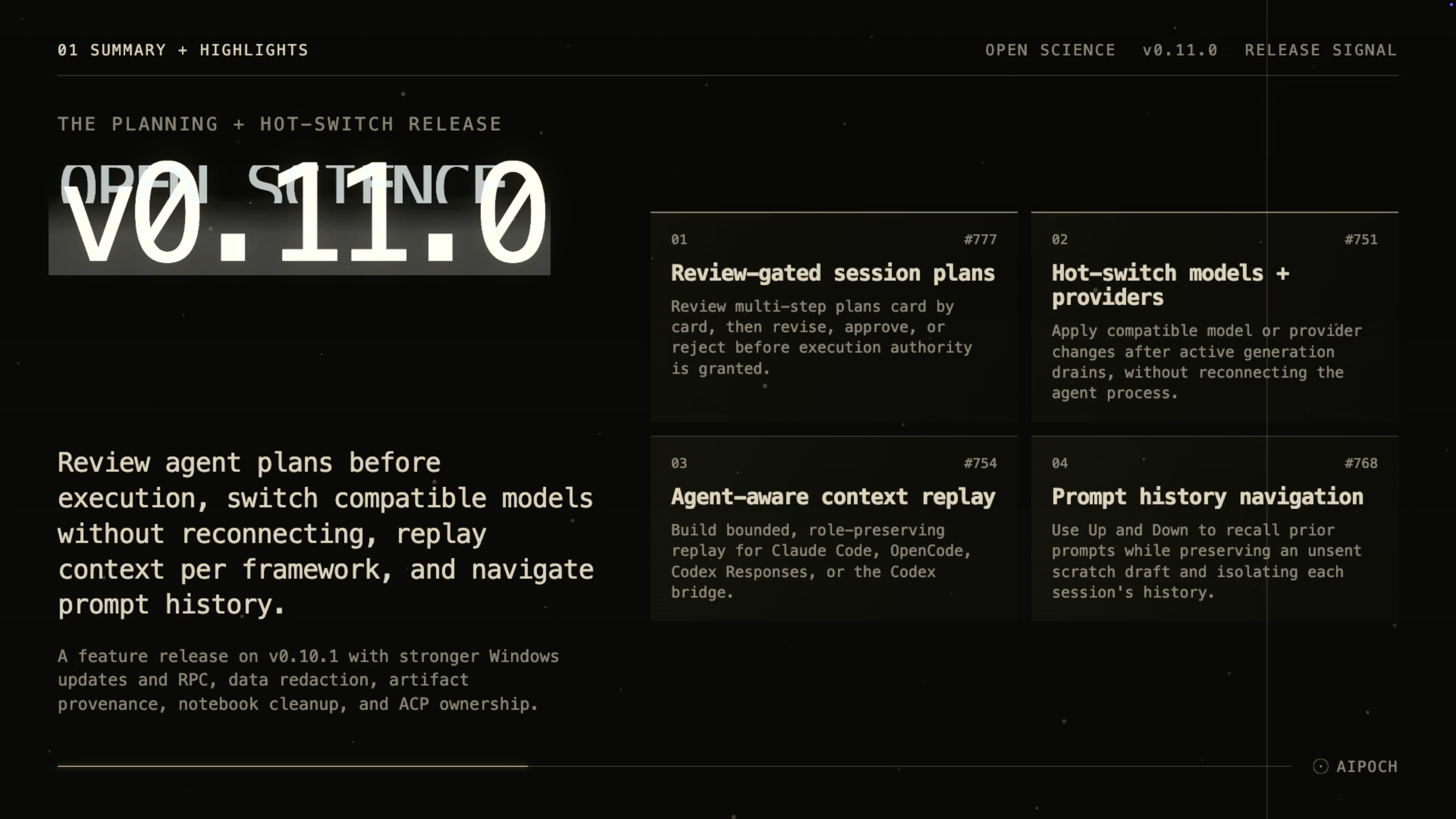
v0.11.0 is a feature release on top of v0.10.1. It introduces a durable, user-reviewable Session Plan contract so multi-step agent work has an explicit execution plan that persists across restarts and context compaction, lets compatible model and provider changes apply to the running session without reconnecting the agent process, rebuilds context replay to be agent-aware so each framework receives a bounded, role-preserving transcript, and adds prompt history navigation, session link favicons, and a standard settings keyboard shortcut.
Under the hood it restores silent Windows auto-update, routes Windows app-local RPC through authenticated named pipes, redacts sensitive data at the logger boundary, binds artifact provenance to the correct prompt runtime segment, gives each notebook shell command a private process group for honest timeout cleanup, remediates all production dependency vulnerabilities, and continues the ACP ownership refactor with provider prompt-execution, session-creator, session-resumer, session-adopter, connection-lifecycle, and capability-provision owners.
Highlight
Review-gated session plans.
A new Session Plan contract gives multi-step agent work a durable, user-reviewable execution plan. The agent generates a plan, the user reviews it card-by-card with revise, approve, or reject decisions, and an approved plan binds execution authority to the current interaction until all required steps are terminal. Active plan projections persist across restarts and context compaction, require explicit continuation before an unfinished plan can resume, and block turn completion while required steps remain unfinished. A compact running-progress indicator and a Plan First entry point are available in the workspace.
Hot-switch models and providers without reconnect.
Changing a model or provider no longer reconnects the agent process when the target is a registered compatible option. The in-flight message finishes on its original model; the new selection applies after generation activity drains, and new prompts wait at an admission barrier. Compatible Claude, OpenCode, and Codex API-key providers route through generation-owned loopback transports so endpoint, credential, and model changes occur without exposing real keys. Fail-closed reconnect is preserved for framework, auth-lane, wire-route, or unsafe capability changes.
Agent-aware context replay.
When an ACP session cannot be resumed after switching agents or starting a replacement session, replay is now classified by target (Claude Code, OpenCode, Codex Responses, or Codex bridge) and built from user-led turns with a bounded token budget derived from the target's advertised context window. The original task is retained, role labels are preserved, oversized messages are truncated within their role, and attachments and images are replayed only when their source message survives selection. A one-shot notebook continuity block is injected on the first replayed prompt.
Prompt history navigation
Up and Down arrows in the composer recall prior prompts, restoring text, skill, and explicit file-reference parts while excluding turns with top-level uploads. Deleted or specialist-disallowed skills are downgraded to readable plain text. History is isolated across sessions and projects, and an unsent scratch draft is restored exactly when browsing begins and resumes.
New Features
Review-gated session plans
an app-owned Session Plan contract, service, and MCP surface for plan generation, revision feedback, approval, and rejection; persisted active projections recovered after restart or compaction; explicit continuation authority before an approved unfinished plan resumes; completion blocked while required steps remain unfinished; Plan First entry points, review cards, restored-plan actions, and a running-progress indicator in the workspace.
Hot-switch ACP models and providers
compatible model and provider targets apply to the existing ACP generation and session without reconnecting; the in-flight message stays on its original model, a latest-wins pending target applies after activity drains, and new prompts wait at an admission barrier; compatible API-key providers route through generation-owned loopback transports; fail-closed reconnect preserved for incompatible or unsafe changes.
Agent-aware context replay
Replay targets are classified as Claude Code, OpenCode, Codex Responses, or Codex bridge; a bounded token budget is derived per target; replay is built from user-led turns retaining the original task; role labels preserved, oversized messages truncated within role; attachments and images replayed only when their source survives; a one-shot notebook continuity block injected on the first replayed prompt.
Prompt history navigation
Up/Down arrows recall prior prompts from the current visible branch; text, skill, and explicit file-reference parts restored; turns with top-level uploads excluded; deleted or specialist-disallowed skills downgraded to readable plain text; scratch draft restored on navigation; history isolated across sessions and projects.
Session link favicons
Links inside assistant session messages now show the destination site's favicon with hover, focus, active, and disabled states; favicons are lazy-loaded without a referrer and fall back to a globe icon on failure; same-hostname URLs coalesce to a single request.
Settings keyboard shortcut
Cmd+, on macOS and Ctrl+, on Windows and Linux open the Settings panel; the shortcut is ignored until startup is interactive or while another top-level modal is active; Cmd/Ctrl+W routes through dismissible surfaces before preview panes and the window.
Improvements
The ACP ownership refactor continues, extracting provider prompt-execution, prompt-preparation, session-creator, session-resumer, session-adopter, session-deletion, session-replacement, connection-close, connection-lifecycle-bootstrap, client-callback, live-effort, startup-session-configurator, turn-scoped Skill, context-usage turn, session-update projection, capability-provision, and process-candidate owners so framework-specific lifecycle logic is isolated behind shared, independently testable contracts.
CI validation enforces a portable-suite outcome in the PR Gate, platform-sensitive workflow tests are stabilized, the Claude ACP patch integrity check runs in CI, and all production dependency vulnerabilities are remediated.
Bug Fixes
- Silent Windows auto-update — in-place updates on Windows now pass the silent and force-run-after flags so electron-updater completes the update and relaunches automatically instead of opening the installer wizard.
- Windows local RPC through named pipes — app-local Notebook, Artifact, Skill, and control-REPL RPC now use authenticated Windows named pipes, resolving opaque
fetch failederrors that affected notebook execution, artifact provenance, skill import, and reviewer findings on Windows. - Artifact provenance bound to prompt runtime segment — finalization now resolves the runtime segment from the requested prompt node instead of always declaring the newest segment, preventing ownership-proof failures after a runtime switch or resume.
- Case-folded lineage bytes — artifact-provenance lineage routing now handles case-folded bytes correctly, preventing checksum mismatches on case-insensitive filesystems.
- Logger sensitive-data redaction — the main-process JSONL logger now enforces recursive redaction at the serialization boundary, scrubbing authorization headers, tokens, cookies, credential-bearing URLs, and oversized text from both file and console output while preserving error categories, status codes, run IDs, and correlation identifiers.
- Claude refusal attribution — Claude refusal responses are now attributed correctly instead of being misclassified as successful completions.
- Notebook process-group cleanup — each POSIX notebook shell command now gets a private process group, so timeout cleanup signals the entire group with SIGTERM and escalates to SIGKILL after two seconds, preventing descendants that ignore SIGTERM from surviving.
- Notebook stream truncation — agent-facing notebook output truncation is relaxed so legitimate long outputs are not cut prematurely.
- Notebook connector result handoff — connector execution results are now handed off to the notebook runtime correctly, preventing dropped or mismatched results.
- Web session re-entry — remote-access Web sessions no longer fail on re-entry, preventing spurious errors when returning to an active session.
- Global search page context — the search dialog now respects the active page context, so searches are scoped correctly instead of searching across unrelated surfaces.
- Session link color — the link color inside session messages is restored to the correct semantic token after the favicon treatment was added.
- Specialist contribution template portability — the contribution template path test is now portable across platforms.
Try Open Science v0.11.0
Open Science is an open-source, local-first and model-agnostic AI research workbench available for macOS, Windows and Linux.