Open Science v0.7.3
Open Science v0.7.3 is a polish and reach release on top of v0.7.2: native context compaction for long sessions, a dark-mode theme, a whole-window find bar, large-file streaming uploads, a Grok (xAI) provider, and framework-aware custom-gateway defaults.
A polish and reach release on top of v0.7.2: native context compaction for long sessions, a dark-mode theme, a whole-window find bar, large-file streaming uploads, a Grok (xAI) provider, and framework-aware custom-gateway defaults.
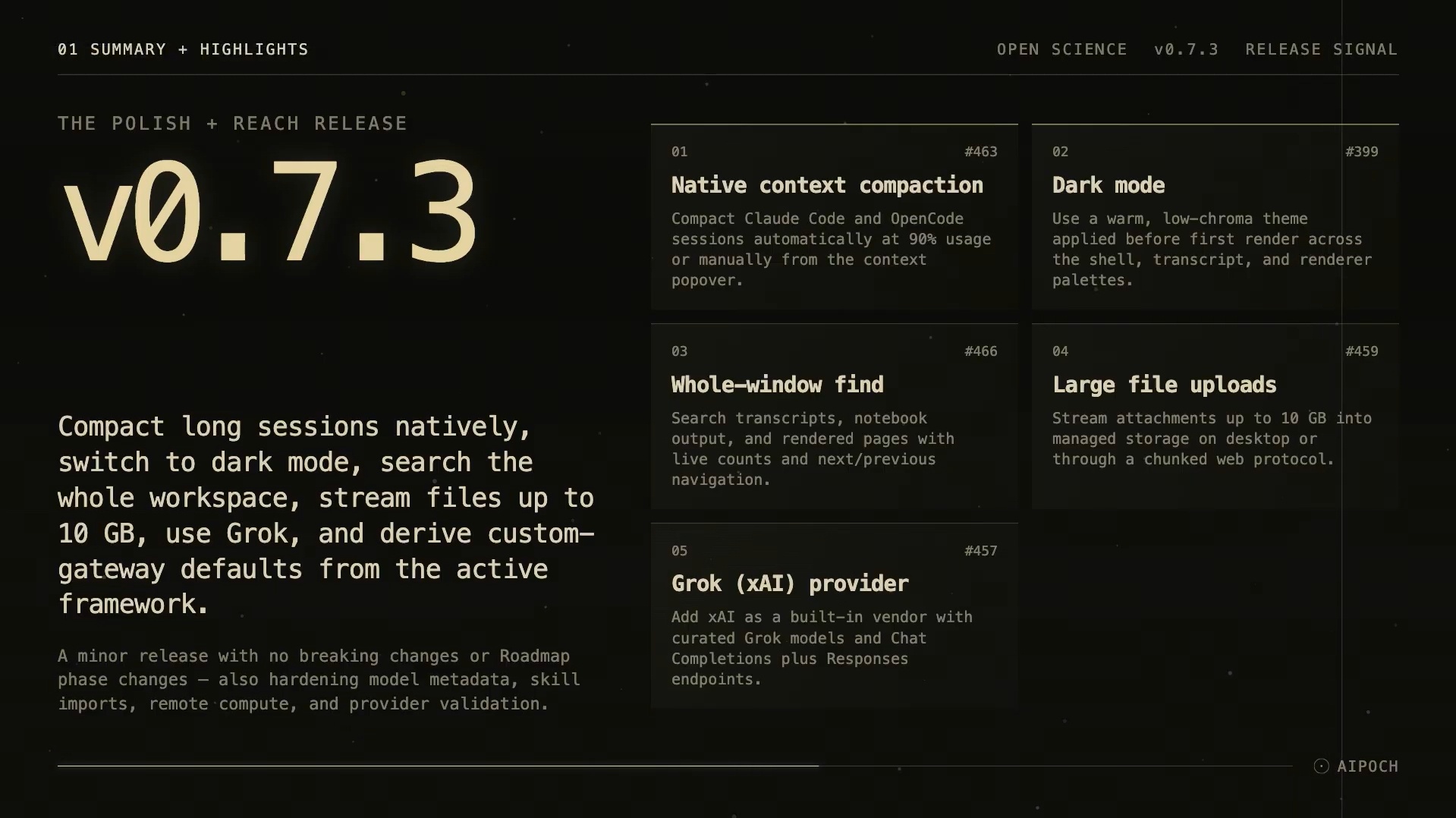
Open Science v0.7.3 is a minor release: no breaking changes and no Roadmap phase status changes. It adds native context compaction (so long sessions self-recover instead of stalling at the context ceiling), a dark-mode theme with synchronous first-render application, a Cmd/Ctrl+F find bar that searches the entire workspace, streaming uploads up to 10 GB per file, a Grok (xAI) provider, and custom-gateway API-format defaults derived from the active agent framework, plus a set of bug fixes hardening Codex model metadata, conversational skill imports, remote compute sourcing, and provider validation.
✨ Highlights
- Native context compaction. Claude Code and OpenCode sessions now invoke the framework's own compaction mechanism — automatically at 90% context usage, or on demand from the context-indicator popover — so long-running sessions stay within the model's context window without losing the conversation.
- Dark mode. A warm, low-chroma dark theme is available under Settings → General, applied synchronously before first render (no flash), covering the shell, transcript, and all renderer palettes.
- Whole-window find.
Cmd/Ctrl+Fopens an overlay search bar over the entire workspace — agent transcripts, notebook output, and rendered pages — with a live match counter, next/previous navigation, and last-query refill. - Large file uploads. Attachments up to 10 GB are streamed directly into managed storage on desktop (native file path resolution in preload) and via a chunked begin/append/finish protocol on web, replacing the previous 50 MB whole-file base64 cap.
- Grok (xAI) provider. xAI is now a first-class built-in vendor with curated Grok models, branded icon, and Chat Completions + Responses endpoints at
api.x.ai.
New Features
- Native context compaction — a framework-level compaction strategy routes Claude Code and OpenCode sessions through their native
/compactcontrol turn (Codex remains framework-managed); compaction fires automatically when reported context usage reaches 90%, and a hover/focus-accessible context popover exposes a manual Compact context action with progress and cancellation; overflow recovery prefers native compaction and falls back to the existing fresh-session/text-replay path; native control turns stay out of the visible transcript while preserving usage updates and safe per-session lifecycle locks. - Dark mode — a complete theme system with light (
:root) and dark (.dark) token sets for all shell, transcript, and streamdown/agent-markdown palettes, following a warm, low-chroma aesthetic that preserves the paper-like feel; the preference is stored inlocalStorageand applied synchronously before React mounts (both Electron and web builds) to prevent flash-of-unstyled-content; all hardcoded structural colors (bg-white,border-[...]) were converted to semantic tokens, with a toggle in Settings → General → Appearance. - Whole-window find bar — a dedicated
WebContentsViewoverlay owned by the main window, so the query text is never part of the page being searched;Cmd/Ctrl+Fopens the bar (intercepted in main'sbefore-input-event, only while a searchable Workspace is mounted and the renderer is responsive); search-as-you-type with a livecurrent / totalmatch counter,Enter/Shift+Enterfor next/previous,Escor theXbutton to close, and reopening refills the last query. - Large file streaming uploads — raises the managed-storage limit to 10 GB per file (shown before selection); on desktop, native
Filepaths are resolved in preload and streamed directly into managed storage without exposing source paths to the renderer; for Web, clipboard, and pathlessFileobjects, an 8 MB begin/append/status/finish protocol with offset validation, bounded retry, progress, and cancellation is used; legacy whole-file base64 staging is removed; partial uploads stage into exclusive.partfiles with cleanup of abandoned partials; per-file queued/uploading/error/cancelling state and progress are shown in Composer; model payloads stay bounded (small text embedded, large text gets a bounded preview plusresource_link, dataset binaries and video are link-only, images and PDFs above the auto-processing threshold are link-only). - Grok (xAI) provider — added immediately after Anthropic in the official catalog, with xAI Chat Completions and Responses endpoints at
https://api.x.ai/v1; curatedgrok-4.5,grok-4.3, andgrok-build-0.1with their documented context, reasoning, and image-input capabilities; a bundled branded Grok SVG replaces the generic provider placeholder. - Framework-aware custom-gateway defaults — the Custom Gateway default API format (Messages, Chat Completions, or Responses) is now derived from the active agent framework's advertised endpoints, applied only to blank or new Onboarding drafts and when Custom Gateway is newly selected; a saved custom provider's API format is preserved when opened for editing, and user-edited Onboarding fields are preserved across remounts and framework changes.
- Conversation import toggle — skill conversation imports can be toggled per session, giving users explicit control over whether the agent may request a package import from an attachment.
Improvements
- Subscription-first AI review — the CI AI-review pipeline now runs a single subscription-authenticated review first, reducing redundant review runs and token consumption on every PR.
- OpenRouter model catalog refresh — the bundled OpenRouter model catalog is updated with the latest stable models.
Bug Fixes
- Codex native Responses model metadata — Codex now registers native Responses model metadata correctly, so models served through the native Responses path show the right instructions and capabilities instead of falling through to a generic profile.
- Referenced-upload skill imports —
@-referenced uploads can now be used as skill import sources without being rejected as invalid candidates. - Conversational import routing hardening — the HTTP host and IPC routing for agent-requested skill imports is hardened against malformed and cross-origin requests, so an invalid or spoofed import request cannot reach the import pipeline.
- Multi-protocol provider validation — custom providers configured for different API protocols (Messages, Chat Completions, Responses) are now validated reliably against the active backend's endpoint compatibility, preventing false validation failures and misconfigured providers from passing the connection test.
- Codex imported subscription routing — Codex sessions that authenticate via an imported ChatGPT/Codex subscription login now route requests through the correct provider, instead of dropping back to an API-key path.
- Electron path.txt trailing newline — a trailing newline in
electron'spath.txtcould resolve to an invalid Electron binary path on some platforms; it is now stripped before use. - Whole-window find overlay hardening — the find overlay no longer intercepts keystrokes meant for the page when the Workspace is not mounted or the renderer is unresponsive, and the overlay geometry is recalculated on window resize and full-screen transitions.
- Remote compute Bash config sourcing — remote SSH workloads now source the target user's Bash profile before dispatching a notebook job, so conda and other environment activations that depend on shell init scripts are present on the remote host.