Open Science v0.8.0
Open Science v0.8.0 adds two connected foundations for exploratory research. Editing an earlier prompt now creates a selectable message branch while preserving the original conversation, and generated outputs receive immutable, checksummed versions linked to their producing branch and available code, execution, input, environment, and review evidence.
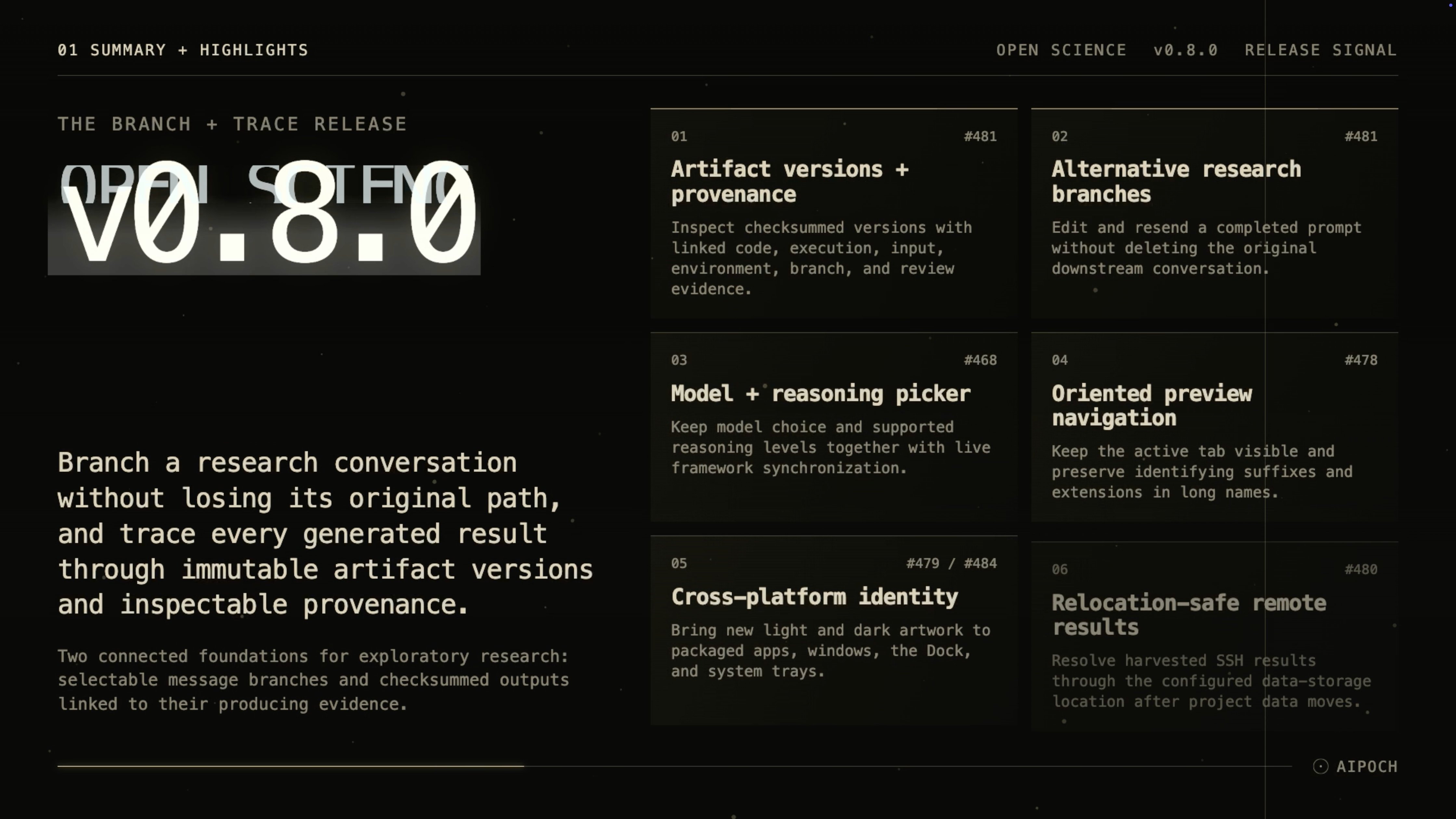
Branch a research conversation without losing the original path, and trace every generated result through immutable artifact versions and inspectable provenance.
Open Science v0.8.0 adds two connected foundations for exploratory research. Editing an earlier prompt now creates a selectable message branch while preserving the original conversation, and generated outputs receive immutable, checksummed versions linked to their producing branch and available code, execution, input, environment, and review evidence.
Highlights
- Immutable artifact versions and provenance. Each generated output can now be inspected as a specific version with checksummed content and linked code, execution, input, environment, branch, and review evidence.
- Message branches for alternative research paths. Edit and resend a completed prompt to explore a different direction without deleting the original downstream conversation; revision controls switch between the alternatives, and branch state persists across restarts.
- Model and reasoning effort in one picker. The composer now keeps model choice and the selected model's supported reasoning levels together, with live synchronization across supported agent frameworks.
- Preview navigation that stays oriented. The active preview tab remains visible through panel resizing, while long names preserve their identifying suffix and extension across previews, mentions, attachments, and artifact suggestions.
- A refreshed cross-platform identity. New light and dark application artwork reaches packaged apps, windows, the Dock, and system trays, with Windows-specific rendering tuned for native sizes and display scaling.
- More reliable remote results with relocated storage. Harvested SSH compute results now follow the configured data-storage location, so jobs remain attachable after moving large project data away from the default location.
New Features
- Durable provenance records — generated artifacts gain session-scoped lineages, immutable versions, checksummed content, producer and input evidence, environment inventories, producing-branch context, version-scoped review evidence, crash recovery, and migration-aware validation.
- Persistent message branching — editing a completed user message forks the conversation from that point, keeps the original later turns available, and preserves branch-specific activity, attachments, files, and artifact ownership.
- Combined composer model control — switch the model and its reasoning effort from one compact menu; available levels adapt to the selected model's capability profile, and changes apply immediately where the active framework supports live updates.
- V2 application identity — light and dark brand assets now cover packaged and runtime surfaces on macOS, Windows, and Linux, including native tray/status-bar variants.
Improvements
- Preview tabs automatically reveal the active result when it moves outside the visible strip, and responsive middle truncation keeps long names recognizable without destabilizing the layout.
- Windows application and tray artwork now uses native icon sizes and dedicated small transparent variants for clearer rendering across light/dark themes and common display scales.
- Remote-compute harvests, result summaries, and notifications resolve through the active data-storage location and pause writes during data migration.
- Public project documentation now leads with clearer local-first research-workbench language, more descriptive imagery, and answer-first summaries for search and generative discovery.
Bug Fixes
- Permission previews use the correct syntax-token palette in dark mode, keeping code readable against dark surfaces.
- Codex can save through the verified app-owned artifact capability without a redundant approval prompt; ordinary writes and unverified tools remain gated.
- Provenance environment evidence now bounds retained operation history by entry count and size while preserving recovery-critical state and reporting cumulative truncation.
- Reviewer findings wrap checksum-like and other long unbroken evidence inside their cards instead of overflowing the layout.