An AI-Assisted Workflow for Structured Methodology Gap Analysis Across Design, Validation, and Reproducibility
Knowing how to identify methodological gaps in research is one of the most time-consuming and judgment-intensive tasks a researcher faces when planning a new study or synthesizing a field. The Method Gap Detector is a Medical Research Agent Skill developed by AIPOCH that can assist researchers in detecting methodological gaps across study design, analysis, validation, bias control, reproducibility, and implementation readiness within a biomedical research area.
The full skill source and reference modules are available in the AIPOCH GitHub repository.
Rather than producing a vague list of limitations, the skill is designed to generate a structured, evidence-aware methodological gap in research map that helps researchers understand which methodological weaknesses are still limiting a field, which shortfalls are most consequential, and what kind of upgraded study would most improve evidentiary quality. Researchers at all career stages — from graduate students conducting systematic reviews to translational teams building next-step study protocols — may find this skill useful as a starting point for methodological audit work.
This skill addresses a different stage of the research workflow than identifying a topic-level research gap. Researchers who have already identified a promising research direction — for example, using a tool such as AIPOCH's Medical Research Gap Finder — can use Method Gap Detector as a next step: auditing the methodological quality of existing literature in that direction before finalizing a study design.
Why Does Methodology Gap Detection Matter?
Methodological weaknesses in published biomedical research are not rare outliers; they remain a persistent, field-level challenge. A 2025 analysis in Annual Reviews of Medicine examined the trajectory of biomedical reproducibility research and found that the underlying problems have remained largely unresolved across multiple waves of large-scale assessment spanning well over a decade.
Beyond direct replication, researchers also need to consider whether findings transfer reliably across different populations, settings, models, or measurement platforms. This generalizability dimension represents a distinct layer of methodological risk. A commentary in EMBO Molecular Medicine argued that external validity in translational biomedicine has received less systematic attention than conventional internal-validity concerns. This underattention may contribute to situations where findings that appear promising in early-stage settings fail to remain robust when tested under different translational conditions.
For individual researchers, manually working out how to identify methodological gaps means reviewing dozens or hundreds of papers, building a gap taxonomy, and distinguishing design problems from analysis problems from reporting deficiencies — a process that can take days of expert-level reading. The Method Gap Detector skill is designed to support researchers in organizing this work into a structured, repeatable workflow, applying consistent research gaps identification methods across an entire evidence base rather than paper by paper.
What Does the Method Gap Detector Skill Do?
The Method Gap Detector agent skill helps researchers identify methodological gaps in study design, analysis, or validation. Find issues such as lack of external validation, weak causal inference, unhandled batch effects, or poor confounder control to support a stronger upgraded study. It is designed to assist with — not replace — the expert judgment required for rigorous methodological evaluation.
Inputs the skill accepts include:
[disease / condition / biomarker / target / method topic / study cluster / paper set] + [request to identify method gaps / validation weaknesses / analysis weaknesses / design weaknesses / upgrade path]
Optional additions:
- target evidence family (clinical cohort / RWE / omics / mechanism / biomarker / model-development / intervention)
- target method concern (external validation / confounding / batch effects / causal inference / transportability / calibration / reproducibility)
- stage constraint (discovery / validation / translation)
- anchor papers or review set
- population, endpoint, or platform constraints
Out-of-scope inputs:
- patient-specific treatment advice
- statistical consulting for a live unpublished dataset without literature context
- fabricating study properties or validation status without evidence
- declaring a method gap solved when the retrieved evidence does not support it
Outputs the skill is designed to provide for researcher review include:
- A Topic Framing section that restates the methodological question, scope boundaries, and assumptions
- A Method Gap Inventory organized by gap class: design gaps, bias-control gaps, analysis-rigor gaps, validation-depth gaps, reproducibility and reporting gaps, and transportability gaps
- A Severity and Field Impact assessment that distinguishes which gaps are merely common from which are truly field-limiting
- An Upgrade Path Recommendation section that identifies the highest-value next-step methodological improvement
- A Self-Critical Review section that flags the most assumption-dependent parts of the analysis for researcher attention
When a transportability gap is primarily driven by population representation — for example, a model validated only in a narrow demographic — researchers may also want to examine that dimension more closely using AIPOCH's Population Gap Detector, which focuses specifically on gaps in population coverage across the literature.
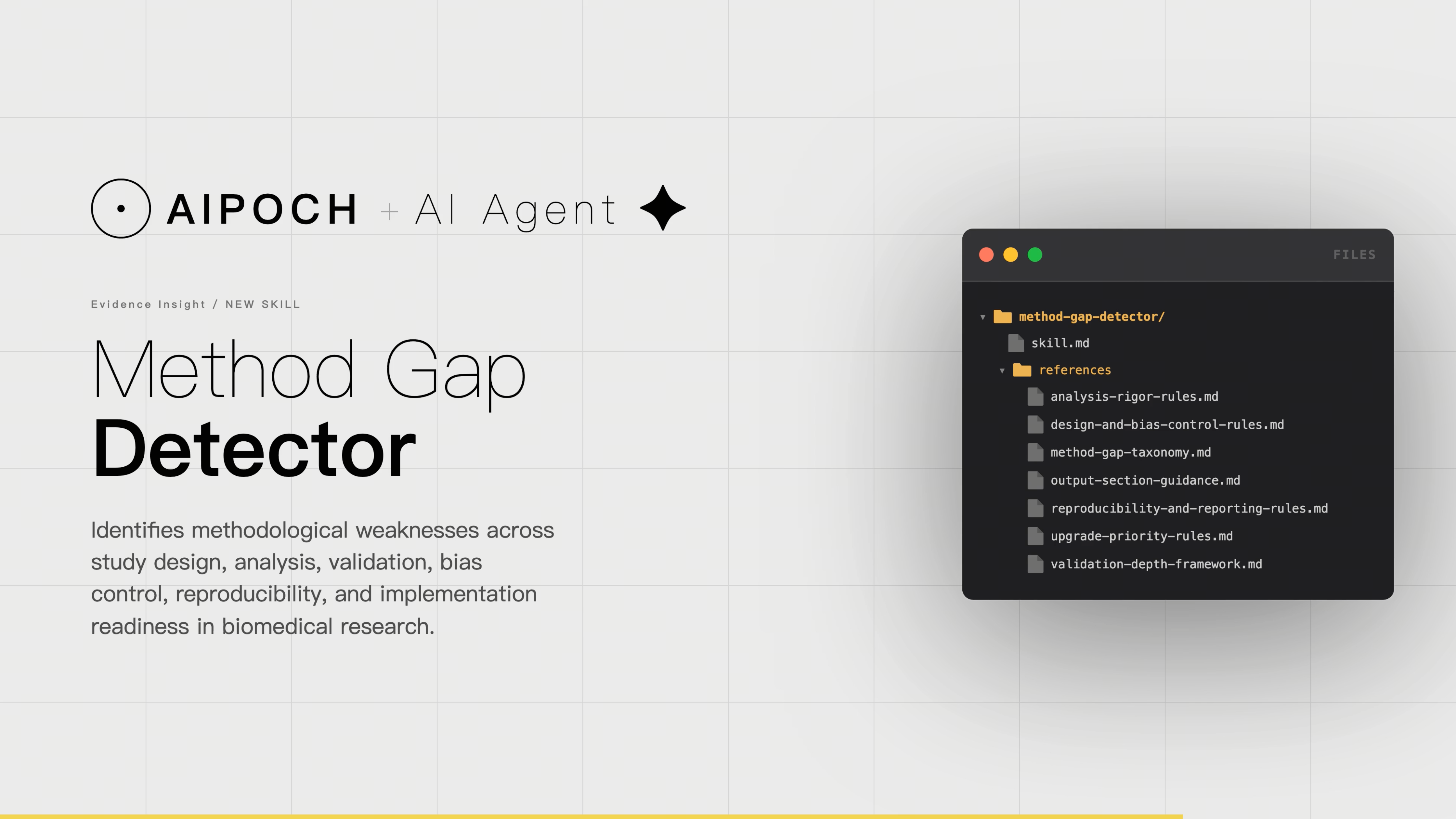
The skill is structured around eight execution steps, from precise topic framing through literature organization, gap classification, validation auditing, severity judgment, upgrade prioritization, and self-critical review. This structure is enforced by a set of reference modules in the skill's GitHub repository, covering areas such as design-and-bias-control rules, analysis rigor rules, validation depth frameworks, reproducibility and reporting rules, and upgrade priority rules.
How to Identify Methodological Gaps in Research? A Step-by-Step Example
A researcher provides a concrete topic-method query. For example: "Identify the main methodological gaps in sepsis prognostic biomarker studies."
Note: The input interface diagram below is illustrative only and does not represent a specific real run or validated output.
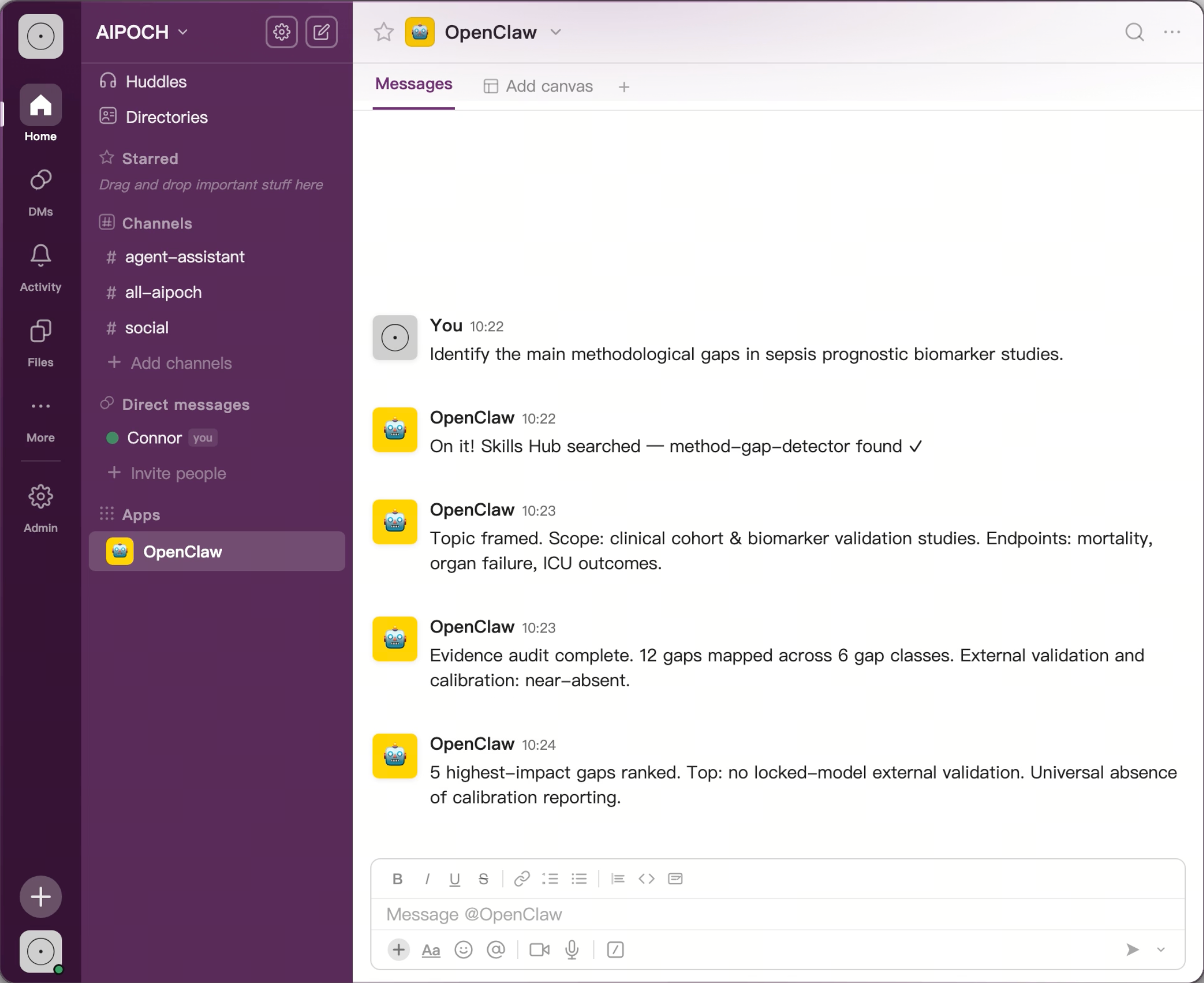
An AI agent following this skill produces a structured output in five stages:
- Topic framing — restates the question (what limits credibility and translation in sepsis biomarker research?) and logs scope assumptions, such as which biomarker types and cohort settings are covered.
- Evidence audit — summarizes the evidence landscape: discovery and internal-validation studies are dense, but external validation, cross-platform harmonization, and implementation studies are sparse to near-absent.
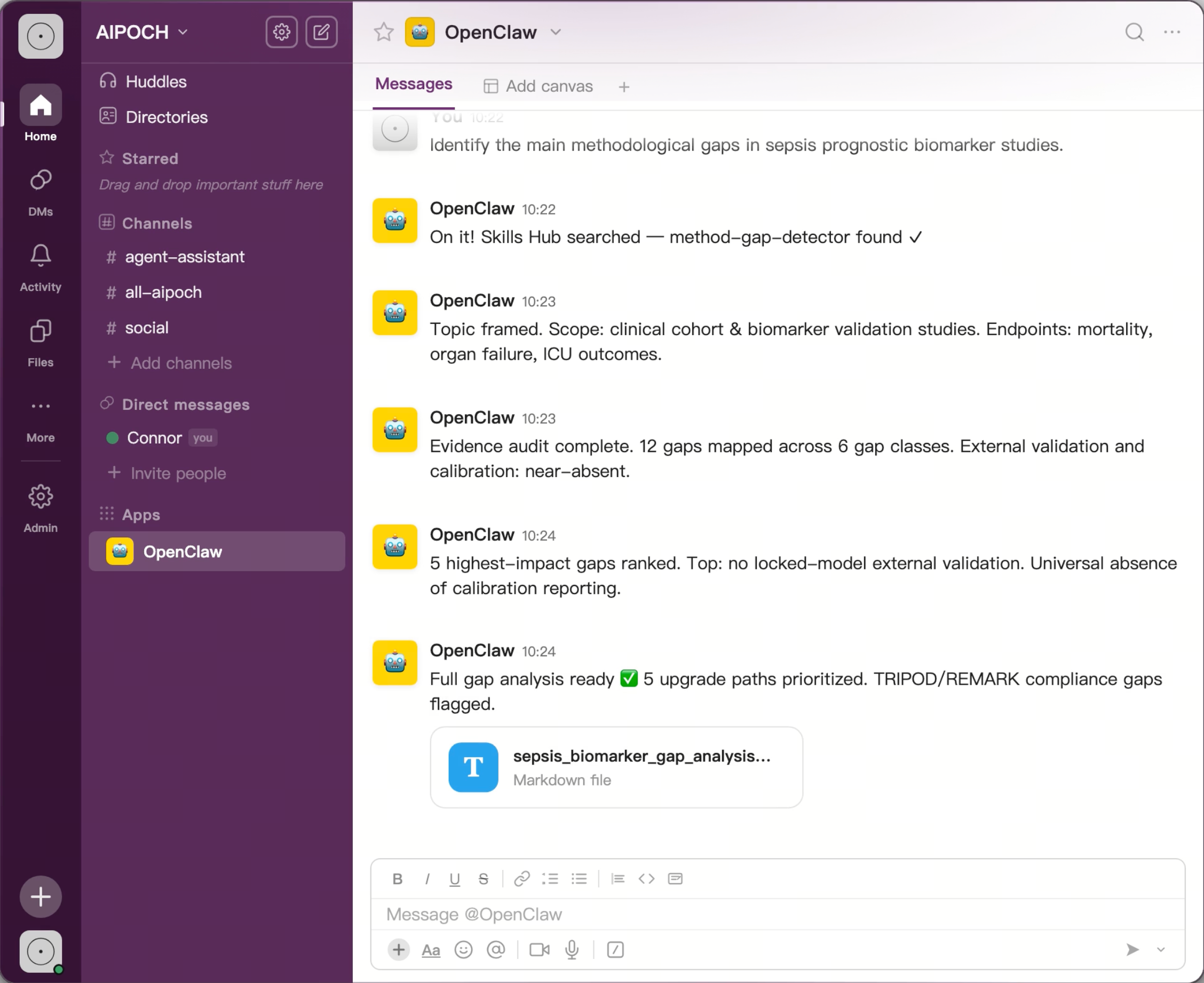
- Gap inventory — builds a table classifying each weakness by type, per the skill's gap taxonomy. For sepsis biomarkers this produced 12 distinct gaps across all six classes, e.g., single-center retrospective design (design gap), missing calibration assessment (analysis-rigor gap), internal-only validation (validation-depth gap), and no clinical decision utility evaluation (transportability gap) — each tracked separately rather than collapsed into one "limitations" statement.
- Severity and upgrade path — ranks the field-limiting gaps and pairs each with a recommendation, following the skill's upgrade-priority rules. Here, the top gap (no external validation with a locked model) maps to Priority 1: a prospective multicenter study testing a locked model under Sepsis-3 criteria.
- Self-critical review — flags which findings are well-supported (external validation and calibration gaps) versus assumption-dependent (severity confounding) or easy to overcall (batch effects, which matter more for omics than for established protein biomarkers).
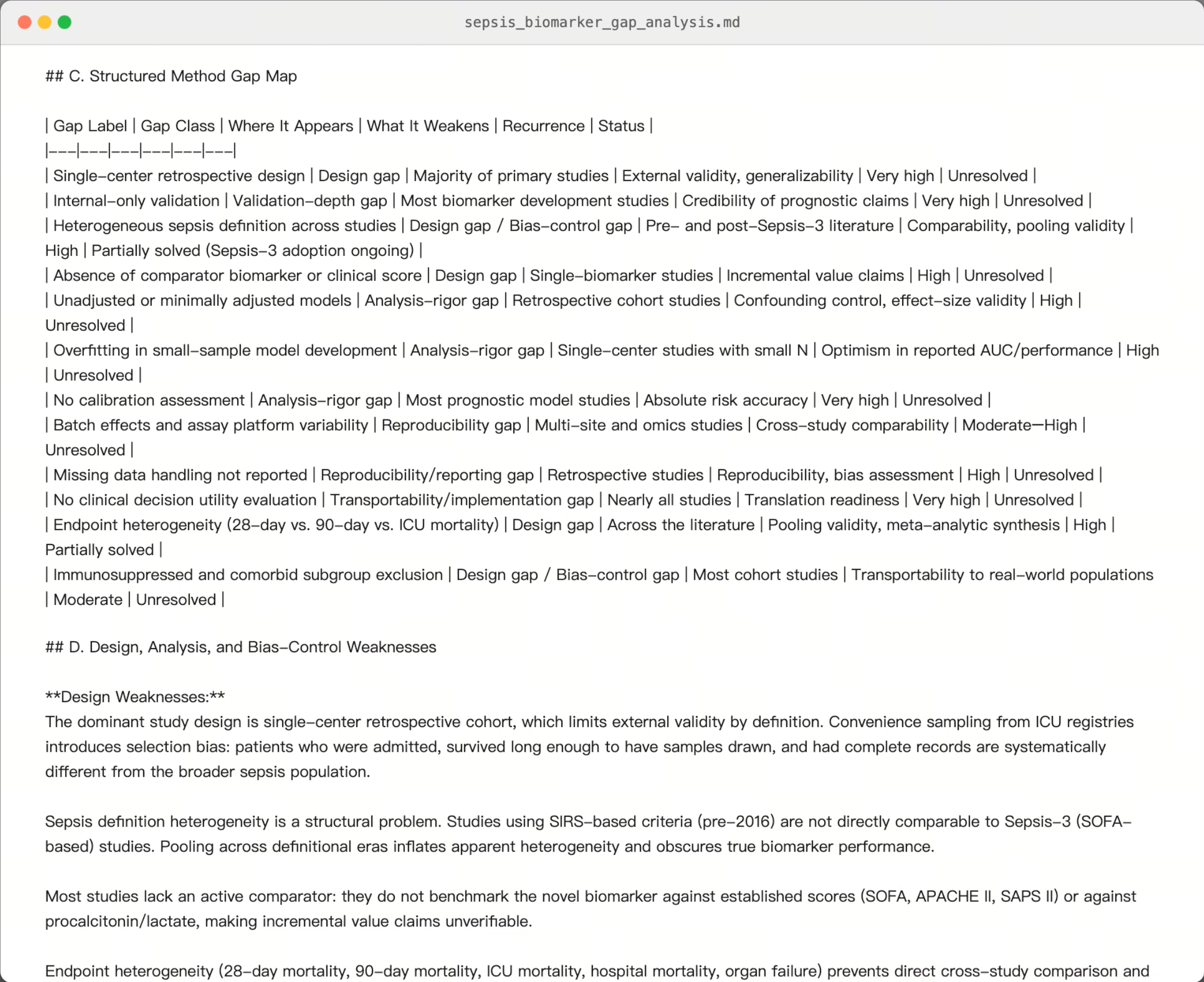
Note: The structured output diagram below is illustrative only. Sample section labels, gap classifications, and severity ratings shown are for demonstration purposes and do not represent any real study or validated research finding.
Structured Outputs for Researcher Review
The final output for researcher review is organized into nine labeled sections (A through I), covering topic framing, retrieval and evidence audit, the structured gap map, design and analysis weaknesses, validation and reproducibility status, the highest-impact method gaps, upgrade path recommendations, a self-critical risk review, and references. Researchers are expected to review and verify all outputs independently.
Watch the Demo
The video below provides a walkthrough of the Method Gap Detector skill in action, demonstrating how a researcher can move from a topic query to a structured methodology gap map.
Manual Workflow vs AI-Assisted Workflow: A Comparison
| Task | Manual Workflow | AI-Assisted Workflow (Method Gap Detector) |
|---|---|---|
| Scope definition | Researcher reads abstracts and selects a topic scope without formal narrowing criteria | Skill helps restate and narrow scope explicitly, logs all assumptions for researcher review |
| Gap inventory | Researcher notes weaknesses informally across papers, often mixing gap types | Skill helps classify gaps by type (design / analysis / validation / reproducibility) in a structured map |
| Severity ranking | Researcher applies subjective judgment; common gaps often treated as equally important | Skill helps distinguish field-limiting gaps from merely common gaps using upgrade-priority reference rules |
| Validation audit | Researcher checks whether external validation is mentioned; may miss underreporting | Skill helps assess validation depth pattern systematically: internal-only vs. external vs. orthogonal |
| Upgrade recommendation | Researcher recommends broadly ("need more external validation") | Skill helps link each upgrade directly to the specific gap it would address, with explanatory rationale |
| Uncertainty disclosure | Varies widely by researcher and time available | Skill includes a mandatory Self-Critical Risk Review section in every output |
| Reproducibility check | Researchers may omit or compress reporting shortfalls | Skill appliesreproducibility-and-reporting-rules.mdto every output as a required module |
Conclusion
The Method Gap Detector agent skill is designed to support biomedical researchers in organizing structured methodological gap analysis — covering design gaps, analysis weaknesses, validation shortfalls, and reproducibility problems — as a structured, repeatable workflow task rather than relying only on unstructured manual review. Outputs are produced for researcher review and are not intended as scientific conclusions; all findings require independent verification. The skill's eight-step execution structure, reference module integration, and mandatory self-critical review are designed to help researchers produce more classification-consistent and evidence-grounded gap analysis as a starting point for study planning, systematic review writing, or protocol auditing.
Once an Upgrade Path Recommendation has been identified, researchers may want to assess whether pursuing that specific upgrade is both novel and practically achievable before committing resources. AIPOCH's Novelty vs Feasibility Assessor is designed to support this next-step evaluation.
AIPOCH has a collection of Medical Research Agent Skills created to support AI-assisted biomedical research workflows across literature review, evidence organization, bioinformatics preprocessing, data analysis support, and research writing tasks. Explore the full skill library at the AIPOCH Agent Skills Library or browse the source repository at the AIPOCH GitHub — Medical Research Skills.
Related Gap-Identification Skills
Method Gap Detector audits the methodological quality of literature within an already-defined research direction. Researchers who have not yet settled on a direction, or who want to evaluate it from other angles, may find these related AIPOCH skills useful:
- Medical Research Gap Finder — surfaces literature-supported knowledge-gap candidates for a topic, as a starting point for choosing a research direction
- Unmet Clinical Need Extractor — identifies clinical needs that remain unaddressed in current practice or evidence
- Medical Topic Saturation and Whitespace Checker — assesses whether a topic area is already saturated or still has open whitespace
- Basic Discovery Translational Opportunity Finder — identifies translational opportunities arising from basic-science findings
- Bioinformatics Translational Opportunity Finder — identifies translational opportunities arising from bioinformatics and omics findings
Frequently Asked Questions
How do I identify methodological gaps in research?
Effective methods for identifying research gaps start by separating gap types — design, bias-control, analysis-rigor, validation-depth, reproducibility, and transportability — rather than treating all weaknesses as a single "limitations" category. The Method Gap Detector is designed to help researchers do this systematically: it accepts a disease, biomarker, or paper cluster as input and produces a classified gap inventory so researchers can see whether a field's primary weakness is in study design, analytical rigor, or external validation coverage.
What is a methodological gap in research, and how is it different from a standard limitations section?
A methodological gap in research refers to a recurring weakness in how studies are designed, analyzed, validated, reproduced, or reported. It is usually visible at the field or paper-cluster level rather than within a single study alone.
A standard limitations section is written after a study is conducted and typically describes that individual study’s specific shortfalls. By contrast, the Method Gap Detector is designed to work at the field level. It helps organize recurring weaknesses across multiple studies, distinguish high-consequence gaps from merely common ones, and suggest upgrade paths that may improve the evidentiary quality of future research.
Does the skill replace expert methodological review?
No. The Method Gap Detector is a workflow support tool. Its outputs are intended as a structured starting point for researcher review, not as validated scientific conclusions. All gap assessments, severity rankings, and upgrade recommendations require independent expert verification before use in any research or publication context.
What inputs does the skill require to function?
The skill requires a disease, condition, biomarker, or evidence family as the core input, combined with a request to identify method gaps, design weaknesses, validation shortfalls, or an upgrade path.
Optional details that can help narrow the analysis include:
- A target evidence family, such as clinical cohort studies, omics studies, mechanism studies, radiomics studies, or prediction-model studies
- A specific methodological concern, such as external validation, confounder control, batch-effect correction, feature-selection overfitting, or reporting completeness
- A stage constraint, such as discovery, validation, translation, or implementation
- A set of anchor papers or a focused paper cluster
- A target population, endpoint, model type, or intended translational use case
Disclaimer
This article is intended for informational purposes only and does not constitute medical advice, clinical guidance, diagnostic recommendations, treatment decisions, or validated scientific conclusions. Sample data, model parameters, and output values shown are illustrative and do not represent any real clinical cohort or validated research finding.
The Method Gap Detector agent skill does not replace researcher judgment, and researchers remain fully responsible for evaluating the accuracy, completeness, and appropriateness of any outputs generated. All outputs it produces require independent verification and expert interpretation before use in any research or clinical context.
References and external links in this article are provided for informational purposes. AIPOCH does not endorse and is not responsible for the content of third-party sources.