What Happens When Kimi K3 Enters A Scientific Workbench?
We connected Kimi K3 to Open Science and tested it on a real bioinformatics reproduction task. Discover how persistent execution, scientific workflows, and an independent reviewer make AI scientific agents more reliable.
TL;DR
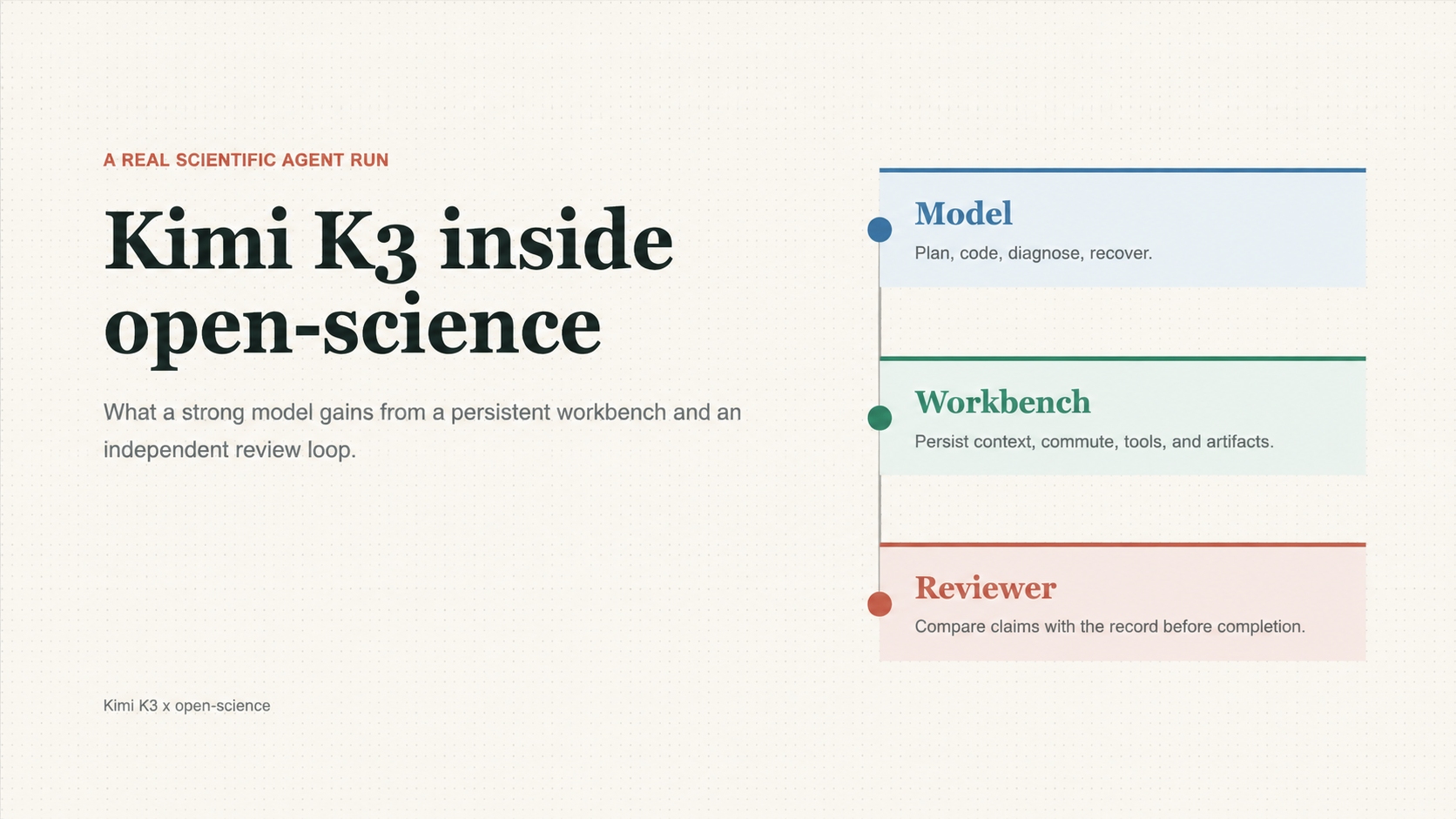
I connected Kimi K3 to Open Science and gave it a real bioinformatics reproduction task. K3 supplied the planning, coding, troubleshooting, and momentum; Open Science supplied the persistent environment, tools, artifacts, and research record around it. The run made one thing clear: a strong model can carry a scientific workflow surprisingly far, but persistence alone is not enough. The workbench also needs an independent review loop that can inspect what the model actually did before fluency turns execution into an accepted result.
Testing Kimi K3 Beyond Benchmarks
In the Kimi K3 scientific agent reproduction benchmark, I focused on the point where a scientific agent should stop. This time, I want to look at everything the agent had to do before reaching that point, and at the workbench that made the run possible.
When Kimi K3 launched, I was curious about the benchmark numbers, but they were not the question I most wanted answered. Scientific work rarely arrives as a clean prompt with a known answer and a self-contained execution environment. It arrives as a paper with incomplete Methods, several public datasets with inconsistent metadata, an R package that no longer behaves like the version used by the authors, and a directory that gradually fills with scripts, logs, tables, figures, and failed attempts.
So instead of giving K3 another isolated coding problem, I connected it to open science and asked it to reproduce the analyses in a published bioinformatics paper. I kept the objective broad on purpose. The point was not to test whether the model could write one differential-expression script or explain how LASSO works. I wanted to see whether it could remain useful across a long scientific task in which understanding the paper, operating the environment, diagnosing failures, revising the plan, and organizing the result all depended on one another.
The test became more revealing than a simple pass or fail. K3 was able to do a large amount of real work, including the parts researchers usually lose time to rather than write about. It also showed why the model and the system around the model should be evaluated as different layers.
Kimi K3 did not behave like a paper Q&A system
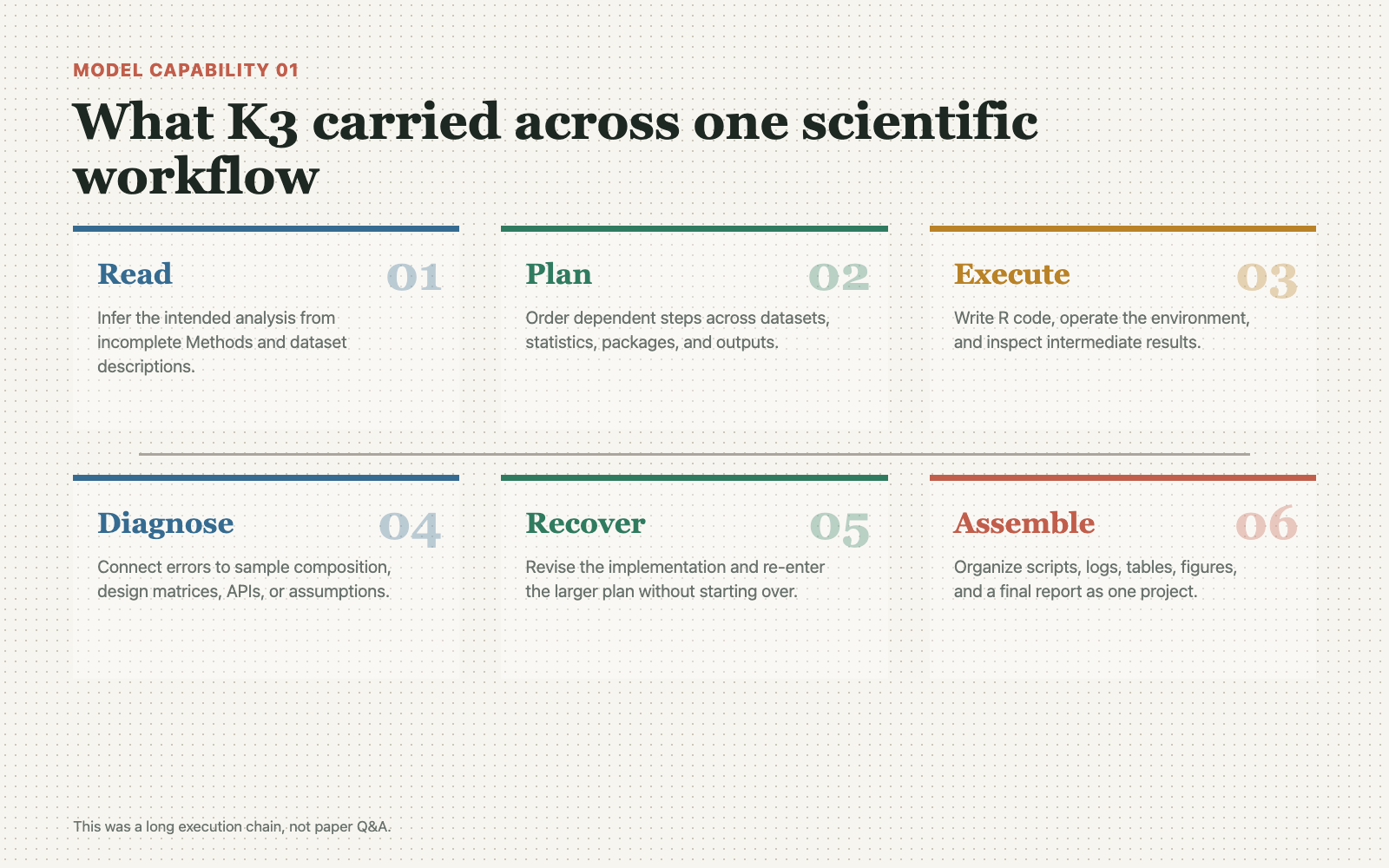
The task began with a paper. K3 had to infer the intended workflow from the Methods, locate the relevant GEO datasets, inspect their sample annotations, reconcile measurements from different platforms, install and operate an R environment, and decide how the downstream analyses depended on one another. It then had to turn that interpretation into executable code and keep adjusting the code as the environment answered back.
This distinction matters because scientific agents are still often demonstrated through retrieval and explanation. A model reads a paper, answers a question about it, and perhaps produces a short script. That can be useful, but it does not expose the harder coordination problem. In this run, a decision made while filtering samples affected batch correction; batch correction affected the expression matrix; that matrix affected differential analysis and feature selection; and those results determined which figures and claims appeared later. K3 was not merely responding to the latest message. It was carrying state through a chain of dependent operations.
Kimi K3 Performed Best When the Workflow Broke
Kimi K3 strongest behavior appeared when the workflow broke. The initial batch-correction step failed with a singular design. Kimi K3 inspected the sample composition and design matrix, revised the filtering and ComBat setup, reran the analysis, and continued from the repaired output. The project retained the initial script, revised scripts, diagnostic scripts, and their logs, so the recovery could be reconstructed afterwards.
That loop is easy to underestimate: observe an execution result, work out whether the problem is caused by code, data, an API, or an assumption, change the implementation, and then re-enter the larger plan without losing the original objective. It requires more than code generation. It requires the model to connect the scientific description, the current filesystem, the statistical operation, and the consequences of its next action.
Kimi K3's Proactive Execution
It did not wait for a separate instruction for every table, figure, or summary. It kept extending the project until it had produced a structured report and a substantial set of outputs. This matches an important limitation Moonshot notes in the Kimi K3 technical blog: training for difficult long-horizon tasks can make the model excessively proactive when the user's intent is ambiguous. In this test, that proactiveness was both a large part of its usefulness and the clearest argument for an independent reviewer. The more capable the agent becomes at continuing, the less reasonable it is to ask the same uninterrupted reasoning process to notice every place where it should have slowed down, disclosed a substitution, or reconsidered the status of a downstream result.
Long Answer vs. Project
The difference between a long answer and a project is consequential. A long answer can describe what should have happened. A project exposes what actually happened. It contains the code the agent really executed, the warnings it encountered, the files it produced, the substitutions it made, and the parts of the plan that never became valid artifacts. Once those objects persist together, the researcher can evaluate the process rather than being asked to trust the fluency of its summary.
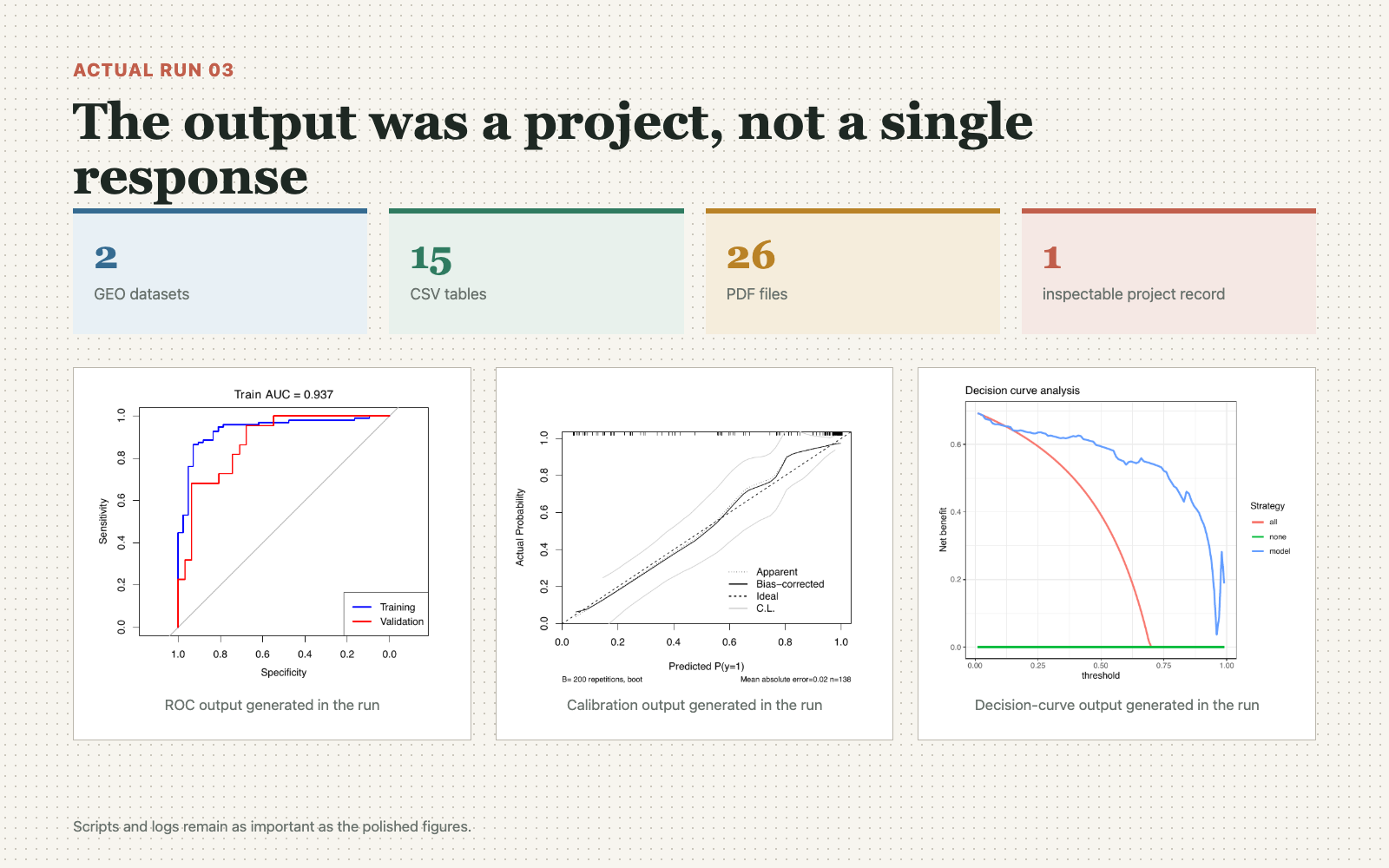
By the end of the run, the workspace contained the original and revised R programs, multiple diagnostic scripts, complete execution logs, 15 CSV tables, 26 PDF files, supporting data objects, session information, and a final reproduction report. The analysis crossed two GEO datasets and moved through normalization and integration, differential expression, feature selection, enrichment, model construction, ROC analysis, a nomogram, calibration, and decision-curve analysis.
Those numbers are not evidence that every scientific conclusion was valid, and I discussed the most important review problem separately in A scientific agent should know when not to make the figure. Their role here is narrower: they show that this was not a one-step demo selected to flatter the model. K3 carried a heterogeneous task across many tools and intermediate states, recovered from failures, and assembled something that another person could reopen and inspect.
Run snapshot Two GEO datasets, cross-platform integration, several rounds of R diagnosis and recovery, 15 CSV tables, 26 PDF files, executable scripts, complete logs, and a final report.
Kimi K3 and Open Science solved different problems
It is tempting to attribute the whole run either to K3 or to open-science. Neither description is accurate. The useful behavior came from an interaction between the reasoning model and the environment in which that reasoning could act.
Kimi K3 supplied flexible scientific and technical judgment. It interpreted incomplete methods, planned the order of operations, wrote and revised code, read error messages, inspected data structures, chose recovery routes, and organized the outputs into a coherent account. These are high-judgment steps, and a weaker model would not become equally capable simply because it had access to the same terminal and files.
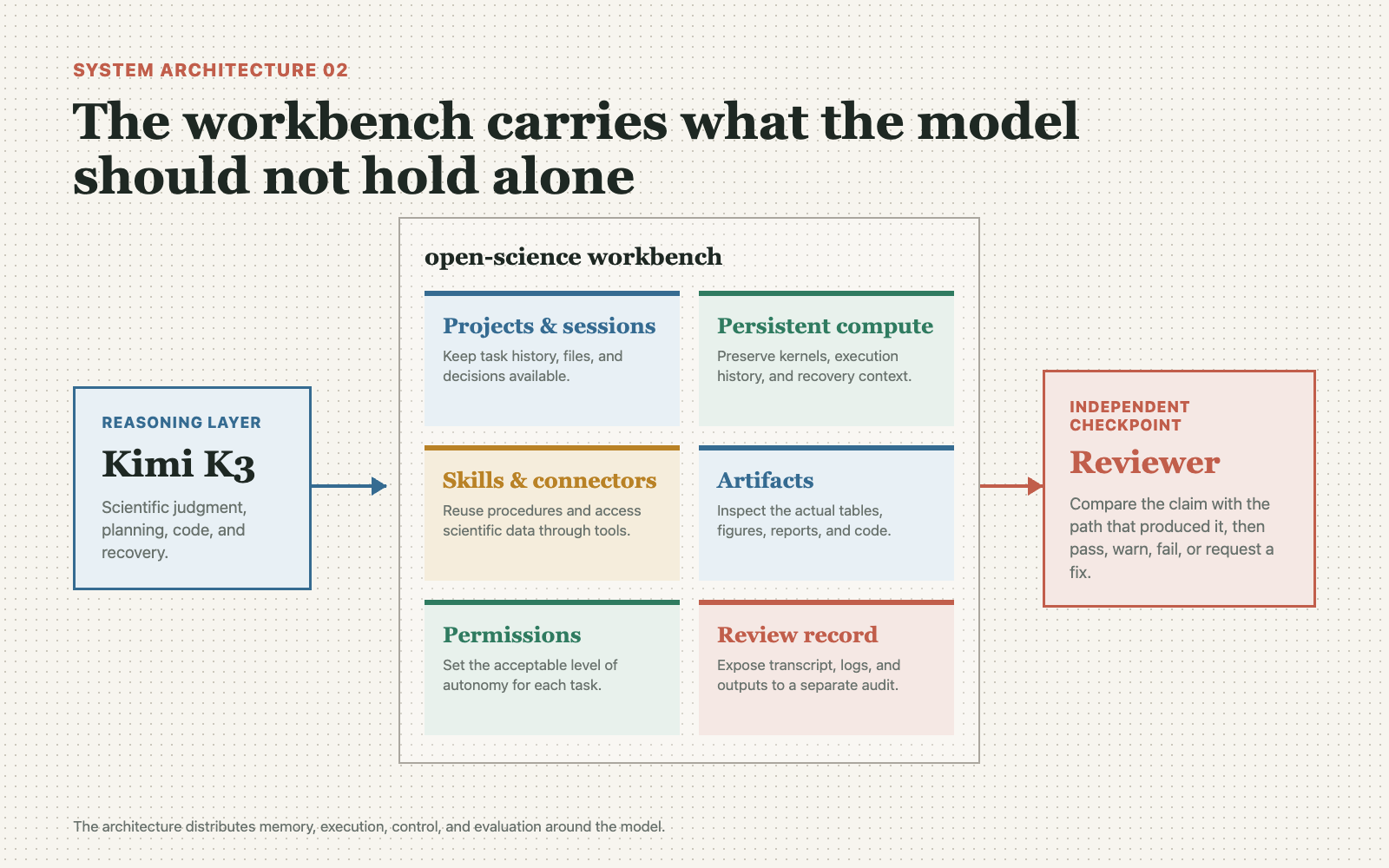
Open Science supplied the durable workbench around those decisions. It gave the agent a project and session rather than a disposable chat, an execution environment rather than a code block, file and artifact surfaces rather than attachments scattered across messages, and an activity history that remained available after the task ended. Its current released workflow is organized around plan -> execute -> produce -> preview, with persistent projects and sessions, a multi-kernel notebook runtime, tool activity, scientific skills and connectors, permission controls, artifact previews, and an opt-in reviewer. That last component matters because persistence creates the material a reviewer needs: the transcript, execution log, and artifacts remain available as evidence rather than being compressed into the agent's own account of its performance.
The third layer is the scientific workflow itself. It defines what an analysis node requires, which assumptions must hold, which substitutions change the question, what counts as independent validation, and when a downstream result should be completed, downgraded, reviewed, or stopped. The K3 run showed that the first two layers are already enough to take a complex task a long way. It also showed why the third cannot be left entirely to the model's improvisation.
| Layer | What it contributed in this test |
|---|---|
| Model: Kimi K3 | Interpreted the paper, planned the analysis, wrote code, diagnosed errors, selected recovery routes, and organized the results |
| Workbench: Open Science | Maintained the agent runtime, project and session state, compute history, permissions, files, artifacts, and inspectable activity record |
| Domain workflow | Should define method prerequisites, dataset roles, acceptable substitutions, validation rules, result states, and stop conditions |
This separation is useful because it prevents two common mistakes. The first is assuming that enough scaffolding can compensate for a model that cannot make difficult scientific decisions. The second is assuming that a strong model no longer needs a workflow because it can usually work out what to do. A workbench does not replace model capability; it makes that capability persistent, inspectable, and governable.
What Open Science Adds Around The Model
Open Science is an open-source, model-agnostic scientific workbench designed to keep the research task, agent activity, computation, and resulting files in one inspectable workspace.
The persistence layer is more important than it first appears. Projects collect related sessions, uploaded sources, generated files, and preview state. A later session can return to the same research object instead of reconstructing the entire history from a summary prompt. This allows a researcher to change models or continue on another day without reducing the previous run to whichever details happened to fit in the context window.
The execution layer turns recommendations into operations. The agent can read and edit files, run commands, work through persistent Python, managed R, and REPL kernels, search, call connectors, and generate artifacts under an approval policy. In the K3 test, that meant the model could move repeatedly between reasoning and execution: it could inspect an error, edit the script that caused it, run the revised version, and then examine the resulting files without handing the task back to me after every step. The current runtime preserves crash-recoverable run history, although reproducible environment snapshotting and export are still roadmap work.
The artifact layer keeps the outputs close to the process that created them. Reports, tables, figures, source code, scientific data, molecular formats, and notebook history can be inspected from the same project. In v0.5.1, the Files tab also gained indexed pagination and session grouping, which matters once a long agent run produces more material than a flat file list can comfortably expose. This does not automatically establish scientific validity, but it changes what review is possible. A claim in the final report can be traced back to a figure, then to the program and log behind it, rather than remaining an unsupported sentence in a chat transcript.
Skills and connectors make the environment extensible without forcing every capability into the base model. File-based skills can encode reusable procedures, while built-in life-science and custom MCP connectors expose literature, gene, protein, genomic, structural, clinical, expression, chemistry, and regulatory resources as permissioned tools. The model still decides when and how to use them, but the access pattern and operating instructions do not have to be rediscovered in every session.
Permissions define how much autonomy is appropriate for the task. File edits, commands, network access, and connector calls can remain approval-gated or be granted more autonomy in a trusted project. This matters in research because the same agent that can save hours by installing a package or downloading a dataset can also send sensitive inputs to an external service or modify important files. Capability without visible control is not a sufficient product design.
What the Open Science Reviewer Does
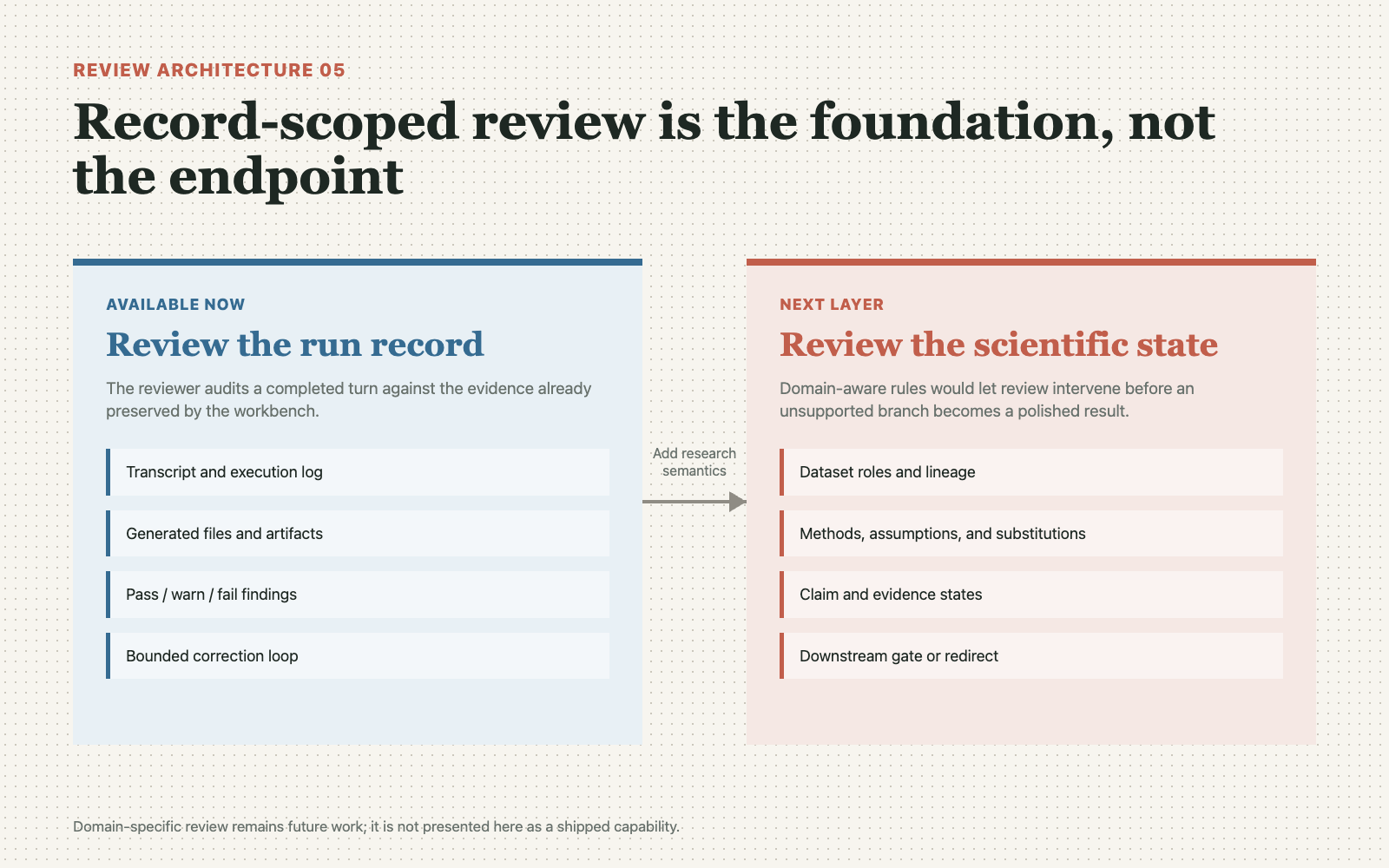
The reviewer provides a separate pass over a completed turn. It can compare the transcript, execution log, and artifacts, return pass, warn, or fail findings, and trigger a bounded correction loop. The latest release further hardens audit isolation, fix-loop integrity, and recovery from context-overflow errors. This separation is important: asking the acting agent to "check its work" still leaves generation and evaluation inside the same trajectory, with the same context, assumptions, and pressure to complete. A reviewer gets a bounded mandate to look for discrepancies between what was claimed and what the run can actually support.
The archive from this K3 run did not contain a reviewer result, so I cannot claim that it was checked by this mechanism. That absence is analytically useful. It leaves us with a concrete example of what the agent produced when its execution loop was allowed to continue without a recorded independent review pass. The current reviewer is still opt-in and record-scoped, and it does not yet apply domain-specific citation, units, statistics, or bioinformatics rules. Even so, it establishes the right architectural boundary: review is part of the workbench, not an instruction appended to the acting model after it has already written the conclusion.
The Architecture Changes What the Model Can Do
The architecture changes how much of the scientific task the model has to carry inside its own context.
Persistent projects and sessions keep the task history, source files, intermediate outputs, and prior decisions available without asking the model to reconstruct the entire study from a summary prompt. Persistent compute keeps variables, environments, and execution history close to the reasoning that produced them, allowing an error to become the start of a diagnosis loop rather than the end of a response.
Other parts of the architecture reduce different kinds of model burden. Skills give the agent reusable operating procedures instead of asking it to invent every analysis workflow from scratch. Scientific connectors provide structured access to external databases rather than relying on the model to recall facts or improvise brittle retrieval code. Artifact previews let both the model and the researcher inspect the actual table, figure, or report. Permission settings make the acceptable level of autonomy explicit, while the reviewer creates a separate checkpoint for comparing claims with the transcript, execution record, and generated files.
Together, these settings do not make the model smarter in the abstract; they distribute the task so that the model can spend more of its capacity on scientific judgment without also being the sole author, operator, witness, and evaluator of the same run.
The Harness Still Matters
Kimi's own documentation warns that K3 is sensitive to how thinking history is preserved and may become unstable if the harness handles that history incorrectly or a session switches models midway. A model-agnostic workbench therefore cannot pretend every endpoint, agent framework, and context format is interchangeable. It needs explicit compatibility rules and durable project-level handoffs so that changing the model does not also mean losing the research process. The project, evidence, artifacts, and review state should remain continuous even when the model changes. That is a stronger form of model choice than simply selecting a provider before opening a new chat.
Inspectability is not the finish line
The K3 run was unusually useful to review because its work remained visible. I could compare the final report with the scripts, logs, tables, and figures and identify where execution success and scientific support had diverged. Without that record, the same run might have looked like an impressive completed analysis with a few ordinary caveats.
However, storing the record does not by itself interpret it. A file existing in the output directory does not prove that the analysis succeeded. A successful command does not prove that it executed the same scientific operation described in the paper. A fluent report does not prove that every claim is supported by the artifacts it cites. The workbench can preserve these objects while still needing a more explicit account of their scientific relationships.
This is where the next layer of open science becomes important. Dataset roles need to persist across the workflow so that a cohort used in feature selection cannot later be relabeled as independent validation without review. Analysis nodes need contracts that identify required inputs, assumptions, acceptable engineering recoveries, substitutions, expected artifacts, and downstream dependencies. Artifacts need validity and version state rather than mere presence. Claims need to inherit the weakest evidence state in the path that produced them.
The current open-science roadmap already points toward several pieces of this direction. Artifact versioning, provenance, environment snapshotting, a unified model gateway, and domain-specific reviewer rules are not shipped in v0.5.1. Dataset lineage, analysis-node contracts, and formal states such as completed, recovered, substituted, approximate, unsupported, and gated would connect the preserved execution record to what a result is allowed to mean.
A Strong Model Is Only Part of a Scientific Agent
What impressed me most was how much of a messy scientific workflow it could carry without repeatedly handing the task back to the user. It read, planned, coded, diagnosed, recovered, and assembled a project across many dependent steps. That is a meaningful change in what an open model can contribute to day-to-day research.
The test also changed how I think about the product around the model. Researchers should not have to choose between a powerful but disposable agent session and a rigid pipeline that preserves structure by removing judgment. The more useful middle ground is a workbench in which strong models can act, their work can persist, alternative models can enter the same project, and an independent reviewer can inspect the actual path from source material to claim before that path is treated as complete.
We are still testing this reviewer layer from several directions. That includes controlled runs with the same model and task under reviewer-on and reviewer-off conditions, as well as tests across different scientific domains, failure modes, artifact types, and levels of task complexity. We are looking not only at whether the reviewer finds an error, but when it intervenes, what evidence it uses, whether its correction changes the downstream analysis, how many unnecessary tokens it prevents, and whether the resulting review is clear enough for a researcher to act on.
The goal is not to add more warnings to an already complicated workflow. It is to improve the reviewer's scientific judgment, make its reasoning easier to inspect, and make review feel like a useful part of doing the work rather than another report to read at the end. These tests are feeding directly into the scientific decision logic and interaction design we are building into open-science. We will continue sharing the runs, the failures, and the product changes they lead to in upcoming releases.
Kimi K3 made this workflow capable of moving. Open-science made the movement visible and recoverable. The next step is to make the scientific state as durable as the code and files already are.