How to Generate Cox Survival Model Calibration Curves: An AI Agent Workflow Guide
Learn how the AIPOCH Model Calibration Curve skill can help researchers generate bootstrap calibration curves for Cox survival models from clinical CSV files.
Does the C-Index Tell You Whether Your Survival Model Is Well-Calibrated?
The short answer is no. Discrimination and calibration are distinct validation dimensions — and calibration is often neglected. The AIPOCH Model Calibration Curve skill addresses this by fitting a Cox model and generating bootstrap calibration curves at one or more prediction horizons from a clinical CSV file.
Introduction
Cox survival model calibration curves are a standard but frequently omitted component of prognosis research validation. A calibration audit of multimodal cancer survival models found that leading models — including MCAT, SurvPath, and MMP — report only C-index metrics with no formal calibration assessment, despite the fact that a model can rank patients correctly while generating survival probability estimates that are substantially wrong. According to a Frontiers in Genetics study by Soave and Strug noted that calibration is rarely reported in risk prediction studies, citing Collins et al. (2014).
The AIPOCH Model Calibration Curve skill is designed for assessing how well a survival model's predicted probabilities agree with observed outcomes — by fitting a Cox model and generating bootstrap calibration curves at one or more prediction horizons from a clinical CSV file. This article describes how that workflow operates and what outputs researchers receive.
What Does the Model Calibration Curve Skill Do?
The Model Calibration Curve skill can be used to fit a Cox proportional hazards model from clinical survival data and user-specified predictors, then generate bootstrap calibration curves at one or more prediction horizons to assess agreement between predicted survival probabilities and observed outcomes, while exporting calibration statistics, visualization outputs, and reproducible run metadata.
The skill is open-source and available in the AIPOCH medical research skills repository on GitHub.
Scope boundaries: It is not intended for nomogram construction, univariate Cox screening, ROC analysis, or decision-curve analysis.
Inputs accepted:
Clinical Data (--data_file)
CSV file with row names as sample IDs and columns for model features, survival time, and event indicator.
Requirements
- File extension must be
.csv. - Row names must be unique sample IDs.
- All requested features plus
time_colandevent_colmust exist. - Survival time values must be finite numbers greater than
0. - Event values must use
0/1encoding. - Complete-case filtering must leave at least 30 samples and at least 10 events.
Feature Selection (--features)
- Comma-separated without line breaks:
age,gender,risk - Character predictors are converted to factors before Cox fitting.
- If every requested feature is absent after validation, the run stops.
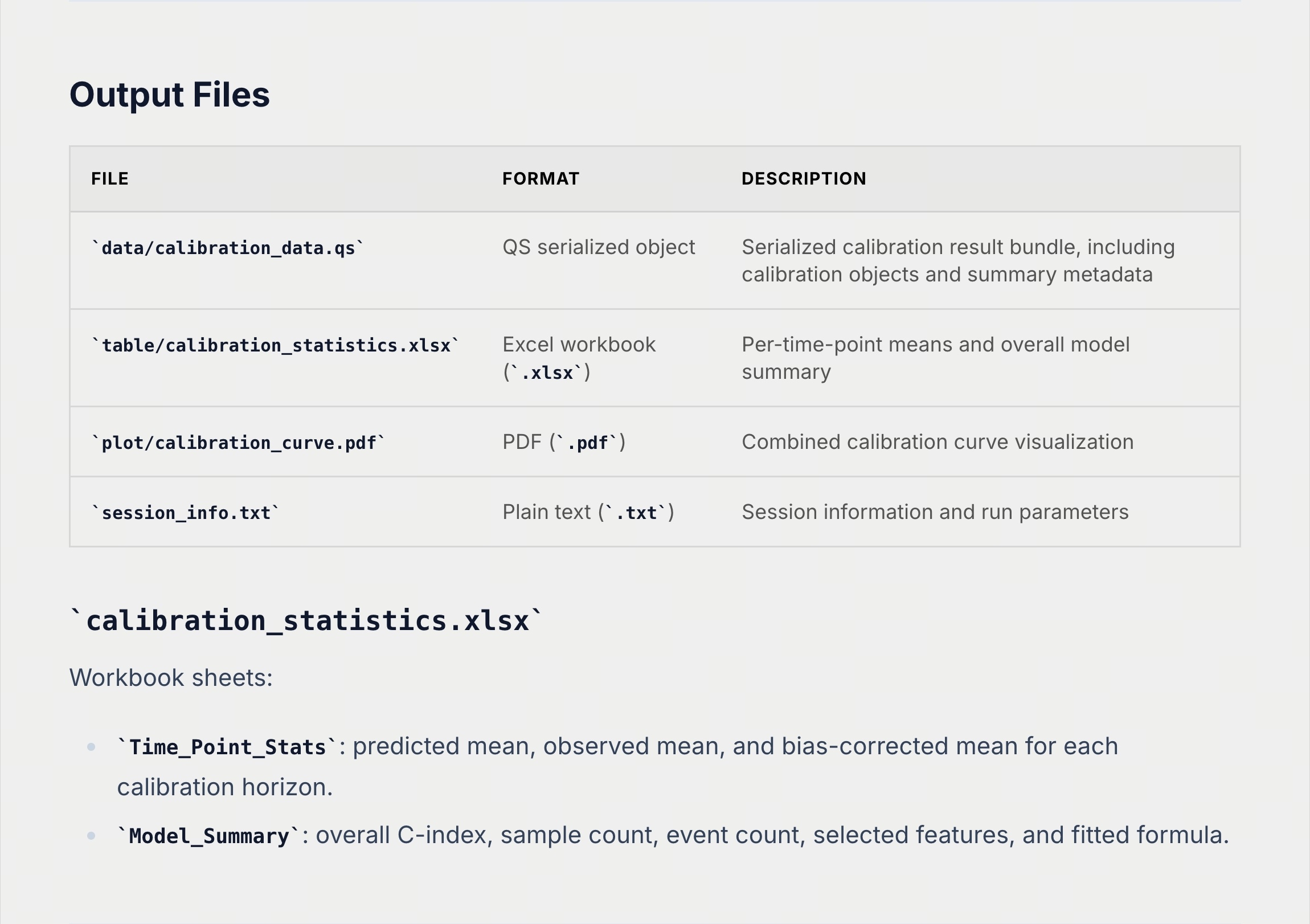
Outputs generated for researcher review:
How Does the Workflow Execute? A Step-by-Step Example
The example is for demonstration purposes only. Sample data, model parameters, and output values shown are illustrative and do not represent any real clinical cohort or validated research finding.
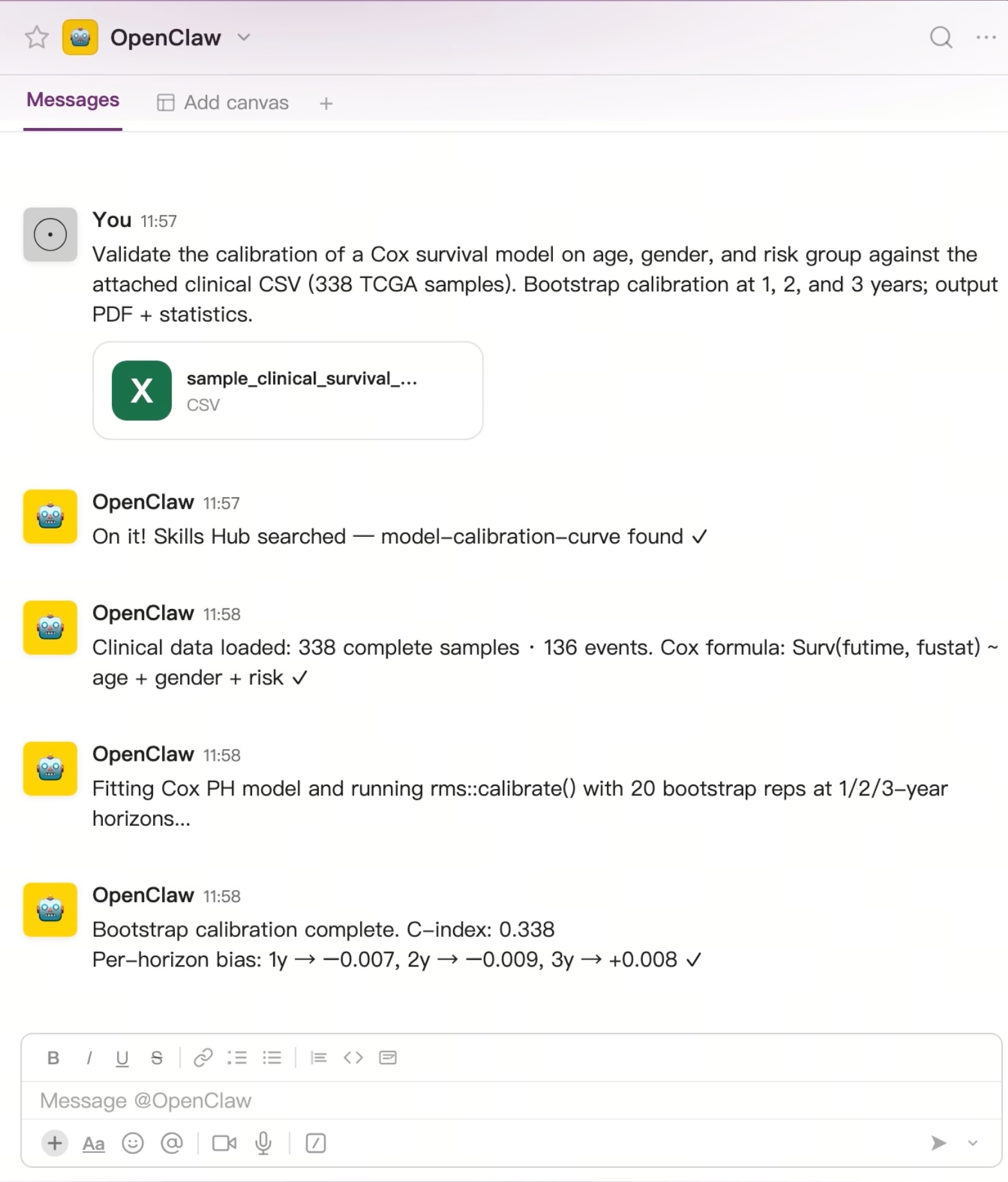
Step 1 — Input
The researcher sends a prompt specifying the task, attaches a clinical CSV file (338 TCGA samples), and requests bootstrap calibration at 1, 2, and 3 years with PDF and statistics as output.
Step 2 — AI Workflow Execution
The agent executes four stages:
Input validation — Confirms the CSV is readable, checks that all requested feature columns, survival time, and event columns are present, and filters to complete cases.
Data preparation — Converts survival time and event columns to numeric; converts character predictors to factors. Rejects data with non-positive follow-up times, invalid event coding, too few samples, or too few events.
Model fitting and calibration — Fits a Cox proportional hazards model with the specified features and runs rms::calibrate() at each requested prediction horizon using bootstrap resampling.
Step 3 — Structured Outputs
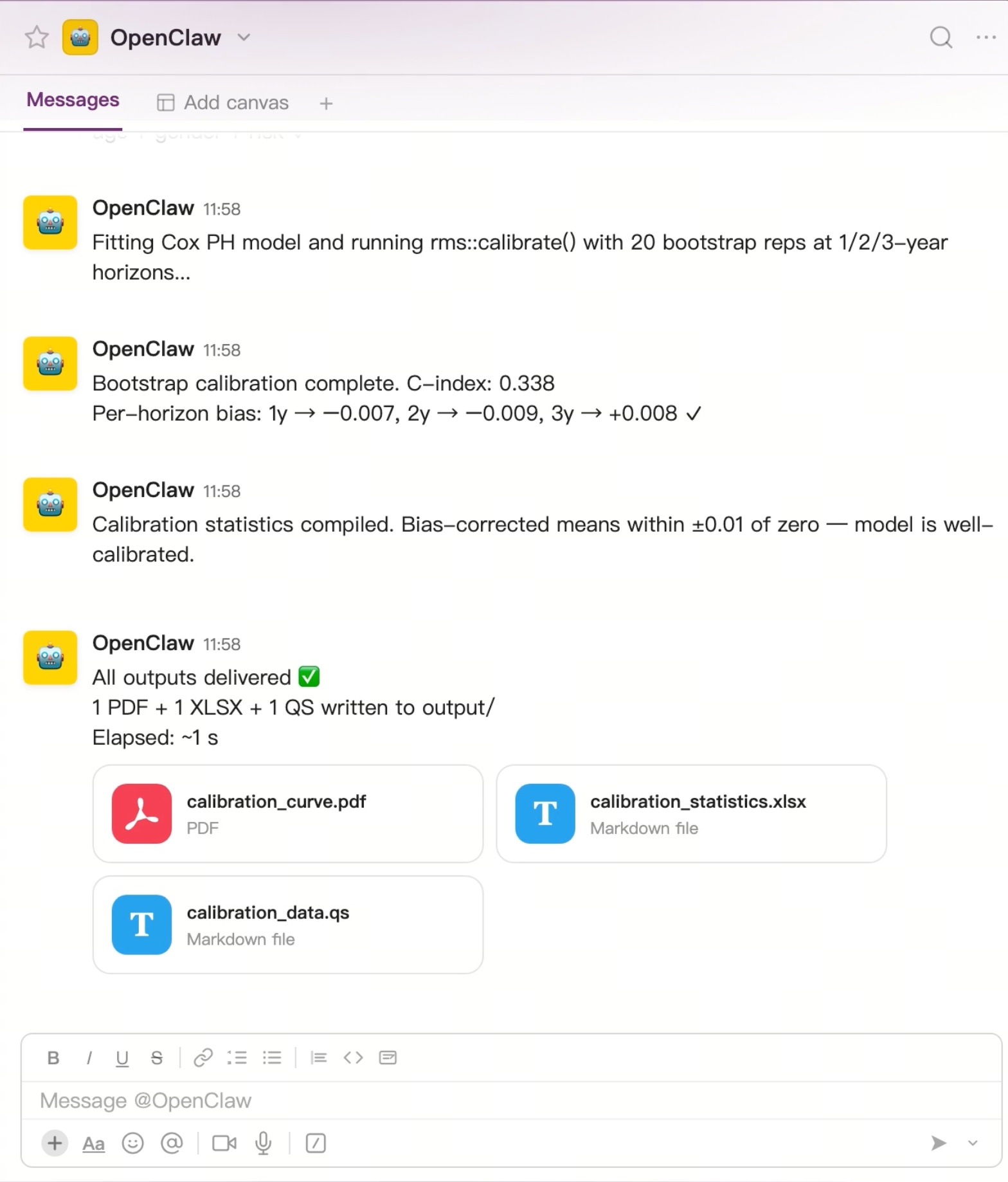
Output:
- calibration_curve.pdf
- calibration_statistics.xlsx
- calibration_data.qs
Manual Workflow vs. AI Agent Workflow
| Task | Manual Workflow | AI Agent Workflow |
|---|---|---|
Cox model fitting withrms | Writerms::cph()call manually; handle factor conversion | Skill organizes factor conversion and model fitting from CSV input |
| Bootstrap calibrate execution | Scriptrms::calibrate()per horizon; manage loops | Skill runsrms::calibrate()across all specified horizons in one command |
| Bias-corrected statistics assembly | Extract and format from calibration objects manually | Statistics exported to structured XLSX workbook for researcher review |
| Combined calibration PDF rendering | Write multi-panel base R plot code | PDF rendered with configurable dimensions, colors, and title |
| Reproducibility documentation | Manually record session info and parameters | session_info.txtgenerated automatically per run |
| Error handling | Debug R errors manually | StructuredSKILL_*error codes with troubleshooting reference |
Conclusion
Bootstrap calibration curves for Cox survival models are an important component of rigorous prediction model validation — yet calibration remains one of the most frequently omitted dimensions of model performance in published survival research. The AIPOCH Model Calibration Curve skill is designed to help researchers:
- assess the calibration of a Cox survival model with bootstrap calibration curves;
- compare predicted and observed survival probabilities at multiple horizons;
- export calibration statistics together with a PDF visualization.
This skill does not replace researcher judgment in selecting predictors, interpreting calibration results, or deciding whether a model meets the standards of a given study context. It is designed to reduce the repetitive preprocessing and scripting steps involved in calibration execution, so researchers can focus on analysis and interpretation.
AIPOCH is a collection of Medical Research Agent Skills created to support AI-assisted biomedical research workflows across literature review, evidence organization, bioinformatics preprocessing, data analysis support, and research writing tasks. Explore the full AIPOCH skill library or browse the medical research skills source repository.
Disclaimer
This article is intended for informational purposes only and does not constitute medical advice, clinical guidance, diagnostic recommendations, treatment decisions, or validated scientific conclusions. Sample data, model parameters, and output values shown are illustrative and do not represent any real clinical cohort or validated research finding.References and external links in this article are provided for informational purposes. AIPOCH does not endorse and is not responsible for the content of third-party sources.
The agent skill does not replace researcher judgment, and researchers remain fully responsible for evaluating the accuracy, completeness, and appropriateness of any outputs generated. All outputs it produces require independent verification and expert interpretation before use in any research or clinical context.