Open Science v0.14.0 Brings Production Subagent Delegation
Open Science v0.14.0 adds durable subagent delegation, stable connector identities, camelCase Host APIs, and fixes for permissions, search, and streaming.
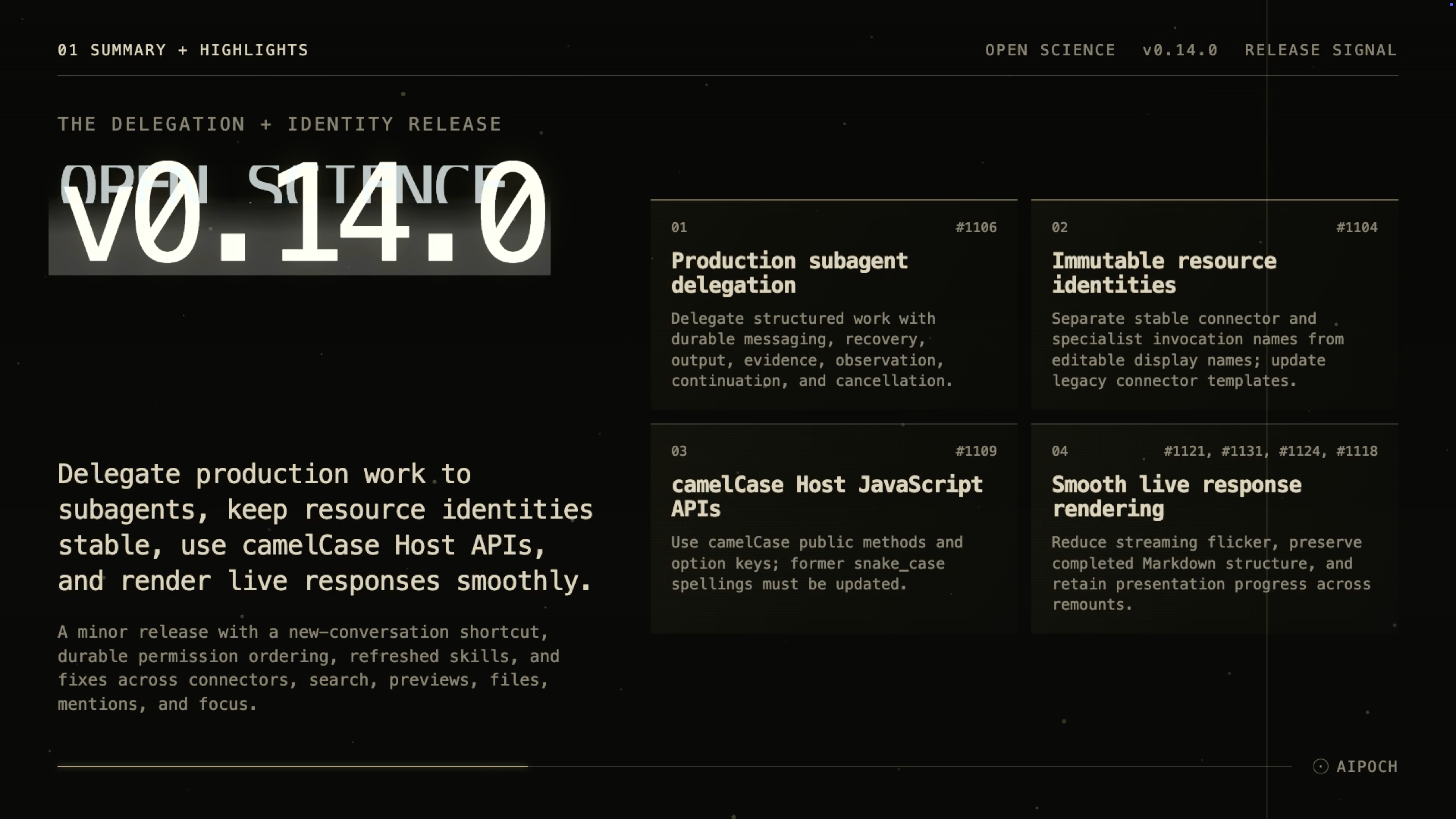
Open Science v0.14.0 makes delegated agent work durable, observable, and recoverable. A main agent can hand a bounded research task to a subagent, follow its progress, respond to questions or permission requests, and bring structured output, artifacts, and associated review evidence back into the same project record.
The release also stabilizes how Connectors and Specialists are identified, moves the public Host JavaScript API to camelCase, and improves everyday interactions including streaming, permission ordering, global search, custom MCP startup, and project-file stability.
Open Science is an open-source, local-first, model-agnostic, self-hosted AI research workbench from AIPOCH. It pairs a plan-and-execute agent with persistent compute, durable project and session storage, and inspectable research artifacts.
Delegate research tasks without losing control
A common research workflow has a single agent trying to do many things at once: search literature, transform data, run code, and write up findings. v0.14.0 lets the main agent hand off a clearly bounded piece of that work to a subagent inside the same project.
For example, you can ask the main agent to prepare a literature evidence table while it also coordinates analysis of an uploaded dataset. The main agent can delegate the evidence extraction to a subagent, continue working on its own task, and later merge the subagent's output back into the conversation and project record.
Four things make this practical for real research:
- Delegate. The main agent can assign a bounded task to a subagent without losing the overall thread of the session.
- Observe and intervene. Subagent status, messages, questions, permission requests, and previews appear in the workspace, and you can stop the subagent if it goes off track.
- Collect outputs. Structured results, artifacts, and any associated review evidence return to the main workspace record.
- Recover. The orchestration state is persisted and recoverable, so a restart or partial failure does not erase the delegated work.
Production-ready here refers to durable, observable, and recoverable delegation inside an Open Science project. It does not mean that delegated work is scientifically validated or that human review is no longer required.
Safer identities for Connectors and Specialists
Connectors and Specialists now keep stable runtime identities. A connector declares an immutable lowercase-hyphenated name at creation, while the displayName remains editable. Renaming a connector no longer breaks routing, permission grants, or generated skill references. Specialists likewise keep an immutable name after creation while the display name can change. Personal skill names must also be lowercase-hyphenated standard names and are used unchanged for frontmatter, package directory, and catalog identity.
This removes a common source of breakage: changing a readable label used to silently change the invocation target, which could invalidate permissions and skill prose.
Developer and extension migration checklist
| Who you are | Do you need to act? | What to check |
|---|---|---|
| You only use built-in features and bundled skills | Usually no action | Upgrade normally |
| You created a custom Connector | Yes | Use the immutable lowercase-hyphenated name; update templates from slug to name + displayName |
| You invoked a Connector by display label or UUID | Yes | Switch to the connector's immutable name |
| Your notebook or skill calls Host JavaScript APIs | Yes | Update method and input keys from former snake_case to camelCase |
Stored connector settings are canonicalized on read so current records remain loadable, but ambiguous allow-policy migration fails closed. If your setup falls into one of the cases above, review it before relying on the connector in a new session.
Daily reliability improvements
- Smoother streaming. Live response rendering has been rewritten to reduce flicker, preserve markdown block structure on completion, and keep presentation progress after view remounts.
- Predictable permission ordering. Concurrent durable permission requests are now serialized, preventing the ordering and loss issue fixed in this release.
- Custom MCP servers start correctly. Connector CLI paths for custom MCP servers are restored, so servers that specify a CLI path resolve and start as expected.
- Stable search and file views. Global search results no longer flash stale entries, and the project file list stays stable during terminal streaming.
- Better mentions and focus. Filenames with spaces stay together as a single
@mention token, and the composer regains focus after session navigation.
Install or update
Open Science v0.14.0 supports macOS 12+ (Apple Silicon or Intel), Linux x64, and Windows 10/11 x64. Download the package for your platform from the GitHub release page or update in place through the app when the update is offered. The first-launch onboarding wizard checks the environment and can install an app-managed agent runtime.
Official macOS builds are Developer ID signed and notarized by Apple. Windows builds are currently unsigned and may show a SmartScreen prompt on first launch.
v0.14.0 moves Open Science from a single-agent workbench toward controlled multi-agent research workflows. The important change is not simply that another agent can run; it is that delegated work remains visible, interruptible, recoverable, and connected to the project's artifacts and evidence.
Download v0.14.0 from GitHub, try delegating one clearly bounded task, and inspect how the subagent's progress and outputs return to the main workspace.
Resources
FAQ
What is production subagent delegation?
It is the ability for the main agent to hand a structured, bounded task to a subagent, observe its progress, exchange messages and questions, collect artifacts and any associated review evidence, and stop or continue the subagent from the same workspace. The orchestration state is persisted so the delegation survives restarts and partial failures.
Do I need to update my existing skills or notebooks?
If you call Host JavaScript methods with snake_case keys, update them to camelCase. If you invoke connectors by display label or UUID, switch to the connector's immutable lowercase-hyphenated name. Connector templates using slug must use name and displayName.
What platforms does Open Science v0.14.0 support?
It supports macOS 12+ on Apple Silicon and Intel, Linux x64, and Windows 10/11 x64. macOS release builds are signed and notarized; Windows builds are unsigned and may trigger a SmartScreen prompt.