How to Build a Translational Study Blueprint with AI?
AIPOCH's Translational Study Blueprint skill helps researchers define translational milestones and validation thresholds for diagnosis, prognosis, treatment response, stratification, and drug development.
Translational Study Blueprint: Map Your Biomarker Evidence Path with AI
Introduction
The AIPOCH Translational Study Blueprint skill is designed to help researchers design a translational blueprint for moving a biomedical finding toward diagnosis, prognosis, treatment response prediction, patient stratification, or therapeutic development, with explicit translational milestones, validation thresholds, and feasibility-sensitive route framing. For researchers working with candidate biomarkers, mechanistic findings, or diagnostic signatures, this structured planning step is frequently the most disorganized part of the workflow.
The scale of the problem is significant. A study published in BMC Medicine (2024) identified 2,437 individual breast cancer recurrence biomarkers in the literature, of which only 23 — representing 0.94% — reached recommended clinical use. A parallel study in colorectal cancer reported an even lower translation rate: among 2,910 published diagnostic biomarker candidates, only four achieved clinical adoption (0.14%). Together, these findings highlight the large gap between biomarker discovery and clinical implementation.
The Translational Study Blueprint skill can assist researchers in designing a translational blueprint for moving basic findings toward clinical application.
What Does the Translational Study Blueprint Skill Do?
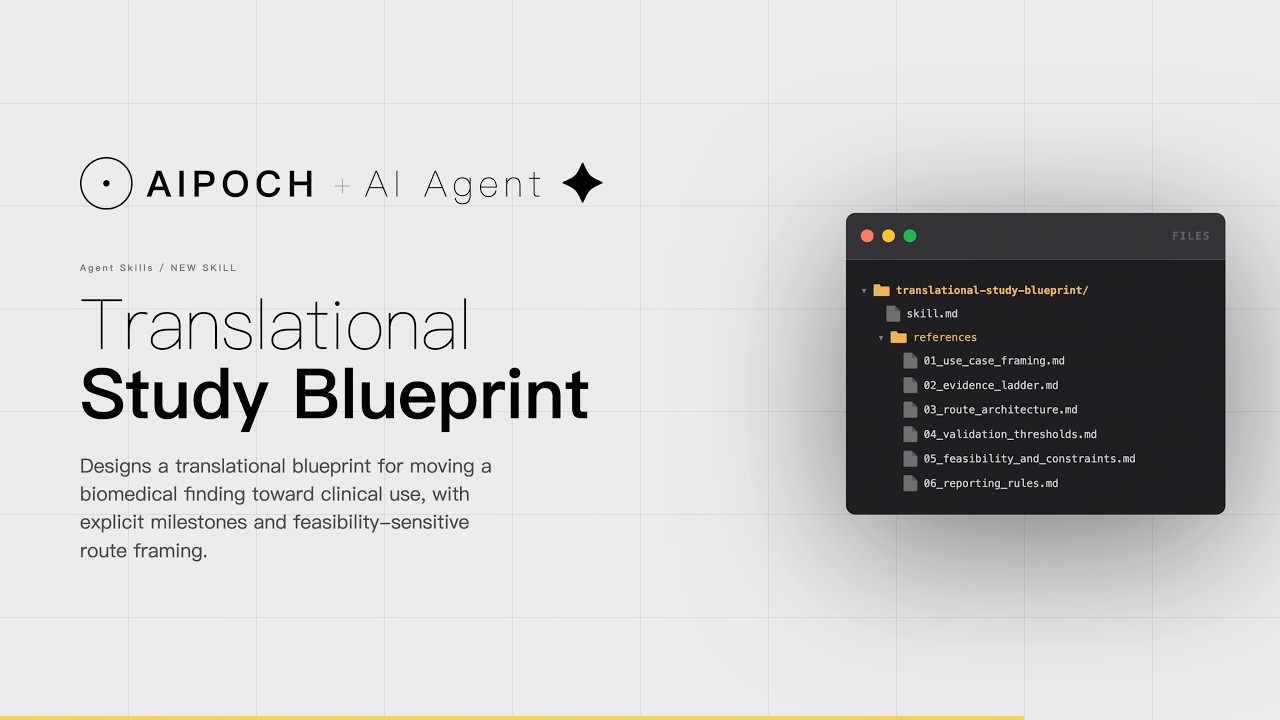
The Translational Study Blueprint skill is designed to help researchers move basic findings toward clinical application by producing a structured, stage-ordered translational plan. Its core function is to define translational milestones and validation thresholds for use cases such as diagnosis, prognosis, treatment response prediction, patient stratification, or drug development — covering the five translational directions researchers most commonly need to plan for.
This skill is for protocol framing, not for claiming clinical readiness, clinical utility, regulatory success, or product viability.
How Does the Workflow Execution Progress Step by Step?
The Translational Study Blueprint skill organizes its workflow into a defined sequence that researchers can follow as a starting point. The demo below shows a complete run using a real biomarker panel as input.
Step 1 — Input
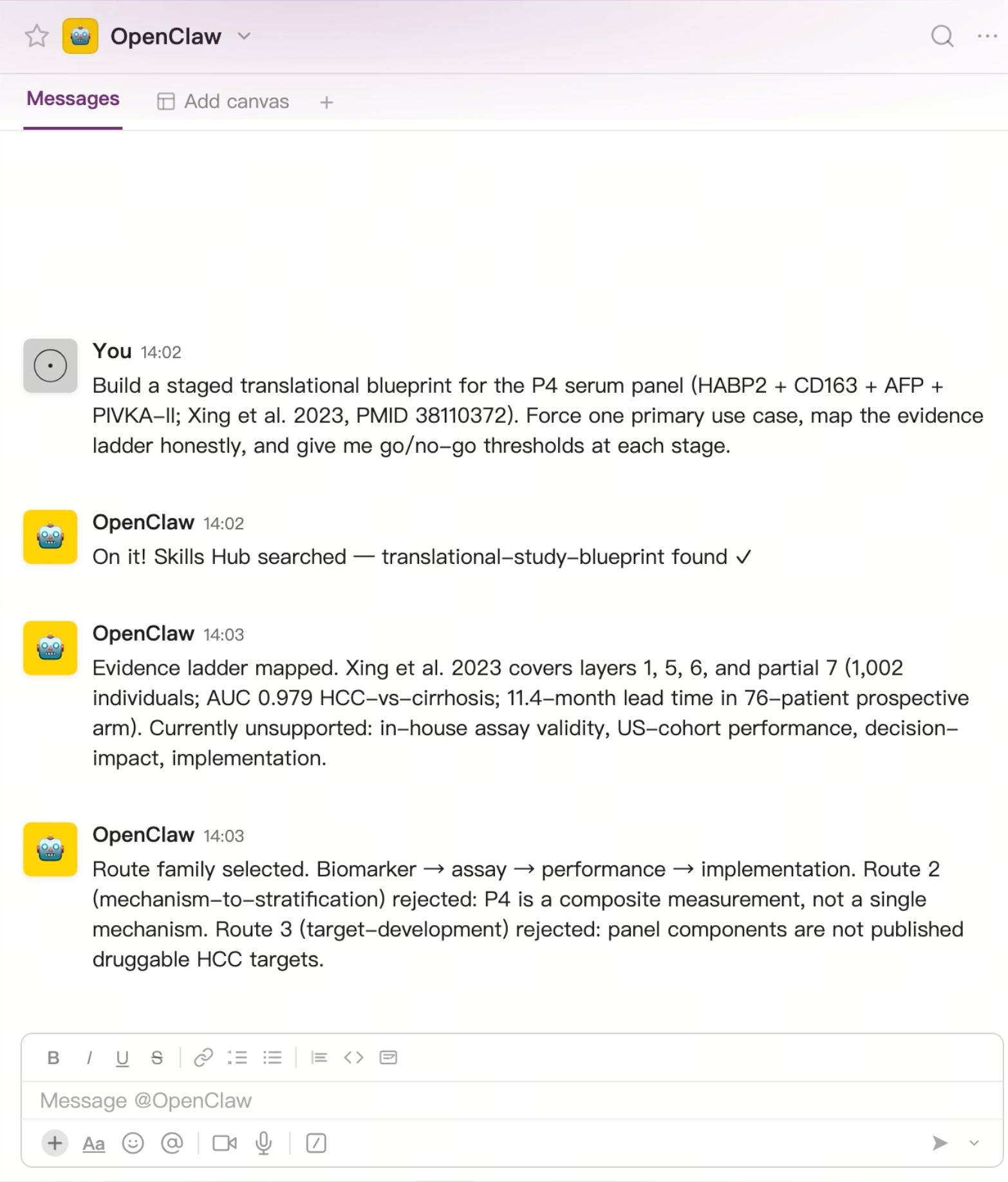
Illustration for reference only. Not an actual skill output.
The skill accepts inputs such as:
- finding, biomarker, signature, target, mechanism, phenotype, or intervention concept,
- disease area or clinical context,
- intended translational use case,
- evidence currently available,
- sample/resource situation,
- preferred evidence types,
- target population or clinical decision point.
The input used in the demo above was:
"Build a staged translational blueprint for moving the P4 serum panel (HABP2 + CD163 + AFP + PIVKA-II; Xing et al. 2023, PMID 38110372) from its current discovery-plus-Chinese-multicenter-validation status toward a US surveillance adjunct for cirrhotic adults. Force one primary use case. Map the evidence ladder honestly. Pick a route family. Give me concrete go/no-go thresholds at each stage. Tell me what should NOT yet be claimed."
Step 2 — AI Workflow Execution
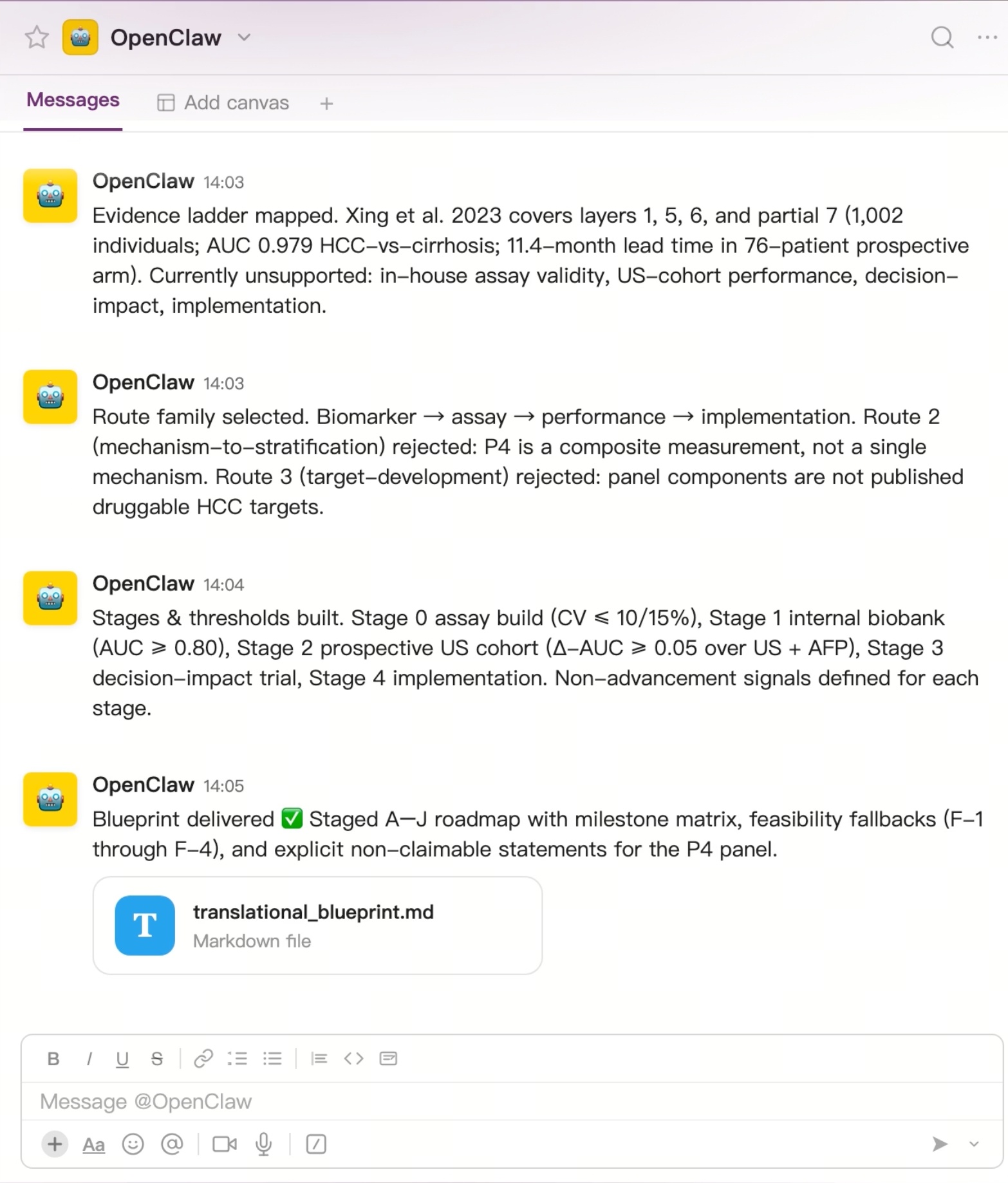
Illustration for reference only. Not an actual skill output.
Once the input brief is submitted, the AI agent runs through a sequence of internal reasoning steps: defining the translational claim boundary, classifying the intended translational use case, auditing the evidence ladder, selecting the route architecture, building the stage-ordered translational blueprint, defining validation thresholds, adding feasibility-aware branching, and recommending the primary translational plan.
Step 3 — Structured Outputs for Researcher Review
The AI agent delivers a structured markdown file with ten sections in a fixed order:
- A. Translational Framing
- B. Use Case Classification
- C. Current Evidence Starting Point
- D. Candidate Route Families
- E. Recommended Blueprint
- F. Milestone and Validation Matrix
- G. Feasibility Dependencies and Fallbacks
- H. Primary Recommendation
- I. Critical Cautions
- J. References
Researchers should treat all outputs as a structured starting point requiring independent expert review — not as a finalized research plan.
How Does a Structured AI Workflow Compare to Manual Translational Planning?
| Planning Task | Manual Workflow | AI-Assisted Workflow (Translational Study Blueprint) |
|---|---|---|
| Use case classification | Informal, often mixed across diagnosis / prognosis / treatment response | Structured classification with one forced primary use case and labeled secondaries |
| Evidence ladder audit | Researcher-dependent, variable across teams | Organized by defined evidence levels; current vs. proposed future evidence separated |
| Route architecture selection | Based on precedent or convention, rarely documented | Compared across route families with documented reasoning for selection and rejection |
| Milestone definition | Often vague ("validate in larger cohorts") | Concrete thresholds per stage including minimal, advancement-worthy, and non-advancement signals |
| Feasibility dependency mapping | Frequently omitted | Explicit identification of available, potentially obtainable, and currently unavailable resources |
| Non-advancement signals | Rarely stated | Required for each stage by the skill's design |
| Reference fabrication risk | Depends on team practice | Explicitly prohibited; unverified references must be flagged, not generated |
The primary advantage is not speed — it is the structural consistency of the output. When the planning framework is explicit and documented, research teams can review, challenge, and refine it before committing resources to the next experimental stage.
Who Can Benefit From This Skill?
The Translational Study Blueprint skill is designed for researchers and teams who engage in pre-validation planning for biomedical findings. Primary beneficiaries include:
- Biomedical researchers moving a discovery-stage finding toward a defined translational use case
- Translational medicine teams needing a structured framework for staged evidence planning
- Systematic review and evidence synthesis teams organizing the translational claim landscape for a biomarker area
- Bioinformaticians working with multi-omics signatures and needing route architecture guidance
- Graduate students and early-career researchers building their first structured translational plans
- Computational biology teams converting signatures into staged validation blueprints
Conclusion
Structured translational planning is one of the most consistently underdeveloped steps in biomedical research workflow. With translation rates for candidate biomarkers frequently below 1%, the evidence suggests that many findings fail to progress not only because of biological limitations, but also because the translational pathway is poorly defined
The AIPOCH Translational Study Blueprint skill can assist researchers in organizing this planning layer: classifying the translational use case, mapping the evidence ladder, selecting a route architecture, and defining concrete milestone thresholds for researcher review and adaptation. It is designed to make overclaiming structurally difficult — by encouraging explicit separation of current evidence from proposed future validation and requiring stated non-advancement signals at each stage.
AIPOCH is a collection of Medical Research Agent Skills created to support AI-assisted biomedical research workflows across literature review, evidence organization, bioinformatics preprocessing, data analysis support, and research writing tasks. The full skill library is available at aipoch agent skill list, and source files are available at AIPOCH github.
Disclaimer
This article describes the Translational Study Blueprint agent skill available through AIPOCH for informational and research workflow support purposes only.
The outputs produced by this skill are intended to assist researchers in organizing and preprocessing research data. They do not constitute medical advice, clinical diagnosis, treatment recommendations, or validated scientific conclusions. All outputs require independent verification and expert interpretation before use in any research or clinical context.
AIPOCH agent skills are research workflow tools. They are not approved medical devices, clinical decision support systems, or substitutes for professional medical or scientific judgment. Researchers remain fully responsible for evaluating the accuracy, completeness, and appropriateness of any outputs generated by this skill.
References and external links in this article are provided for informational purposes. AIPOCH does not endorse and is not responsible for the content of third-party sources.