Open Science v0.18.2: More Control Over Exports, Connectors, and Agent Streams
Open Science v0.18.2 adds turn-selective Markdown and PDF exports, pre-registered OAuth clients, Russian localization, and responsive high-volume agent streams.
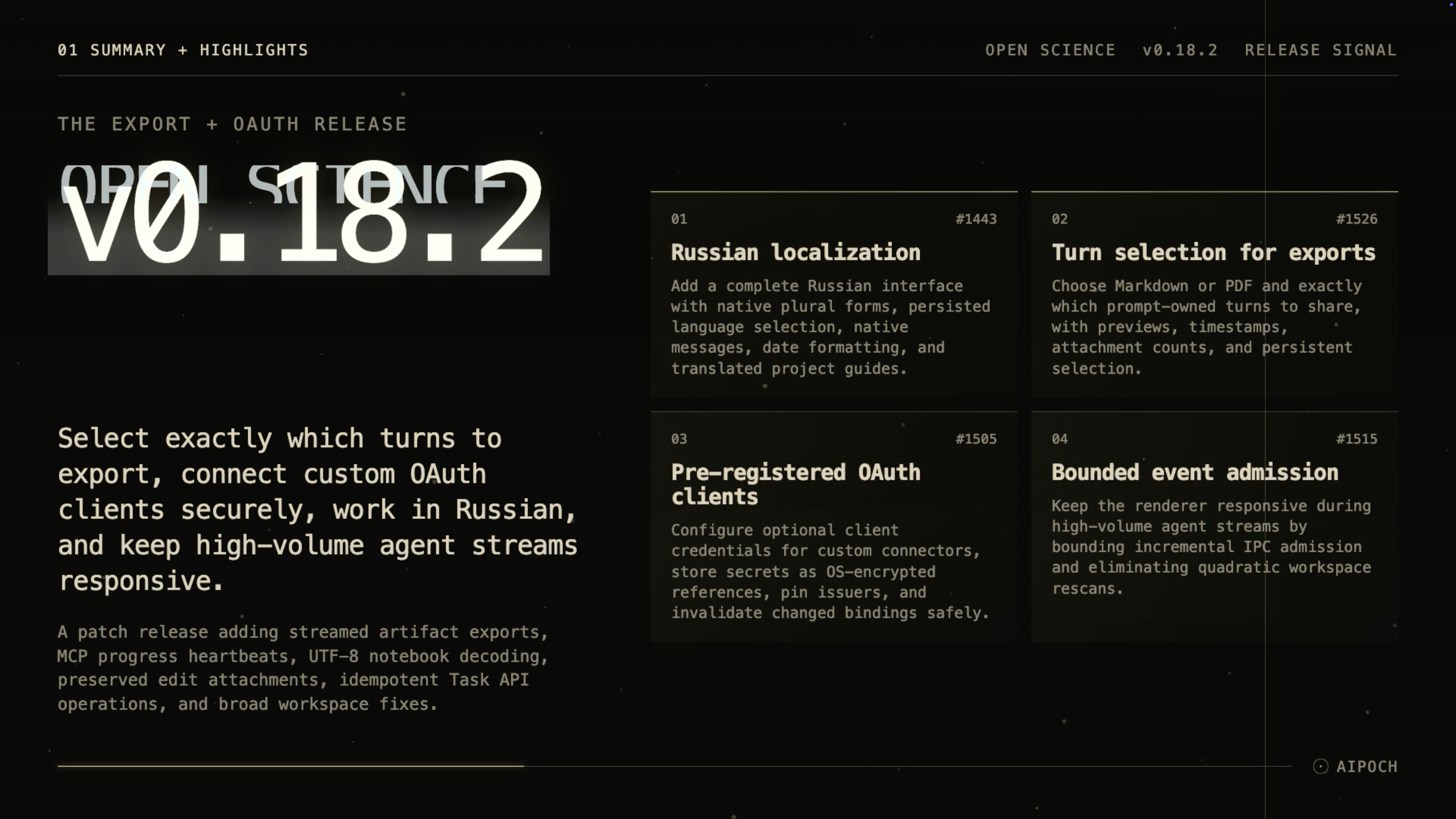
Open Science v0.18.2 adds selective exports, pre-registered OAuth clients, Russian localization, and performance fixes for demanding agent workflows.
Open Science is the local-first AI research workbench from AIPOCH, designed to support reproducible execution while keeping research activity and inspectable provenance evidence visible.
Published on August 21, 2026, v0.18.2 is a patch release focused on precise sharing, connector authentication, multilingual use, and reliable operation under heavy agent activity.
What new capabilities help researchers share, connect, and work more reliably?
Turn selection for conversation exports
Research conversations often contain setup exchanges, corrections, and exploratory branches that do not belong in a shared record. Exporting the entire conversation can create extra review work or expose irrelevant context.
Open Science v0.18.2 replaces the nested export-format menu with one Export conversation dialog. Researchers can choose Markdown or PDF and select individual prompt-owned turns with tri-state select-all, response previews, timestamps, and attachment counts. Selections persist if Save As is canceled, while export failures appear inline.
This lets researchers prepare a more focused conversation record for collaborators without manually deleting unrelated turns after export.
Pre-registered OAuth clients for custom connectors
Some authorization servers disable dynamic client registration and require an existing client ID and secret. Without a way to supply those credentials, a custom connector cannot complete the authorization-code flow.
Version 0.18.2 adds optional client ID and write-only client secret fields for custom connectors. The secret is persisted only as an OS-encrypted reference, the renderer sees only whether a secret exists, and the authorization-server issuer is pinned. Changing the issuer or client ID invalidates bound state until sign-in succeeds again. The SDK can select client_secret_basic, client_secret_post, or no client authentication as required by the server.
Researchers can therefore connect to more controlled OAuth environments while keeping secret values out of the visible interface and invalidating credentials when important bindings change.
Russian interface and project guides
Working in an untranslated interface adds friction when researchers need to inspect settings, messages, dates, and contribution instructions in their preferred language.
Open Science v0.18.2 adds a complete Russian interface catalog with native plural forms, locale detection, persisted language selection, native messages, localized date formatting, and direct English fallback. A translated README and contribution guide accompany the interface.
Russian-speaking researchers can use the workbench and project documentation in a consistent language. Russian joins Simplified Chinese, Traditional Chinese, Japanese, Korean, and French.
Bounded event admission for high-volume agent streams
Agent runs can produce tens of thousands of fine-grained thought, tool, and message events. Unbounded incremental processing and repeated workspace rescans can make the renderer unresponsive during demanding sessions.
Version 0.18.2 bounds incremental IPC event admission and removes quadratic rescans from the workspace event processor. Project Artifact ZIP exports also stream entries instead of buffering the complete archive in the main process.
The application can remain responsive during very high-volume streams, while large artifact exports avoid the memory spikes and long main-process pauses caused by full buffering.
What else is new in v0.18.2?
- Notebook execution sends 30-second MCP progress heartbeats while long-running tools are active and stops them when execution finishes.
- Python notebook source is decoded as UTF-8, preventing Windows ANSI code pages from corrupting non-ASCII input.
- Settings navigation uses a simpler route-state model.
host.agents.list()now returns onlyid,name,displayName,description, andenabled. Code that needs full editable records should callhost.agents.get(name)for each selected summary.
Bug fixes that affect daily use
- Attachments remain available after message edits. Editing a message no longer drops uploaded attachments, and edited attachments are inlined when the message is resent.
- Opaque Codex resume failures recover. Sessions can recover when a resume failure does not include a structured reason instead of remaining stalled.
- Task API retries avoid duplicate work. Task creates and runs honor idempotency keys.
- Caches are reclaimed. Unused conda package caches and stale session caches are released.
- Run status remains visible. The running indicator stays present between tool rounds.
- Conversation layout is more stable. Mention popups no longer clip during editing, scroll position is retained when approval or permission panels appear, and streaming no longer reserves blank space before tool cards.
- Completion order is corrected. The completion footer appears after its tool activities.
- Concurrent tag edits reject stale updates. A tag change that loses a revision race fails cleanly instead of overwriting newer state.
- Update subscriptions are deduplicated. The renderer no longer registers duplicate update subscriptions.
- Export labels fit their rows. Message labels align correctly and avoid overflow in the export interface.
- Deletion failures provide better diagnostics. Session-deletion errors record the phase in which the failure occurred.
Install or update
Open Science v0.18.2 is available for:
- macOS 12 or later on Apple Silicon or Intel: download the matching DMG.
- Linux x64: download the AppImage or Debian package.
- Windows 10 or 11 x64: download the Windows installer.
Choose the appropriate package from the Assets section of the Open Science v0.18.2 release. The onboarding wizard can inspect the environment and configure an app-managed agent runtime, and an existing installation can update in place.
Official macOS release builds are Developer ID signed and notarized. Windows builds do not yet have an Authenticode certificate, so SmartScreen may show an “unrecognized app” prompt. Confirm that the installer came from the official release page before continuing.
Resources
- Open Science v0.18.2 release notes and downloads
- Open Science product page
- AIPOCH
- AIPOCH Blog
- Open Science v0.18.1: Session Compute and Clearer Alerts
- Specialist AI Agents in Open Science: Roles and Scope
- How Open Science Extends a Research Agent
- How Open Science Tracks Results with Artifact Provenance
FAQ
Is Open Science v0.18.2 a patch release?
Yes. Open Science v0.18.2 is a patch release published on August 21, 2026. It adds selective conversation exports, pre-registered OAuth clients, Russian localization, performance improvements, and daily-use fixes.
Can v0.18.2 export only selected conversation turns?
Yes. The Export conversation dialog supports Markdown and PDF and lets researchers choose individual prompt-owned turns. It includes select-all states, previews, timestamps, and attachment counts; it does not provide arbitrary editing of exported responses inside the dialog.
Does Open Science store a custom connector client secret in the interface?
No. In v0.18.2, the client secret is write-only and persisted as an OS-encrypted reference. The renderer receives only a hasClientSecret state. Changing the issuer or client ID invalidates the existing binding until authorization succeeds again.
Which platforms support Open Science v0.18.2?
Open Science v0.18.2 provides packages for macOS 12 or later on Apple Silicon and Intel, Linux x64, and Windows 10 or 11 x64.
Does bounded event admission validate agent output?
No. Bounded event admission keeps the renderer responsive during high-volume streams; it does not validate scientific claims, methods, citations, or results.
Disclaimer
Open Science assists researchers with AI-supported workflows and supports reproducible execution, but it does not replace scientific judgment, independent validation, domain expertise, or peer review. Researchers remain responsible for checking sources, methods, analyses, and conclusions before use.